Looking for an authentic village in inland Salento, away from the crowds of the seaside villages, with a Baroque square, a castle and one of the most famous nights in Salento? This guide takes you to Ruffano, «Rufànu» in dialect, and to Torrepaduli, its hamlet: piazza del Popolo and the Chiesa Madre della Natività with the large canvases by Saverio Lillo, the Castello Brancaccio, the Byzantine crypts, the hill of the Madonna della Serra, the Night of San Rocco with the ronde of the pizzica scherma and the nearest sea, on both coasts, with practical tips and local curiosities.
In short
Ruffano is a municipality of just over 9,000 inhabitants in southern Salento (Lecce), in the heart of the Serre salentine, 127 metres above sea level and about 50 km from Lecce. The old town, gathered around piazza del Popolo, is home to the Baroque Chiesa Madre of the Nativity of the Blessed Virgin Mary, the Castello Brancaccio and churches with ancient Byzantine crypts. Its only hamlet, Torrepaduli, «Turre» in dialect, is less than a kilometre away: here, on the night of 15 to 16 August, people dance the pizzica scherma in front of the Sanctuary of San Rocco; it is also known as the sword dance (danza delle spade). The nearest sea is 17-19 km away, at Torre San Giovanni on the Ionian coast and between Marina Serra, Marina di Andrano and Castro on the Adriatic coast. The best months are May, June and September, and mid-August for San Rocco.
What is Ruffano?
Ruffano is an inland village in southern Salento, on the Serre salentine, the low hills of olive trees, pines and Mediterranean scrub that run across the south of the province of Lecce: its territory ranges from 96 to 179 metres above sea level. The old town, in the upper part of Ruffano, has stone-paved lanes, courtyard houses, noble palazzi and underground olive mills; to the east, almost joined to the town, is Torrepaduli, the only hamlet, with its small old town and the Sanctuary of San Rocco. Ruffano is part of the Borghi Autentici d’Italia (authentic villages of Italy) network and is also known for its handmade ceramics.
Ruffano is a town that is alive all year round, and its people meet in piazza del Popolo: at the highest point of the village, between the two old entrance gates, stand the Castello Brancaccio and the Chiesa Madre with its Torre dell’Orologio, and in the evening the café tables fill up for the aperitivo. From the square, lanes of pale stone and whitewash lead off, with courtyard houses, carved doorways and palazzi that hide gardens behind their walls.
It is not a seaside town, but it lies halfway between the two coasts: in just over twenty minutes you reach the beaches of the Ionian coast, at Torre San Giovanni, and in less than half an hour the rocks of the Adriatic coast, between Marina Serra, Marina di Andrano and Castro. This is the Salento for those who love historic villages, Baroque art, folk music and the countryside, and for those looking for a quiet, central base. In this guide you will find how to get there, what to see, where to swim and how to plan your day, nearby too.
Curiosities and atmosphere
There are two theories about the origin of the name: according to tradition it comes from Rufus, a Roman centurion who is said to have been allotted these lands; according to others from the Latin «rubus», bramble, because the area was full of it. The town’s coat of arms shows three hills, representing the Serre on which Ruffano stands, with a flame on the central one and a large R topped by a crown. The village belonged to the Principality of Taranto until 1463 and then passed to various feudal families, including the Colonna, the Filomarino and, in the seventeenth century, the Brancaccio, the family that turned the castle into a noble residence; they were followed by the d’Amore and, from 1753, the Ferrante marquises. In the nineteenth century the Castriota Scanderbeg family also came to Ruffano; it bears the name of the Albanian military leader and still lives in the sixteenth-century Palazzo Mariglia.
Torrepaduli has a history all of its own too. The name recalls the towers that defended the hamlet from raids and the marshes, the «paduli», that once surrounded it; no trace of the towers remains today. From 1806 it was a municipality in its own right, until in 1853 a royal decree joined it to Ruffano. Devotion to San Rocco, the pilgrim saint who protects against the plague, draws worshippers and folk music lovers here every year. Ruffano is the birthplace of the painter Saverio Lillo (1734-1796), who filled the Chiesa Madre with canvases, and of the sculptor Antonio Bortone (1844-1938). The town is part of the Borghi Autentici d’Italia and its workshops still produce ceramics, copperware, embroidery and tambourines; you will also find places and events on the website of the municipality of Ruffano.
Where it is and how to reach it
Ruffano is in southern Salento, inland between the Ionian and the Adriatic coasts, on the Serre salentine: it borders Casarano and Supersano to the north, Montesano Salentino and Miggiano to the east, Specchia and Presicce-Acquarica to the south, and Taurisano and Ugento to the west. Torrepaduli is less than a kilometre from the centre, to the east. The nearest sea, at Torre San Giovanni, is about 17 km away; Santa Maria di Leuca is 28 km away, Gallipoli 32 km and Lecce about 50 km.
By car: from Lecce take the SS16 towards Maglie and then the provincial roads to Cutrofiano and Supersano, as far as the SP362, which enters Ruffano: about 50 minutes without traffic. There is also an exit for Ruffano from the SS275 Maglie-Leuca road. In the old town the streets are narrow: leave the car in the surrounding streets and explore on foot. On 15 and 16 August, for the feast of San Rocco, thousands of people come to Torrepaduli: park well away from the sanctuary and walk.
By public transport: Ruffano has no railway station. The nearest FS Sud Est (Ferrovie del Sud Est) stations are Ugento-Taurisano, Miggiano-Montesano and Casarano, 8-10 km away, a quarter of an hour by car: check the timetables and any replacement buses. In summer the «Salento in Bus» lines connect many places on the coast: check this year’s routes and timetables before you set off. The most convenient airport is Brindisi, about an hour and a half away by car.
What to do and what to see
You can walk round the centre of Ruffano in half a day, but it is worth giving it more time: around piazza del Popolo are the Chiesa Madre, the castle and the palazzi, beneath the churches the excavations and the Byzantine crypts, in Torrepaduli the sanctuary of San Rocco and, just outside the town, the hill of the Madonna della Serra. Here are the experiences not to miss.
1. Piazza del Popolo and the Chiesa Madre della Natività (1 hour)
Piazza del Popolo is the heart of Ruffano: it lies at the highest point of the town, enclosed between the two old gates of the village, with the Castello Brancaccio on one side and the Chiesa Madre on the other. The Chiesa Madre, dedicated to the Nativity of the Blessed Virgin Mary, was built in just a few years from 1706, on the site of an old Greek-rite church, thanks to the confraternities of the Santissimo Rosario and the Santissimo Sacramento and to contributions from the whole town; the work was entrusted to the master builders Ignazio and Valerio Margoleo of Martano. On the square rises the Torre dell’Orologio, built in 1725 over the church’s secondary door, while the main entrance, on a narrow side street, has a doorway with the Madonna and Child and, in the niches, the large stone statues of St Peter and St Paul. The interior, a Latin cross, has six chapels with Baroque altars carved in Lecce stone and two large altars in the transept: the richest is that of the Santissimo Sacramento, the work of the sculptor Gaetano Carrone of Corigliano d’Otranto. Between 1765 and 1776 the Ruffano-born painter Saverio Lillo covered the walls with large canvases, from the Nativity of Mary to St Anthony and the Miracle of the Mule. The church also holds the silver-sheet statue of Sant’Antonio da Padova, the patron saint, made in 1791 by the Neapolitan Sebastiano Ajello.
2. Beneath the Chiesa Madre: the excavations and the Museo della Ceramica (30-45 minutes)
During the latest restoration work, in 1996 in the sacristy and in 2002 beneath the church, the foundations of the medieval houses demolished to build the Chiesa Madre came to light, along with burial pits, traces of the old late fifteenth-century church and a cemetery from the Byzantine period. You visit these underground spaces by going down a flight of steps, and a small chapel has been created in the middle of the old burial chambers. Next door is the Museo della Ceramica (ceramics museum), with fragments of local pottery from the thirteenth to the eighteenth century found in the excavations, evidence of Ruffano’s old workshops. Opposite the church, in via Cesare Battisti, the Museo degli arredi sacri (museum of sacred furnishings) displays chalices, monstrances and gold-embroidered vestments from the sixteenth to the nineteenth century. Ask at the parish or at the Torrepaduli Info Point for opening days and times.
3. The Castello Brancaccio and the old town (1-2 hours)
Next to the Chiesa Madre, at the highest point of the town, is the Castello Brancaccio, also called Palazzo Brancaccio. It has an older core from the late fifteenth century, but it owes its appearance to the Brancaccio, who turned it into a noble residence in the first half of the seventeenth century. Its jewel is the courtyard with superimposed arcades, decorated with helmets, shields, breastplates, quivers and weapons carved in stone by the Lecce sculptor Angelo Ricciardo, who signed the work in 1654: in a niche stands the statue of the founder of the family line, Rinaldo Brancaccio, and the walls of the upper loggia keep a frescoed frieze with mythological scenes, now badly damaged. Around 1657 the Loggia Brancaccio was built, a raised walkway that spans vico del Popolo and links the palazzo to the Chiesa Madre. Since 1835 the castle has belonged to the same family and is a private residence: you admire it from the outside; check on the spot whether the courtyard can be visited. All around lies the old town, with stone-paved lanes, courtyard houses and noble palazzi: Palazzo Licci, in piazza IV Novembre, with its mullioned double window on the façade, the eighteenth-century Palazzo Pizzolante and Palazzo D’Urso, Palazzo Villani, from 1790, and Palazzo Castriota Scanderbeg; beneath the houses hide many underground olive mills, where olives were once processed. In via Bortone, in the old San Foca district, is the house where the sculptor Antonio Bortone was born, with the date 1595 carved on the balcony: on the first floor a museum room displays his bronze self-portrait bust and pictures of his most important monuments. He also made the 1924 Winged Victory, the war memorial in piazza IV Novembre. Many palazzi are private and you admire them from the outside.
4. The churches and the Byzantine crypts (1 hour)
For centuries people in Ruffano also prayed in the Greek rite, and its crypts tell the story. In piazza IV Novembre the church of the Madonna del Carmine was built in 1713 on the foundations of the church of San Marco, the most important of the town’s Greek-rite churches: it has an eighteenth-century doorway attributed to the sculptor Gaetano Carrone and a high altar in Lecce stone from 1713. From inside, a long flight of steps leads down into the Byzantine crypt of San Marco, an almost entirely natural cave with frescoes of St Mark and St Peter from the early fourteenth century and a fifteenth-century Annunciation; in recent years the church has seen building work and new finds, so check whether it is open. In piazza della Libertà, the church of San Francesco d’Assisi was built in 1621 together with the Capuchin convent: it holds seventeenth-century canvases and one by Saverio Lillo, and the former convent houses the Pinacoteca comunale (municipal art gallery), with more than 300 works of contemporary art, including works by Salvatore Fiume, Ibrahim Kodra and Luigi Veronesi. The church of the Madonna del Buon Consiglio, built between 1847 and 1867, stands instead on the site of the old Greek church of San Foca, the town’s first parish church. Out in the countryside, on the border with Casarano and Taurisano, the Cripta del Crocefisso, or of Santa Costantina, is a natural cave turned into a place of worship by the Byzantines in the eleventh century, with frescoed walls and prehistoric graffiti: for a visit, ask the Info Point for information.
5. Torrepaduli, the Sanctuary of San Rocco and the Museo della Civiltà Contadina (1 hour)
Torrepaduli, «Turre» to its inhabitants, is less than a kilometre east of the centre of Ruffano. In its small old town is the mother church of the Immacolata, from the mid-sixteenth century, with two fine stone doorways: one from 1588, with the town’s old coat of arms, a fortified tower, and one from 1603 carved with Marian symbols. The most famous place, however, is the Sanctuary of San Rocco, a pilgrimage destination for centuries: the church you see today was rebuilt in 1882, but it keeps the 1738 stone high altar with the painting of the saint made in 1851 by Giovanni Grassi of Lecce, and it has an 1891 mosaic floor, the work of Michele Peluso of Tricase. The square in front, Largo San Rocco, was renovated in 2024, with a new bronze statue of the saint, a fountain and two murals devoted to popular tradition; here too is the Torrepaduli and Ruffano tourist Info Point. A few steps away, in the eighteenth-century Palazzo Pasanisi, in via Torricella, the «Ettore Pasanisi» senior citizens’ association has set up the Museo della Civiltà Contadina (museum of rural life), with about 3,000 objects from everyday life in the past, and, in the former church of the Madonna delle Grazie, from 1634, a small museum of sacred art.
6. The Night of San Rocco and the pizzica scherma (one night, 15-16 August)
Every year, on the night of 15 to 16 August, the eve of the feast of San Rocco, thousands of people come to Torrepaduli from all over Salento and from outside the region. After the evening procession on the 15th with the statue of the saint and the fireworks, the «ronde» form on the square in front of the sanctuary: circles of people around the tambourine players, which go on until dawn. Inside the circle people dance the pizzica and, above all, the pizzica scherma, also called danza scherma, the knife dance or, by a very widespread but imprecise name, the sword dance: two men mime a duel, with the index and middle fingers held out in place of the knife that was once really used, following a code of gestures and rules learned from those who already know it. Two styles are recognised, the «leccese» and the «zingaro». At dawn on the 16th the first masses are celebrated at the sanctuary, and the feast goes on all day with the services, the fair in the streets of the town, which was once mainly a livestock fair, and the music of the bands. It is first and foremost a religious feast: watch with respect and leave room for those who play and those who dance.
7. The hill of the Madonna della Serra and the Bosco Occhiazzi (half a day)
About 3 km north-west of the centre rises the hill of the Madonna della Serra, one of the heights of the Serre salentine, at just over 175 metres. On top is the little church of the Madonna della Serra, from the sixteenth century, restored in 1648 by Prince Carlo Brancaccio and again around 1831: inside, on a pillar, is a sixteenth-century fresco of the Madonna del Latte. From the Middle Ages onwards, pilgrims heading for the sanctuary of Santa Maria di Leuca stopped here. Next to it stands a sixteenth-century watchtower, built by the Aragonese after the siege of Otranto in 1480, now the visitor centre of the Bosco Occhiazzi – Madonna della Serra nature park, and not far away there is a viewpoint over the countryside. 2.5 km from the town, the Bosco Occhiazzi is a small wood of about two hectares, restored and equipped for visitors. In the surrounding countryside you come across masserie (farmsteads), pajare and «truddhi», the traditional dry-stone huts, such as the large Trullo Ferrante. In July 2026 a large fire struck the hill of the Madonna della Serra: before you go, check the state of the paths and the vegetation.
The nearest sea and who it suits
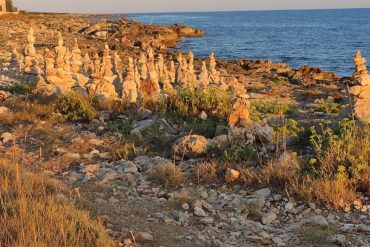
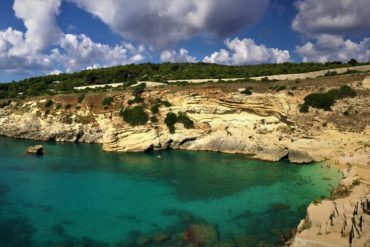
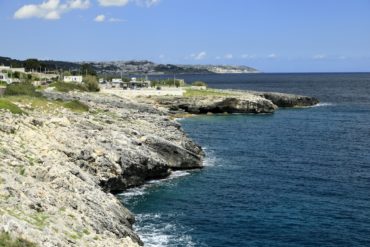
Ruffano is inland, halfway between Salento’s two coasts: the nearest sea is 17-19 km away, between twenty minutes and half an hour by car, and every day you can choose between sand and rocks. On the Ionian coast, 17 km away, is Torre San Giovanni, Ugento’s seaside village, with the sixteenth-century tower that now serves as a lighthouse, the harbour, the low, rocky coast to the north and the sandy beaches to the south; further south, between Torre Mozza and Lido Marini, 21-25 km away, long beaches of fine sand stretch out with a shallow sea, ideal with children. On the Adriatic coast, in less than half an hour you reach Marina Serra, with its famous natural pool among the rocks, the rocky coast of Marina di Andrano, Tricase Porto, the little fishermen’s harbour, and Castro, where the boats leave for the caves: here the sea is deep and crystal clear, suitable for those who can swim. Read our guide to Tricase Porto.
Ruffano is perfect for those who love historic villages, Baroque art and folk music, for anyone who wants to experience the Night of San Rocco, for those looking for a quiet, central base between the two coasts and for those who prefer a real town, alive all year round. It is less suited to people who want to step out of the house and be on the beach, or who are looking for nightlife: for that there are the seaside villages along the coast and Gallipoli.
Free beach and facilities
On both coasts, beach clubs with umbrellas, sunbeds and bars alternate with free stretches: sandy beaches on the Ionian coast, mostly rocks and small coves on the Adriatic. Check access, parking and any paid zones on the spot; in the seaside villages many places are open mainly in summer. In Ruffano you will find bars and places to go in the evening, especially around piazza del Popolo.
On the sand bring an umbrella, water and sun cream; on the Adriatic rocks, reef shoes and a mask. When the sea is rough, don’t go down onto the rocks, and stay where you can touch the bottom.
Ruffano vs other villages of southern Salento
In southern Salento the towns are very close to each other. Here is a practical comparison to help you choose:
Ruffano vs Presicce
- Ruffano: the Baroque Chiesa Madre with the canvases by Saverio Lillo, the Castello Brancaccio, the Night of San Rocco in Torrepaduli and both coasts less than half an hour away
- Presicce: the «town of hypogea», with its underground olive mills, the Palazzo Ducale and the hanging gardens, closer to the beaches of Pescoluse and Torre Pali. Read our guide to Presicce
Ruffano vs Specchia
- Ruffano: piazza del Popolo with the Chiesa Madre and its museums, the Byzantine crypts and the feast of San Rocco in Torrepaduli
- Specchia: one of the Borghi più belli d’Italia, with the Castello Risolo and a compact old town, a quarter of an hour away by car
Ruffano vs Ugento
- Ruffano: the village of the Serre, with the countryside and hills around it and the sea of both coasts
- Ugento: the ancient city of the Messapians, with the archaeological museum, the castle and the Ionian coast 7 km away. Read our guide to Ugento
When to choose Ruffano: if you love historic villages, folk music and traditional festivals, want to experience the Night of San Rocco and are looking for a central base from which to reach both coasts.
When to choose somewhere else: if you want to walk to the beach, look at the seaside villages of the Ionian coast, from Torre San Giovanni to Pescoluse; if you are after cliffs and deep sea, the Adriatic coast, between Tricase Porto and Castro.
Practical tips
Explore the old town early in the morning or from late afternoon: in summer it is very hot in the middle of the day and churches and museums may be closed. For the excavations and museums of the Chiesa Madre, the Pinacoteca, the crypts and the Museo della Civiltà Contadina in Torrepaduli, ask the Torrepaduli Info Point, on Largo San Rocco, for days and times a few days ahead, especially out of season. To go into a church, dress appropriately and respect the services.
For the Night of San Rocco, plan ahead: on 15 August thousands of people come to Torrepaduli, so park well away from the sanctuary and walk, bring comfortable shoes and water, and keep an eye on children in the crowd. The ronde form after the fireworks and go on until dawn: watch from outside, don’t use the flash on the musicians and only step into the ronda if you are invited. For the sea, remember that Ruffano is halfway between the two coasts: with just over twenty minutes’ drive you can choose, every day, the one where the sea is calmest.
Useful practical information
| 📍 Where | Ruffano (Lecce), on the Serre salentine, 17 km from the sea at Torre San Giovanni, 28 km from Santa Maria di Leuca and 50 km from Lecce; Torrepaduli less than 1 km away |
|---|---|
| 🚗 Parking | In the streets around the old town, which you explore on foot; on 15 and 16 August in Torrepaduli, park well away from the sanctuary |
| ♿ Access | Old town with stone-paved streets; some churches, the crypts and Casa Bortone are reached by steps |
| 🏖 Beach | No sea in the town: sand at Torre San Giovanni and between Torre Mozza and Lido Marini; rocks at Marina Serra, Marina di Andrano and Castro, 17-19 km away |
| 🌊 Sea | Shallow and sandy on the Ionian coast, suitable for children; deep and clear on the Adriatic coast, for those who can swim |
| 👟 What to bring | Comfortable shoes for the lanes and for the Night of San Rocco, suitable clothes for the churches, an umbrella, sun cream and reef shoes for the sea |
| 🍴 Food | Bars and places to eat in the town, especially around piazza del Popolo; in summer in the seaside villages along the coast too |
| 📅 Best time | May, June and September; the night of 15 to 16 August for San Rocco in Torrepaduli |
Where to stay near Ruffano
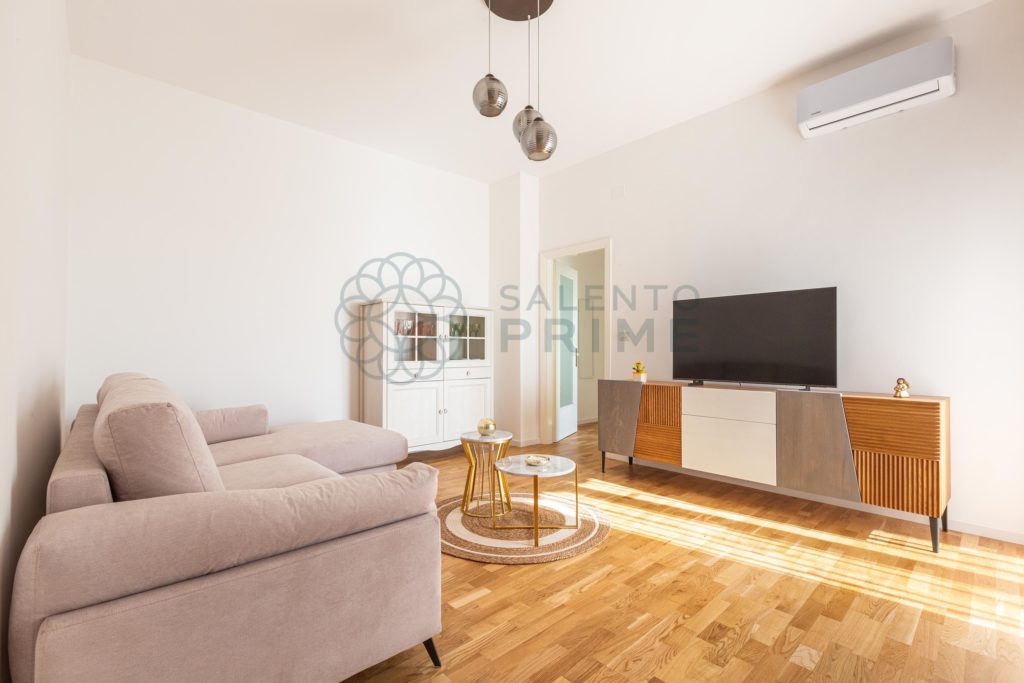
We have no houses in Ruffano, but there are three of ours 20-25 minutes away by car, one in town and two in the countryside. In the centre of Tricase, 14 km from Ruffano, on Corso Roma, near Piazza Cappuccini, is our Casa Amalia – Center of Tricase: a 100 m² apartment renovated in 2024, for 4 guests, with a double bedroom and a bedroom with two single beds, air conditioning, a fully equipped kitchen, washing machine and dishwasher, a few steps from shops, bars and restaurants. From here Tricase Porto is about 4 km away, ten minutes or so by car.
If you prefer the countryside, in contrada Schiafazzi in Presicce-Acquarica, about 17 km from Ruffano and a quarter of an hour from the beaches of Pescoluse and Torre Pali, we have two apartments in a typical Salento masseria, with a garden and outdoor play equipment for children, a hot tub for guests, a barbecue and private parking; breakfast is included. The Apartment “Lu Mare” sleeps up to 4 people: 35 m², one bathroom, a double bedroom with antique wrought-iron beds, to which an extra bed can be added, and a fully equipped solid-wood kitchen. The Apartment “Lu Salentu” is designed for a couple: 2 guests, 35 m², one bathroom, a double bedroom and the same wooden kitchen. Both have air conditioning, TV and a washing machine.
You will find these and our other houses in the area on the pages holiday homes in Tricase and holiday homes in Torre Pali. Would you like advice on dates, getting around or other houses in the area? Contact us: we will help you choose the right option.
When to go and how much time to plan
April and May: the ideal time for exploring the village and the countryside of the Serre, with mild temperatures and the seaside villages still quiet; on 25 April Ruffano celebrates San Marco, with its fair.
June: the sea is already pleasant and the days are very long; in the middle of the month the town celebrates Sant’Antonio da Padova, its patron saint.
July and August: it is the liveliest time, with feasts and evening events in the old town, and the most eagerly awaited moment is the Night of San Rocco in Torrepaduli, from 15 to 16 August. It is hot: explore the town early in the morning or in the evening and, for the sea, arrive early to find parking.
September: the best month, in our opinion. The sea is still warm, there are fewer people and the late-afternoon light on the stone of the old town is beautiful.
October and November: mild, quiet days, good for walking among the olive trees of the Serre and visiting churches and museums at your leisure.
December to March: you experience Ruffano as an everyday town. At Christmas the old town lights up with «InCanto di Natale» and the living nativity scene returns to Torrepaduli; in February, around Valentine’s Day, the village turns red with the «Borgo degli innamorati» (village of lovers).
Events and festivals (indicative dates, check them every year on the Ruffano municipality website and on SalentoMe):
- Borgo degli innamorati: mid-February, with the old town decorated on a Valentine’s Day theme
- Feast and fair of San Marco: 25 April
- Feast of Sant’Antonio da Padova, the patron saint: 12-13 June, with the procession of the silver statue on the 13th
- Feast of San Rocco in Torrepaduli: mid-August, with the procession and fireworks on the evening of the 15th, the night of the ronde and the pizzica scherma until dawn on the 16th, and the fair on the 15th and 16th
- InCanto di Natale and the Torrepaduli living nativity scene: between 8 December and 6 January; the nativity scene, around the Museo della Civiltà Contadina, opens on some evenings between Christmas and Epiphany
How much time to allow: half a day is enough for piazza del Popolo, the Chiesa Madre, the old town and Torrepaduli; a whole day if you add the excavations, the crypts and the Madonna della Serra. With three or four days you can combine the beaches of the Ionian coast, the rocks of the Adriatic coast, Presicce, Specchia and Ugento. A typical day:
- 9:00: a swim at Torre San Giovanni or Marina Serra, while the sea is still calm
- 13:00: lunch by the sea or in town
- 17:00: the Chiesa Madre, the excavations and piazza del Popolo
- 18:30: the Castello Brancaccio and the lanes of the old town
- 19:30: Torrepaduli and the Sanctuary of San Rocco
- 21:00: aperitivo and dinner around piazza del Popolo
Surroundings and extra ideas
Ruffano is in the middle of southern Salento: in a few minutes you reach the other villages of the Serre and in less than half an hour both coasts. Distances and driving times are approximate.
Specchia (9 km, 13 minutes): one of the Borghi più belli d’Italia, with the Castello Risolo and an old town to explore on foot.
Ugento (11 km, 15 minutes): the ancient city of the Messapians, with the New Archaeological Museum, the copy of the Zeus of Ugento and the castle of the d’Amore, the same family that held the fief of Ruffano. Read our guide to Ugento.
Presicce (13 km, 19 minutes): the town of hypogea, with the underground olive mills beneath piazza del Popolo and the Palazzo Ducale with its hanging gardens. Read our guide to Presicce.
Torre San Giovanni (17 km, 23 minutes): Ugento’s seaside village, with the lighthouse, the harbour and the sandy beaches of the Ionian coast.
Tricase and Tricase Porto (14-19 km, 20-28 minutes): the town with its centre and, by the sea, the fishermen’s harbour and the natural pool of Marina Serra. Read our guide to Tricase Porto.
Alessano (16 km, 22 minutes): the Renaissance palazzi, the Chiesa Madre that was once a cathedral and the tomb of don Tonino Bello, to whom Ruffano’s municipal library is also dedicated. Read our guide to Alessano.
Castro (19 km, 29 minutes): the harbour where the boats leave for the caves, and the village on the hill with its castle.
Santa Maria di Leuca (28 km, 33 minutes): the lighthouse, the de Finibus Terrae sanctuary and the seafront with its nineteenth-century villas.
Gallipoli (32 km, 37 minutes): the old town on an island linked to the mainland by a bridge and the liveliest evening scene on the Ionian coast.
Local tip
If you can, plan your trip around the Ferragosto holiday and treat yourself to a night in Torrepaduli: arrive for the procession on the evening of the 15th, wait for the fireworks in front of the sanctuary and stay for the ronde, when late at night the tambourines play without a break and the scherma begins in the circle. If you can manage it, stay until dawn, when the first masses are celebrated at the sanctuary: that is the moment when you understand that this is, first and foremost, a feast of devotion.
On the other days, live Ruffano like the locals: an evening aperitivo in piazza del Popolo, beneath the Torre dell’Orologio, and then a stroll through the lanes, among the courtyard houses and palazzi of the old town.
At the table, look for the traditional dishes: «ciciri e tria cu li frizzuli», chickpeas with fresh pasta, part of it fried, pieces of horse meat stewed in tomato sauce with pepper and bay leaf, the «cecamariti», fritters with seasonal vegetables, and at Christmas the «caranciuli». Ask also about Torrepaduli celery, «lu lacciu de Turre», and take home a plate or a bowl from the town’s ceramics workshops.
FAQ
Where is Ruffano?
In southern Salento, in the province of Lecce, on the Serre salentine, inland between the Ionian and the Adriatic coasts, bordered by Casarano, Supersano, Specchia, Presicce-Acquarica, Taurisano and Ugento. Lecce is about 50 km away, Santa Maria di Leuca 28 km and Gallipoli 32 km.
Are Ruffano and Torrepaduli the same thing?
No: Torrepaduli, «Turre» in dialect and sometimes written Torre Paduli, is Ruffano’s only hamlet, less than a kilometre from the centre. It was a municipality in its own right from 1806 to 1853 and has its own old town, with the church of the Immacolata and the Sanctuary of San Rocco.
When is the Night of San Rocco in Torrepaduli?
On the night of 15 to 16 August, the eve of the saint’s feast day. After the evening procession and the fireworks, the ronde form with the tambourines on the square in front of the Sanctuary of San Rocco and go on until dawn; on 15 and 16 August there is also the fair. Dates and programme should be checked every year.
What is the pizzica scherma, or sword dance?
It is a form of pizzica in which, by tradition, two men mime a knife duel using only the index and middle fingers, to the rhythm of the tambourines, inside a circle of people, the ronda. The name «sword dance» (danza delle spade) is very widespread but considered imprecise: it is also called danza scherma or knife dance.
What is there to see in Ruffano?
Piazza del Popolo with the Torre dell’Orologio, the Chiesa Madre della Natività with the excavations and the Museo della Ceramica, the Castello Brancaccio, the palazzi and courtyard houses of the old town, the church of the Carmine with the crypt of San Marco, the Pinacoteca comunale, Torrepaduli with the Sanctuary of San Rocco and, in the countryside, the hill of the Madonna della Serra.
Does Ruffano have a coastline?
No, Ruffano is inland. The nearest sea is 17-19 km away: Torre San Giovanni on the Ionian coast, with sandy beaches, and Marina Serra, Marina di Andrano and Castro on the Adriatic coast, with rocks and deep sea.
How do you get to Ruffano without a car?
Ruffano has no station: the nearest, on the FS Sud Est network, are Ugento-Taurisano, Miggiano-Montesano and Casarano, 8-10 km away. Check trains and any replacement buses before you set off; for getting around between the villages and the sea, a car remains the most convenient option.
When is the best time to go?
May, June and September, when it is less hot for exploring the town and the sea is already, or still, pleasant. On 12 and 13 June there is the feast of Sant’Antonio, the patron saint; on the night of 15 to 16 August, the Night of San Rocco in Torrepaduli.
Where to stay near Ruffano?
In the centre of Tricase, about twenty minutes away, there is Salento Prime’s Casa Amalia, for 4 guests; in the countryside of Presicce-Acquarica, 25 minutes away, there are Appartamento Lu Mare, for 4 guests, and Appartamento Lu Salentu, for 2, in a masseria with a garden and hot tub, a quarter of an hour from the beaches of Pescoluse and Torre Pali.
Conclusion
Ruffano is the Salento of the Serre and of tradition: a square at the highest point of the town, a Chiesa Madre full of canvases and carved altars, a castle with a Baroque courtyard, Byzantine crypts and, in Torrepaduli, the Night of San Rocco, when the tambourines play until dawn. Give it at least an afternoon, without hurrying, and if you can, come back in mid-August for the ronde of the pizzica scherma.
If you want to stay nearby, in the centre of Tricase, about twenty minutes away, there is our Casa Amalia, for 4 guests; in the countryside, at Presicce-Acquarica, there are the Apartment “Lu Mare”, for 4 guests, and the Apartment “Lu Salentu”, for 2, in a masseria with a garden and hot tub. You will find our houses in the area on the pages holiday homes in Tricase and holiday homes in Torre Pali.
Discover the available accommodations with Salento Prime. To best organize your base and transfers, contact us here or start a chat on WHATSAPP.
Cover photo: SBramato, CC BY-SA 4.0, via Wikimedia Commons