Looking for an authentic village in southern Salento, with stone lanes, Baroque palazzi and a town hidden beneath the square? This guide takes you to Presicce, the «town of hypogea»: the olive mills cut into the rock beneath piazza del Popolo, the Palazzo Ducale with its hanging gardens, the Chiesa Madre di Sant’Andrea, the courtyard houses of the old town, the countryside of the Serra di Pozzomauro and the nearest sea, between Pescoluse, Torre Pali and Lido Marini, with practical tips and local curiosities.
In short
Presicce is a village in southern Salento (Lecce), inland from the Ionian coast, about ten kilometres from the sea and 16 km from Santa Maria di Leuca. Since 2019 it has formed, together with Acquarica del Capo, the municipality of Presicce-Acquarica, which has about 9,000 inhabitants. It is known as the «town of hypogea» for its underground olive mills, where olives were pressed for centuries: there are 23 of them in the area, eight of them in the old town. It is one of the Borghi più belli d’Italia (the most beautiful villages in Italy) and of the Città dell’Olio (olive oil towns). The nearest sea is at Pescoluse, Torre Pali and Lido Marini, 10-12 km away. The best months are May, June and September.
What is Presicce?
Presicce is a town of medieval origin in the Capo di Leuca, nestled in a valley rich in water at the foot of the Serra di Pozzomauro, a hill of terraces, dry-stone walls, Mediterranean scrub and centuries-old olive trees. Until 2019 it was a municipality in its own right; today it is the main town of the municipality of Presicce-Acquarica, which also includes Acquarica del Capo, 2 km away. The stone-paved old town mixes noble palazzi, Baroque churches and sixteenth-century courtyard houses, and beneath its squares it hides old olive mills cut into the rock.
Presicce is a quiet town whose life revolves around two squares very close to each other: piazza del Popolo, with the Palazzo Ducale and its early twentieth-century battlements, and piazzetta Villani, where the column of Sant’Andrea rises in front of the white façade of the Chiesa Madre. All around are stone-paved lanes, palazzi with gardens of citrus trees and palms hidden behind their great doors, and the old farmers’ courtyards, with the well and the stone washtub.
It is not a seaside town, but the Ionian coast is a quarter of an hour away by car: in the morning you go down to Pescoluse or Torre Pali for a swim, in the evening you come back for a stroll in the village. This is the Salento for those who love historic villages, the history of olive oil and the quiet of the countryside, and for those looking for a peaceful base away from the bustle of the seaside villages. In this guide you will find how to get there, what to see, where to swim and how to plan your day, nearby too.
Curiosities and atmosphere
There are two theories about the origin of the name: for some it comes from the Latin «praesidium», a military garrison against the Saracens, for others from «praesitium», «arisen because of thirst». Water, in any case, is at the heart of its history: the first inhabitants probably arrived around the seventh century, drawn by groundwater close to the surface, and the town’s coat of arms still shows a deer drinking from a spring. According to some sources, it was the inhabitants of Pozzomauro, a hamlet on the nearby hill destroyed by the Saracens in 1481, who made the village in the valley grow. In 1088 the Norman castle became part of the possessions of the Principality of Taranto, and over the centuries the fief passed to the Securo, the De Specola, the Gonzaga, the Brayda and the Bartilotti, and then, at the beginning of the eighteenth century, to the de’ Liguoro, who entrusted the land to the farmers and pushed the production of olive oil for export to Naples and Spain. In 1745 there were 17 «trappeti», olive mills, in the town.
The people of Presicce are nicknamed «mascarani». According to tradition, during the Carnival of 1655 the feudal lord, a Bartilotti, looked out to watch the festivities and was killed by a pistol shot fired by a man in a mask; according to other accounts, it happened instead in November, during the feast of the patron saint. Presicce is also the birthplace of the Marquis Michele Arditi, regarded as the founder of the National Archaeological Museum of Naples: it was he who obtained the marble holy-water stoups of the Chiesa Madre from King Francis I of the Two Sicilies. Today the village is part of the Borghi più belli d’Italia and of the national association Città dell’Olio.
Where it is and how to reach it
Presicce is in southern Salento, inland from the Ionian coast of the Capo di Leuca, between Acquarica del Capo, the other part of the municipality, and Specchia to the north, Alessano to the east, Salve to the south and Ugento to the west. The nearest sea, at Pescoluse, is about 10 km away; Santa Maria di Leuca is 16 km away, Gallipoli 34 km and Lecce about 60 km.
By car: from Lecce take the SS101 to Gallipoli and then the SS274 towards Santa Maria di Leuca, leaving it at the Presicce exit: just over an hour without traffic. In the old town the streets are narrow: leave the car in the surrounding streets and explore on foot. For the sea, provincial road 193 runs down to Lido Marini, from where the coast road continues towards Torre Pali and Pescoluse.
By public transport: national trains arrive in Lecce; from there the FS Sud Est (Ferrovie del Sud Est) regional trains to Gagliano del Capo stop at Presicce-Acquarica station, about 1 km from the centre: check the timetables and any replacement buses. In summer «Salento in Bus» line 207 connects Presicce-Acquarica with Lido Marini, Torre Pali, Pescoluse and Torre Vado (in 2026 from 1 July to 31 August): check this year’s routes and timetables before you set off. The most convenient airport is Brindisi, about an hour and three quarters away by car.
What to do and what to see
You can walk round the centre of Presicce in half a day, but it is worth giving it more time: beneath the squares are the underground olive mills, above ground palazzi, churches and courtyards, and just outside the town the countryside of the Serra di Pozzomauro, with little rural churches and fortified masserie (farmsteads). Here are the experiences not to miss.
1. The underground olive mills beneath piazza del Popolo (1 hour)
Beneath piazza del Popolo lies «a town beneath the town»: the underground olive mills, or «trappeti», cut into the rock to process olives. There are 23 in the territory of Presicce, eight of them in the old town. The oldest were dug on the slopes of the Serra di Pozzomauro; then, after the Arnea marsh was drained, the work moved down into the valley, into the town. From October to March the «trappetari», the mill workers, stayed shut away in these underground rooms, with the mule that turned the millstone and the presses for squeezing the olive paste; the oil of Presicce was then shipped to Naples and Spain. Abandoned at the end of the nineteenth century, some of them turned into cellars or stables, the mills have been restored since the 1990s. As well as those of piazza del Popolo, you can visit those of vico Sant’Anna and via Gramsci, usually on a guided tour: ask the Pro Loco di Presicce, the local tourist association, for days, times and the meeting point.
2. The Palazzo Ducale and the hanging gardens (1 hour)
The Palazzo Ducale looks out over piazza del Popolo; it grew up around the keep of the Norman castle. In 1630 Princess Maria Cito Moles turned it into a noble residence and had the chapel of the Santissima Annunziata built there, with its carved façade facing the square, as well as a hanging garden on the earthwork of the old walls: it is laid out on several levels linked by ramps and flights of steps, with ornamental plants and a shell-shaped fountain in the middle. At the end of the eighteenth century, under the de’ Liguoro, the double-flight grand staircase was built in the courtyard; the battlements you see today date from the early twentieth century. The palazzo belongs to the municipality and since 1990 has housed the Museo della Civiltà Contadina (museum of rural life), with about 300 tools and objects of farmers, olive millers, blacksmiths, carpenters, coopers and weavers, arranged in themed rooms: in the room devoted to time there is the old clock from the bell tower of the Chiesa Madre, dated 1879. Check the opening times before you go; the hanging gardens can mainly be visited during Presicce in Mostra.
3. The Chiesa Madre di Sant’Andrea and the column (45 minutes)
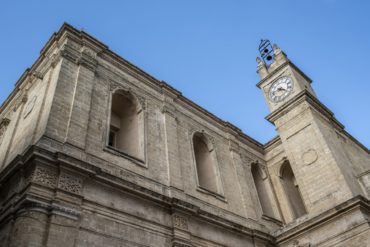
On piazzetta Villani, a stone’s throw from piazza del Popolo, stands the Chiesa Madre, dedicated to St Andrew the Apostle, the patron saint. It was built between 1776 and 1781 on the site of the old parish church damaged by the earthquake of 1743, from which it keeps the sixteenth-century Renaissance bell tower. The pale, elegant Baroque façade has a richly decorated doorway; the interior, a Latin cross with a single nave, has eight side altars adorned with stucco, the high altar in polychrome marble of the Neapolitan school and the holy-water stoups donated by Francis I of the Two Sicilies. Above the wooden choir hangs the 1601 canvas of St Andrew, signed by Giovan Battista Catalano, which was already in the earlier church. Next door, the little chiesa dei Morti (church of the Dead), named after its underground tombs, bears the date 1575 on its architrave. In front of the façade rises the column of Sant’Andrea, commissioned by the Bartilotti princes at the beginning of the eighteenth century: on top is the statue of the saint, and around the base a balustrade with four female figures, the cardinal virtues.
4. Via Marchese Arditi, the palazzi and the courtyard houses (1-2 hours)
From piazzetta Villani runs via Marchese Arditi, considered the most beautiful street in the old town. Along it stand Palazzo Colella Bisanti, with a large garden and a dovecote tower carved with the dates 1563 and 1770, the eighteenth-century Palazzo Villani, faced with rustication and as big as a whole block, the sixteenth-century Casa Cesi, Casa Rollo, Palazzo Arditi, where the Marquis Michele Arditi was born, and Palazzo Seracca, with its inner courtyard announced by a play of arches. Near piazza del Popolo, the Cappella Arditi, from 1767, which combines Lecce stone with rococo decoration, is also worth a stop. Between one palazzo and the next hide the courtyard houses, «li vecchi curti», where the farmers lived: small houses of one or two rooms around a courtyard with the well and the «pila», the stone washtub. The finest are in the Corciuli and Padreterno districts, in via E. Arditi, vico Sant’Anna, via Anita Garibaldi and vico Matteotti, where one courtyard bears the date 1581. Many palazzi are private: you admire them from the outside, and some gardens open during Presicce in Mostra.
5. The church of the Carmine and the Casa Turrita (45 minutes)
In via Roma is the church of the Madonna del Carmine, from the second half of the sixteenth century, with the Carmelite convent built between 1585 and 1590, which now houses municipal offices and the library. Inside the single-nave church, the high altar in Lecce stone is extremely fine work, with twisted columns, openwork, bas-reliefs and statues; the choir and the pulpit are wooden. The bell tower, brought down by lightning in 1945, was rebuilt in 1951. In via Gramsci, among the houses of the well-to-do families of the past, is the Casa Turrita, or Torre di San Vincenzo: a sixteenth-century tower house that was part of the village’s defences, with machicolations, arrow slits and diamond-point rustication on its lower part. Since 2012 it has belonged to the municipality, which has restored it. Along the same street there are also Palazzo Lia, with its doorway, and Palazzo Valentini, with two sixteenth-century family coats of arms.
6. Santa Maria degli Angeli and the sunset walk (1 hour)
From the column of Sant’Andrea take via Madonna degli Angeli and walk for just over a kilometre to the convent of Santa Maria degli Angeli, in the countryside: it is the most beautiful walk to take at sunset. The church stands where the medieval settlement of Pozzomauro once was, destroyed by the Saracens in the fifteenth century. It was rebuilt from 1598, according to tradition after two miraculous events, and in 1603 the Reformed friars settled here and built the convent around a cloister with a well in the middle. Inside, a single nave on a T-shaped plan, there are eight altars, vaults decorated with eighteenth-century stucco and, in the transept, the oldest frescoes in the church, Byzantine in style, dating from between the twelfth and the fourteenth century. After the suppression of 1866 the complex was abandoned for a long time: check with the Pro Loco whether the church is open.
7. The Serra di Pozzomauro, the Madonna di Loreto and the masserie (half a day)
Above the town rises the Serra di Pozzomauro, a hill of terraces, dry-stone walls, Mediterranean scrub, pines and centuries-old olive trees. On top of it stands the little rural church of the Madonna di Loreto, which the people of Presicce call «Madonna te lu Ritu»: it is Basilian in origin, has a gabled façade and, inside, a fresco of the Madonna and Child among angels. Behind the chapel opens the Byzantine crypt of San Mauro, later turned into an underground olive mill, with frescoes from the twelfth to fourteenth century, including an Annunciation. In the surrounding countryside there are the Specchia di Pozzomauro, an ancient mound of stones, the Pagliarone di San Mauro, a cone-shaped farmers’ shelter more than 9 metres high, built entirely of stone, and, further away, the fortified sixteenth-century masserie, such as La Casarana, Del Feudo and the Tunna, with its round tower from 1553. Some masserie are private, others have become places to stay: you admire them from the outside. For roads and paths, ask the Pro Loco for directions.
The nearest sea and who it suits
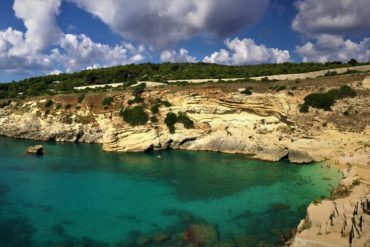
Presicce has no coastline of its own: the nearest sea is on the Ionian coast of the Capo di Leuca, 10-12 km away, a quarter of an hour by car. At Pescoluse, one of Salve’s seaside villages, there is a long beach of very fine white sand with dunes behind it, and the sea stays shallow and clear for several metres: it is the heart of the Maldives of Salento, the stretch of coast between Torre Pali and Torre Vado, ideal with children. At Torre Pali, also one of Salve’s seaside villages, the sixteenth-century tower stands in the sea in front of the beach, and about 500 metres further west is the Isola della Fanciulla, a low islet you can swim out to. Lido Marini, which belongs mostly to Ugento and partly to Salve, has a long sandy beach that alternates with low rocks towards Torre Pali. Read our guides to Marina di Pescoluse, Torre Pali and the Isola della Fanciulla.
Presicce is perfect for those who love historic villages, history and art, for anyone who wants to discover olive-oil culture, for those looking for a quiet, central base in the Capo di Leuca and for families who want sandy beaches a quarter of an hour’s drive away. It is less suited to people who want to step out of the house and be on the beach, or who are looking for nightlife: for that there are the seaside villages along the coast and Gallipoli.
Free beach and facilities
Along the coast between Lido Marini, Torre Pali and Pescoluse, beach clubs with umbrellas, sunbeds and bars alternate with stretches of free beach: the widest are between Pescoluse and Torre Pali, towards Posto Vecchio and opposite the Isola della Fanciulla. In Torre Pali, on Piazza Vanini, there is a free beach equipped for people with disabilities. In the seaside villages many places are open mainly in summer; in Presicce you will find bars and restaurants for the evening.
On the free beach bring an umbrella, water and sun cream: the dunes give no shade and in the middle of the day the sand is scorching. To reach the sea, use the access paths through the dunes, without trampling the vegetation.
Presicce vs other villages of the Capo di Leuca
In southern Salento the towns are very close to each other. Here is a practical comparison to help you choose:
Presicce vs Specchia
- Presicce: the underground olive mills, the Palazzo Ducale with its hanging gardens, the Baroque Chiesa Madre and sandy beaches 10 km away
- Specchia: also one of the Borghi più belli d’Italia, with the Castello Risolo in the old town, a little further from the sea
Presicce vs Alessano
- Presicce: the town of olive oil, with its farmers’ courtyards and the Ionian coast closer by
- Alessano: the Renaissance palazzi, the Chiesa Madre that was once a cathedral, don Tonino Bello’s tomb and the rocky coast of Novaglie. Read our guide to Alessano
Presicce vs Salve’s seaside villages
- Presicce: a real town, alive all year round, quiet in the evening, with the sea a quarter of an hour away
- Pescoluse and Torre Pali: the beach on your doorstep, but lots of people in August and several places open only in summer
When to choose Presicce: if you love historic villages and history, want to discover the underground olive mills and are looking for a quiet base between the countryside and the sea of the Ionian coast.
When to choose somewhere else: if you want to walk to the beach, look at the seaside villages along the coast, from Lido Marini to Pescoluse; if you are after cliffs and deep sea, the Adriatic coast of the Capo di Leuca, such as Marina di Novaglie, about 14 km away.
Practical tips
Explore the old town early in the morning or from late afternoon: in summer it is very hot in the middle of the day and churches and museums may be closed. For the underground olive mills, the Palazzo Ducale and the Museo della Civiltà Contadina, contact the Pro Loco a few days ahead, especially out of season, and ask for the days, times and meeting point of the guided tours. In the mills the floor is beaten earth and the rooms are cut into the rock: you need comfortable shoes.
To go into a church, dress appropriately and respect the services. If you want to combine village and sea, the easiest thing is to swim in the morning at Pescoluse or Torre Pali and come back to town in the late afternoon, when the warm light sets the stone of the old town aglow and the squares fill up.
Useful practical information
| 📍 Where | Presicce (municipality of Presicce-Acquarica, Lecce), in southern Salento, 10-12 km from the sea at Pescoluse and Torre Pali, 16 km from Santa Maria di Leuca and 60 km from Lecce |
|---|---|
| 🚗 Parking | In the streets around the old town, which you explore on foot; in the seaside villages, in August, arrive early |
| ♿ Access | Flat old town, with stone-paved streets; underground olive mills cut into the rock, with uneven floors |
| 🏖 Beach | No sea in the town: sandy beaches at Pescoluse, Torre Pali and Lido Marini, 10-12 km away |
| 🌊 Sea | Shallow and clear on the Ionian coast, suitable for children |
| 👟 What to bring | Comfortable shoes for the lanes and the mills, suitable clothes for the churches, an umbrella and sun cream for the sea |
| 🍴 Food | Bars and restaurants in the town; in summer in the seaside villages too; more choice in Santa Maria di Leuca |
| 📅 Best time | May, June and September; late July and early August for Presicce in Mostra |
Where to stay in Presicce
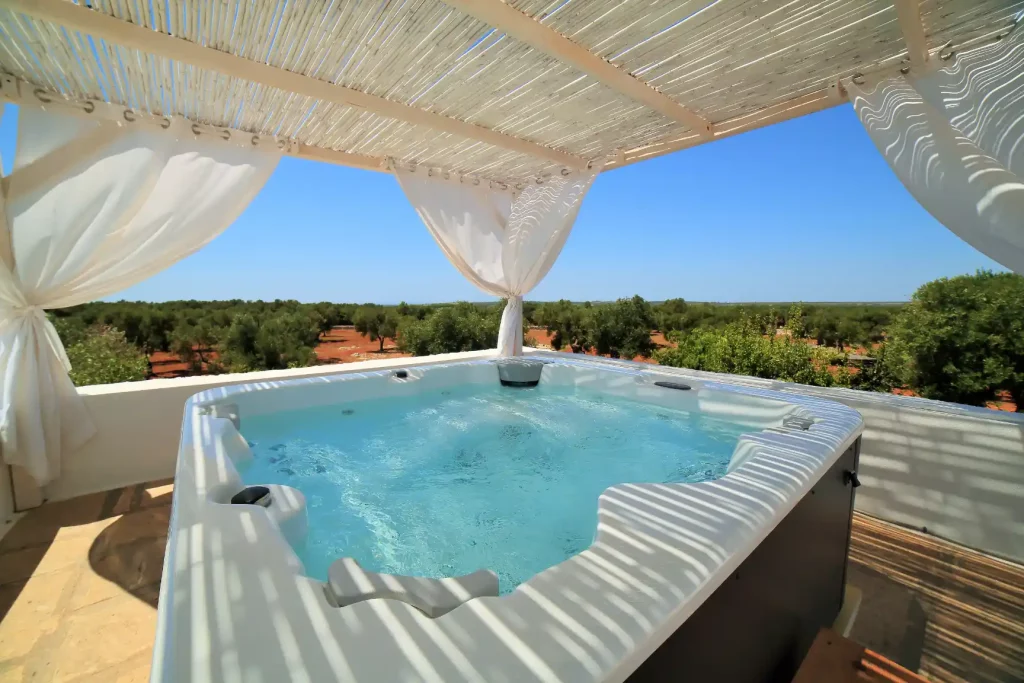
To enjoy the village in the evening and the sea in the morning, it is best to stay in the area. In the countryside of Presicce, in contrada Schiafazzi, about 4 km from the centre and a quarter of an hour’s drive from the beaches of Pescoluse and Torre Pali, we have two apartments in a typical Salento masseria, with a garden and outdoor play equipment for children, a hot tub for guests, a barbecue and private parking; breakfast is included. The Apartment “Lu Mare” sleeps up to 4 people: 35 m², one bathroom, a double bedroom with antique wrought-iron beds, to which an extra bed can be added, and a fully equipped solid-wood kitchen. The Apartment “Lu Salentu” is designed for a couple: 2 guests, 35 m², one bathroom, a double bedroom and the same wooden kitchen. Both have air conditioning, TV and a washing machine.
You will find these and our other houses on the coast on the page holiday homes in Torre Pali. Would you like advice on dates, getting around or other houses in the area? Contact us: we will help you choose the right option.
When to go and how much time to plan
April and May: the ideal time for exploring the village and the countryside of the Serra di Pozzomauro, with mild temperatures and the seaside villages still quiet.
June: the sea is already pleasant and the days are very long: the morning on the beach, the evening in town.
July and August: it is the liveliest time, with feasts and evening events in the old town. It is hot: explore the village early in the morning or in the evening and, for the sea, arrive early to find parking and a spot on the free beach.
September: the best month, in our opinion. The sea is still warm, there are fewer people and the late-afternoon light on the stone of the old town is beautiful.
October and November: it is the olive season, when the trappetari once went down into the underground olive mills, and at the end of November the town celebrates its patron saint, Sant’Andrea.
December to March: Presicce is quiet and you experience it as an everyday town, ideal for a cultural visit; the seaside villages are almost deserted.
Events and festivals (indicative dates, check them every year on the Presicce-Acquarica municipality website and on SalentoMe):
- Feast and fair of the Madonna del Carmine: mid-July, around the 16th
- Presicce in Mostra: two Sundays between late July and early August, when the gardens of the palazzi, the courtyard houses and the underground olive mills of the old town open to the public, with music and Salento dishes
- Feast of Sant’Andrea, the patron saint: 29-30 November, with the «focareddha», the great bonfire in the square on the evening before, and fireworks; on the days of the novena, before dawn, «lu tamburreddhu» (the drum) plays through the streets of the town
How much time to allow: half a day is enough for the old town, the Chiesa Madre and the Palazzo Ducale; a whole day if you add the guided tour of the underground olive mills, Santa Maria degli Angeli and the Serra di Pozzomauro. With three or four days you can combine the sea of the Ionian coast, Santa Maria di Leuca, Specchia and Alessano. A typical day:
- 9:00: a swim at Pescoluse or Torre Pali, while the beach is still quiet
- 13:00: lunch in the seaside villages or in Presicce
- 16:30: guided tour of the underground olive mills, by booking
- 18:00: Palazzo Ducale, Chiesa Madre and via Marchese Arditi
- 19:30: a walk to Santa Maria degli Angeli, at sunset
- 21:00: dinner in town
Surroundings and extra ideas
Presicce is well placed for discovering the Capo di Leuca, between the beaches of the Ionian coast, the cliffs of the Adriatic coast and the other inland villages. Distances and driving times are approximate.
Pescoluse (10 km, 15 minutes): the white sand, the dunes and the shallow sea of the Maldives of Salento, ideal with children. Read our guide to Marina di Pescoluse.
Torre Pali and the Isola della Fanciulla (12 km, 19 minutes): the tower in the sea, the little harbour and the islet of the legend, which you can swim out to. Read our guide to the Isola della Fanciulla.
Lido Marini and Torre Mozza (11-13 km, 18-20 minutes): Ugento’s long sandy beaches, with the sixteenth-century tower of Torre Mozza and, behind them, the wetland basins of the Parco Litorale di Ugento.
Salve (7 km, 8 minutes): the town that Pescoluse and Torre Pali belong to, with the mother church of San Nicola Magno and its seventeenth-century organ.
Specchia (7 km, 9 minutes): another of the Borghi più belli d’Italia, with the Castello Risolo and an old town to explore on foot.
Alessano (8 km, 13 minutes): the Renaissance palazzi, the Chiesa Madre that was once a cathedral and don Tonino Bello’s tomb. Read our guide to Alessano.
Santa Maria di Leuca (16 km, 17 minutes): the lighthouse, the de Finibus Terrae sanctuary, the seafront with its nineteenth-century villas and the boats to the caves.
Gallipoli (34 km, 36 minutes): the old town on an island linked to the mainland by a bridge and the liveliest evening scene on the Ionian coast.
Local tip
Book your visit to the underground olive mills for the late afternoon, after the sea: going down beneath piazza del Popolo, among millstones and presses carved out of the rock, shows you how the trappetari lived, shut away down there from October to March, and why Presicce is called the town of hypogea.
Then, at sunset, walk from the column of Sant’Andrea along via Madonna degli Angeli to the convent, among gardens, dry-stone walls and olive trees, and come back to town when the lights in the squares come on. At dinner, if you happen to be there on the eve of a feast, look out for the «pittule», fritters of leavened dough made here with shrimps, salt cod or vegetables.
If you are in the area between late July and early August, mark Presicce in Mostra on your calendar: it is one of the few times in the year when you can go into the gardens of the palazzi and the private courtyards of the old town.
FAQ
Where is Presicce?
In southern Salento, in the province of Lecce, inland from the Ionian coast of the Capo di Leuca, between Specchia, Alessano, Salve and Ugento. The sea at Pescoluse is about 10 km away, Santa Maria di Leuca 16 km and Lecce 60 km.
Are Presicce and Presicce-Acquarica the same thing?
Presicce is the main town of the municipality of Presicce-Acquarica, created on 15 May 2019 by the merger with Acquarica del Capo, 2 km away. That is why you often see «Presicce-Acquarica» on maps and in addresses.
Why is Presicce called the town of hypogea?
Because of its underground olive mills, the «trappeti», cut into the rock to process olives: there are 23 in the area, eight of them in the old town, many beneath piazza del Popolo. They were used until the end of the nineteenth century.
Can you visit the underground olive mills?
Yes, usually with a guided tour: the mills open to the public are those of piazza del Popolo, vico Sant’Anna and via Gramsci. Ask the Pro Loco di Presicce for days and times; during Presicce in Mostra, between late July and early August, they are open together with the gardens of the palazzi.
What is there to see in Presicce?
The underground olive mills, the Palazzo Ducale with its hanging gardens and the Museo della Civiltà Contadina, the Chiesa Madre di Sant’Andrea with its column, via Marchese Arditi and the courtyard houses, the church of the Carmine, the Casa Turrita, the convent of Santa Maria degli Angeli and, in the countryside, the Serra di Pozzomauro.
Does Presicce have a coastline?
No, Presicce is inland. The nearest beaches are on the Ionian coast: Pescoluse about 10 km away, Lido Marini 11 km and Torre Pali 12 km, a quarter of an hour by car.
How do you get to Presicce without a car?
By train: from Lecce the FS Sud Est regional trains to Gagliano del Capo stop at Presicce-Acquarica station, about 1 km from the centre. In summer «Salento in Bus» line 207 connects the town with Lido Marini, Torre Pali and Pescoluse. Check the timetables and any replacement buses before you set off.
When is the best time to go?
May, June and September, when it is less hot for exploring the village and the sea is already, or still, pleasant. Between late July and early August there is Presicce in Mostra; on 29 and 30 November the feast of Sant’Andrea, with the focareddha.
Where to stay near Presicce?
In the countryside of Presicce, about 4 km from the centre and a quarter of an hour from the sea at Pescoluse and Torre Pali, there are Salento Prime’s Appartamento Lu Mare, for 4 guests, and Appartamento Lu Salentu, for 2, in a masseria with a garden and hot tub. Other houses are on the holiday homes in Torre Pali page.
Conclusion
Presicce is the Salento of historic villages and olive oil: a town hidden beneath piazza del Popolo, a Palazzo Ducale with hanging gardens, a Baroque Chiesa Madre with its column, stone-paved lanes and farmers’ courtyards, and the sea of the Ionian coast a quarter of an hour away. Give it at least an afternoon, without hurrying, between the underground olive mills, the squares and the sunset walk to Santa Maria degli Angeli.
If you want to stay nearby, in the countryside of Presicce, about 4 km from the town, you will find our Apartment “Lu Mare”, for 4 guests, and our Apartment “Lu Salentu”, for 2, in a masseria with a garden and hot tub. You will find our houses in the area on the page holiday homes in Torre Pali.
Discover the available accommodations with Salento Prime. To best organize your base and transfers, contact us here or start a chat on WHATSAPP.
Cover photo: Lupiae, CC BY-SA 3.0, via Wikimedia Commons