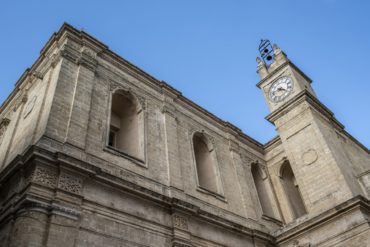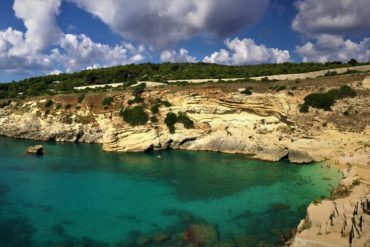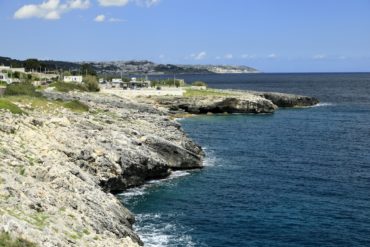
Looking for clear sea you can reach on foot from the low rocks, a seafront path to cycle along and sunsets that go down over the Ionian Sea every evening? This guide takes you to Posto Rosso and the Alliste coast, on the Ionian side of Salento between Capilungo and Torre San Giovanni: swimming from the rocks, the Baia dei Pinnacoli with its stone stacks, Torre Sinfonò and the Baia dei Diavoli, the villages of Alliste and Felline and everything there is to see nearby, with practical tips and local curiosities.
In short
Posto Rosso, also called Cisternella or Stella Marina, is a small seaside resort and hamlet of Alliste (Lecce), on Salento’s Ionian coast between Capilungo and Torre San Giovanni, 4 km from Torre San Giovanni and 24 km from Gallipoli. It is the last stretch of the Alliste coast, which runs from Capilungo, Pilella and Torre Sinfonò to the border with Ugento. The coast is a low rocky shore, easy to walk on, with clean, clear sea, and a seafront path for walkers and cyclists, about 4 km long, links it to Capilungo. The coast faces south-west: in the evening the sun sets over the sea. The best months are June and September.
What is Posto Rosso?
Posto Rosso is a coastal hamlet in the municipality of Alliste, in southern Ionian Salento. It is a place born for holidays that grew mainly from the 1970s onwards, made up of little villas and low houses looking out over the rocks, where you swim from the rock in clear sea. Its stretch of coast, between Torre Sinfonò and the border with Torre San Giovanni, is also known as the Baia dei Pinnacoli, after the many small balanced stone stacks that have appeared on the rocks in recent years.
Posto Rosso is a simple place: little white villas, gardens with palm trees, dry-stone walls and the coast road running a few steps from the rocks, alongside a seafront path for walkers and cyclists. In winter it is almost deserted; in summer the houses open up and the coast fills with families on holiday. Behind it begins the Alliste countryside, dotted with caseddhi, the dry-stone farm buildings.
This is not the place for long sandy beaches: here you reach the sea from the low rocks, the water is clear and lets you see the rocky seabed, and small inlets open up along the coast. This is the Salento for those who love swimming, walking or cycling by the sea and ending the day with the sunset. In this guide you will find how to get there, where to swim, what to see and how to plan your day, nearby too.
Curiosities and atmosphere
The name has a simple explanation. By the sea there was a house painted red, which the small boats sailing close to the shore used as a landmark; and some of the rocks here also have an odd reddish colour. To many people the place is also Cisternella or Stella Marina, and in recent years it has picked up two new nicknames, «Baia dei Pinnacoli» and «Bosco di Statue» (forest of statues): on the coast an anonymous artist, mainly in summer, has built a great number of slender stone stacks without mortar, like pinnacles, which have become the symbol of Posto Rosso.
The history of this coast is much older than the villas. For centuries pirates and armies arriving from the sea struck this stretch of the Ionian: Felline, the nearby village, was destroyed several times, including by the Venetians in 1480, and according to tradition its fleeing inhabitants founded Alliste and Melissano, two villages that cannot be seen from the sea. In 1547 the Turks landed at San Giovanni and sacked Ugento, Felline and Alliste. A few years later, between 1560 and 1570, Torre Sinfonò, also called Zunfano, was built on the coast: a round tower in the defensive system of the Kingdom of Naples, which to the north communicated by sight with Torre Suda. The village of Alliste, Caḍḍiste in dialect, also has an ancient name: according to one theory it comes from the Greek Kallístē, «very beautiful»; legend, on the other hand, says that an angel wrapped the refugees from Felline in its wings, making them invisible to the enemy, and those wings are still on the municipal coat of arms.
Where it is and how to reach it
Posto Rosso is on Salento’s Ionian coast, in the municipality of Alliste, between Torre Sinfonò and Capilungo to the north-west and Torre San Giovanni, Ugento’s seaside village, to the south-east. This is where the Alliste coast ends: a little further south begins the locality of Mare Verde, which is already part of Torre San Giovanni. From the Posto Rosso crossroads a road climbs inland to Felline, 5.5 km away; the village of Alliste is about 6 km away, Torre San Giovanni 4 km, Gallipoli 24 km, Santa Maria di Leuca 33 km and Lecce about 59 km. The coast road runs along the sea, leading north to Capilungo, Torre Suda and Gallipoli and south to Torre San Giovanni and the seaside villages of Ugento.
By car: from Lecce take the SS101 to Gallipoli and then the SS274 towards Santa Maria di Leuca, leaving it towards the Ionian coast and following the signs for Alliste or Torre San Giovanni: about an hour without traffic. You can park along the village streets and along the coast road; check on the spot for any no-parking and paid zones and in August arrive early in the morning.
By public transport: national trains arrive in Lecce; the nearest station is Racale-Alliste, on the FS Sud Est (Ferrovie del Sud Est) line between Casarano and Gallipoli, about 8 km away: check the timetables and any replacement buses. In summer «Salento in Bus» line 108, Lecce – Gallipoli – Santa Maria di Leuca, stops all along the Alliste coast, at Capilungo, Pilella, Torre Sinfonò and Posto Rosso, in front of the Stella del Mare church (in 2026 from 13 June to 13 September): check this year’s routes and timetables before you set off. The most convenient airport is Brindisi, about an hour and forty minutes away by car.
What to do and what to see
Posto Rosso is about the rocks and the seafront: a swim in the clear sea in the morning, a trip to the inland villages in the hottest hours, a bike ride towards Capilungo and the sunset over the Ionian Sea in the evening. Here are the experiences not to miss.
1. Swimming from the low rocks (2-3 hours)
At Posto Rosso the coast is a low rocky shore, easy to walk on and broken up by small inlets: you settle down on the flat rock and get into the water wherever the way down is easiest. The sea is clean and clear, turquoise near the shore and blue further out, with a rocky seabed to explore with a mask and snorkel. When the sea is calm it makes for a quiet swim, away from the crowds of the sandy beaches.
2. The Baia dei Pinnacoli (30 minutes)
On the rocks of Posto Rosso, in recent years, an anonymous artist has built, mainly in summer, a great number of balanced stone stacks, as slender as pinnacles: that is why the place is called Baia dei Pinnacoli or Bosco di Statue. The best time to see them is the late afternoon, when the low, slanting light turns the stone orange and the sea becomes dark blue. They are fragile structures that the wind and heavy seas can knock down: if you find them, look at them and photograph them without touching them.
3. The seafront path to Capilungo, by bike or on foot (1-2 hours)
From Posto Rosso a seafront path for walkers and cyclists follows the coast for about 2.4 km to Torre Sinfonò and carries on for another 1.8 km to Capilungo: about 4 km in all beside the rocks, separate from the road. It is an easy route and is part of the Ugento – Racale loop of the Ciclovia del Salento Ionico, the cycle touring route of about 300 km presented by the Province of Lecce in 2024. Go early in the morning or towards evening, because there is no shade, and get back before dark: the seafront path is not lit.
4. Torre Sinfonò and the Baia dei Diavoli (45 minutes)
Where Posto Rosso ends and Capilungo begins stands Torre Sinfonò, the round coastal tower built between 1560 and 1570 against Turkish raids. Today it is damaged: what is left is its stone stump, surrounded by houses and gardens, and you look at it from the outside, from the road. Right next to it opens the Baia dei Diavoli, for many simply «i Diavoli»: here the rocks are a little higher, the water is turquoise and in summer you can watch the young people diving. Watching them is quite a show; if you want to have a go yourself, do it only when the sea is calm and where you know the depth well.
5. Sunset over the Ionian Sea (1 hour)
The coast of Posto Rosso faces south-west, onto the open sea, and in the evening the sun goes down right into the water. Sit on the rocks of the Baia dei Pinnacoli, where the stone stacks become dark silhouettes against the sky, or along the seafront path towards Capilungo: in summer the red disc of the sun plunges into the Ionian Sea and sets the horizon alight.
6. Alliste, the village (1-2 hours)
6 km from the sea is Alliste, the village Posto Rosso belongs to, with just over 6,000 inhabitants. The old centre, the «Terra», was already a walled village at the end of the fourteenth century and still has its straight streets laid out at right angles. Here you will find the church of San Giuseppe, mentioned as early as 1452, with a large painting of the Madonna del Rosario surrounded by fifteen ovals with the Mysteries, painted in the mid-seventeenth century by Giovanni Andrea Coppola; the church of San Quintino, the patron saint, founded in 1455 just outside the walls and rebuilt in the nineteenth century; the church of the Immacolata, from 1712, and a few seventeenth- and eighteenth-century noble palazzi. Alliste was home to a Greek community for a long time, and the Greek rite survived until the end of the sixteenth century. Check the churches’ opening times before you go.
7. Felline, the castle and the Madonna dell’Alto (1-2 hours)
5.5 km from Posto Rosso is Felline, the other hamlet of Alliste, whose name is said to come from the Latin figlinae, the potters’ workshops: in Roman times a kiln for pottery operated here. In the centre stands the medieval castle of the Bonsecolo, remodelled by the Tolomei and the Pignatelli, with four corner towers, square at the front and round at the back. Not far away are the apse of Santa Sofia, from the late fourteenth century, with frescoes of a Crucifixion, Sant’Antonio da Padova and Santa Deodata, and, on the ridge, the little church of the Madonna dell’Alto, linked to the Basilian monks, with Byzantine-style frescoes, one of them from 1577, and next to it the remains of an ancient specchia. In the countryside there are also two menhirs, the Ninfeo and the Terenzano, about two and a half metres tall. The castle can be seen from the outside; for the churches and the menhirs check access and opening times on the spot and respect private property.
Sea, rocks and who it suits
The sea at Posto Rosso is clean and clear, turquoise over the pale rock and blue further out. The coast is a low rocky shore that is easy to get about on, with small inlets; towards Torre Sinfonò and the Baia dei Diavoli the rocks rise a little and there are deeper spots. The coast faces south-west: with the tramontana, the north wind, the sea is usually calm and clear; when the wind blows from the sea the waves come in and break hard on the low rocks, and swimming should be avoided.
It is perfect for those who love swimming and snorkelling, for couples, for anyone looking for a quiet Salento and for those who want to get around by bike on the seafront path. It also works with older children who can get about on the rocks. It is less suited to small children looking for sand and to those who find it hard to walk on rock: for them the sandy beaches begin a few minutes away, south of the harbour of Torre San Giovanni.
Free beach and facilities
At Posto Rosso you swim freely from the rocks all along the coast: there are no real sandy beaches. Check on the spot whether there are licensed beach services with sunloungers and umbrellas, and when. In the village there are a few restaurants and some places to stay, and near the sea a small football pitch and a children’s play area; for shops, bars and more choice, especially in the evening, there is Torre San Giovanni, 4 km away.
Bring reef shoes, a small umbrella and water: there is no shade on the rocks and in the middle of the day the rock is scorching.
Posto Rosso vs other seaside villages of the Ionian coast
Along this coast the villages are very close to each other. Here is a practical comparison to help you choose:
Posto Rosso vs Torre San Giovanni
- Posto Rosso: low rocks, low houses and a quiet atmosphere, with the seafront cycle path towards Capilungo
- Torre San Giovanni: Ugento’s main seaside village, 4 km away, with the harbour, the lighthouse tower, the sandy beaches south of the harbour and many more facilities
Posto Rosso vs Torre Suda
- Posto Rosso: free access to the sea right on your doorstep, the Baia dei Pinnacoli and the seafront path by bike
- Torre Suda: the seaside village of Racale, 7 km away, with the sixteenth-century tower in the garden by the sea, the piazzetta for the sunset and the early twentieth-century villas
Posto Rosso vs Torre Mozza
- Posto Rosso: rocky shore, snorkelling and sunsets over the sea
- Torre Mozza: a long beach of fine sand with shallow sea, ideal with small children, and the basins of the Parco Litorale di Ugento
When to choose Posto Rosso: if you love swimming from the rocks, want a quiet base with a seafront path to cycle along and prefer peace and quiet to the busiest resorts.
When to choose somewhere else: if you are travelling with small children and looking for sand and shallow water, look at Torre Mozza, 10 km away, or the beaches of Torre San Giovanni, 4 km away.
Practical tips
To swim, choose the spots where the rock slopes gently down to the water and always wear reef shoes: the rocks are low but near the water they can be slippery and sharp. If the sea is rough, don’t go down onto the rocks: waves come in without warning and getting out of the water becomes difficult.
In July and August arrive early to park near the sea and find a good spot on the rock. The seafront path belongs to walkers and cyclists alike: go slowly and watch out for others, and since it is not lit, get back before dark. In the hottest hours leave the sea and take a trip to Alliste and Felline, then come back to the coast for the sunset. At the Baia dei Pinnacoli, don’t touch or move the stone stacks.
Useful practical information
| 📍 Where | Posto Rosso (Alliste, Lecce), 4 km from Torre San Giovanni, 24 km from Gallipoli and 59 km from Lecce |
|---|---|
| 🚗 Parking | Along the village streets and along the coast road; check the no-parking and paid zones, in August arrive early |
| ♿ Access | Into the water from the low rocks; seafront path for walkers and cyclists, about 4 km long, to Capilungo |
| 🏖 Beach | No sandy beach: low rocky shore with small inlets |
| 🌊 Sea | Clean and clear, with a rocky seabed; excellent for snorkelling when the sea is calm |
| 👟 What to bring | Reef shoes, mask, umbrella, sun cream, water and a bike for the seafront path |
| 🍴 Food | A few restaurants in the village; more choice in Torre San Giovanni and Gallipoli |
| 📅 Best time | June and September for the sea; spring and autumn for the seafront path and the villages |
Where to stay near Posto Rosso
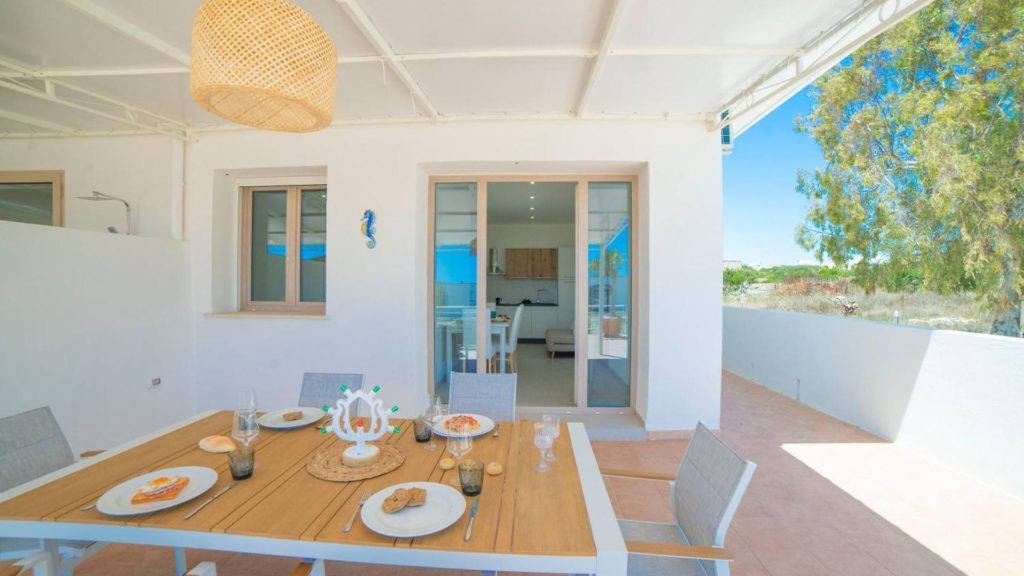
We have no houses in Posto Rosso, but along the same Ionian coast, between Lido Marini and Torre Pali, about 13 km from Posto Rosso and around twenty minutes by car, you will find our Le Secche Suite & House – 4, La Secca di Venerdi: 4 guests, 1 bathroom and 50 m², with a double bedroom and a bedroom with two single beds or a double bed, views of the sea and the Mediterranean scrub, an equipped terrace, air conditioning, a modern fully equipped kitchen with a dishwasher, a living room, Wi-Fi, a garden and private parking. Small dogs are allowed and the sea is less than 1 km away.
The house is part of Le Secche Suite & House, a small complex of six units completed in 2024, with other options for 3 or 4 guests, some with a private pool: you will find them all on the page holiday homes in Lido Marini. From here the free beaches of Lido Marini and Torre Pali are a few minutes away, and you can combine the rocks of Posto Rosso and the shallow sea of the Ugento coast in the same holiday.
Would you like advice on dates, getting around or other houses in the area? Contact us: we will help you choose the right option.
When to go and how much time to plan
June: the sea is already pleasant, the rocks are quiet even at weekends and the days are very long, with the latest sunsets of the year.
July and August: it is high season. The sea is warm and the coast is full of families; the car parks and the best spots on the rocks fill up early, so go to the sea early in the morning or in the late afternoon. In these months there are also the festivals and food fairs of Capilungo and Felline.
September: the best month, in our opinion. The sea is still warm, there are far fewer people and the sunsets over the rocks are beautiful.
April, May and October: the ideal time for cycling the seafront path and discovering Alliste, Felline and the countryside of the caseddhi; swimming is for those who don’t mind cool water. At the end of October, in Alliste, there is the fair of the patron saint, San Quintino.
November to March: Posto Rosso is almost deserted and many houses are closed. In heavy seas the sight of the waves on the low rocks is impressive, but it is best watched from a distance; in November, in Alliste, there is the new wine festival.
Events and festivals (indicative dates, check them every year on the Alliste municipality website and on SalentoMe):
- Feast and fair of the Madonna dell’Alto, linked to the little church on the Felline ridge: the first Sunday after Easter
- Sagra della patata (potato festival) in Felline: July
- Feast of the Madonna della Luce in Capilungo: August
- Sagra della polpetta (meatball festival) in Felline: August
- Fair of San Quintino, patron saint of Alliste: from 30 October to 1 November
- New wine festival in Alliste: 11 November
How much time to allow: half a day is enough for a swim and the Baia dei Pinnacoli; a whole day if you add the seafront path to Capilungo, Alliste and Felline. With three or four days you can combine Torre San Giovanni, Torre Suda, Gallipoli and the sandy beaches of the Ugento coast. A typical day:
- 8:30: a swim and snorkelling from the rocks of Posto Rosso, when the sea is calmest
- 11:00: by bike or on foot along the seafront path to Torre Sinfonò and Capilungo
- 13:30: lunch in Posto Rosso or Torre San Giovanni
- 17:00: Felline and Alliste, with the castle, the churches and the Madonna dell’Alto
- 19:30: sunset at the Baia dei Pinnacoli
- 21:00: dinner and an evening stroll in Torre San Giovanni or in the old town of Gallipoli
Surroundings and extra ideas
Posto Rosso is well placed for exploring the Ionian coast of southern Salento, with its rocky shores, coastal towers, sandy beaches and inland villages. Distances and driving times are approximate.
Capilungo and Pilella (3-4 km, 3-4 minutes): the other seaside villages of Alliste, with a low rocky shore full of small inlets, the seafront path for walkers and cyclists and, at Pilella, the church of the Santi Medici. Capilungo has been a hamlet since 1964 and is divided into two areas, Capilungo Valeriano and Capilungo Le Campore.
Torre San Giovanni (4 km, 6 minutes): Ugento’s main seaside village, with the harbour, the black and white chequered lighthouse tower, the remains of the Messapian walls and, south of the harbour, the sandy beaches. Read our guide to Torre San Giovanni.
Felline and Alliste (5-6 km, 9-10 minutes): the castle of the Bonsecolo, the Madonna dell’Alto, the menhirs, the church of San Giuseppe with the painting by Giovanni Andrea Coppola and, in the surrounding countryside, many caseddhi, the dry-stone farm buildings.
Torre Suda and Marina di Mancaversa (7-9 km, 9-11 minutes): the seaside village of Racale, with the sixteenth-century tower in the garden by the sea, and just beyond it that of Taviano, with the little beach of the Mare dei Cavalli. Read our guide to Torre Suda.
Ugento (10 km, 13 minutes): the Messapian town of art, with the castle, the Nuovo Museo Archeologico and the Cripta del Crocifisso. Read our guide to Ugento.
Torre Mozza and the Parco Litorale di Ugento (10 km, 15 minutes): the 1565 tower, the long beach of fine sand with its shallow sea and the basins of the Litorale di Ugento Regional Nature Park. Read our guide to Torre Mozza.
Lido Marini (12 km, 18 minutes): a long sandy beach that alternates with low rocks towards Torre Pali, near our houses.
Gallipoli (24 km, 30 minutes): the old town on an island linked to the mainland by a bridge, the sandy beaches and the liveliest evening scene on the Ionian coast.
Santa Maria di Leuca (33 km, 35 minutes): the lighthouse, the de Finibus Terrae sanctuary, the seafront with its nineteenth-century villas and the boats to the caves.
Local tip
Take a bike and ride the seafront path early in the morning, when the light is low and the sea is still flat: from Posto Rosso to Capilungo and back is about 8 km beside the rocks, with stops for a swim in the small inlets along the way.
In the hot hours head inland: between Posto Rosso, Felline and Alliste the countryside is full of caseddhi, the farmers’ dry-stone buildings, and on the ridge the little church of the Madonna dell’Alto holds frescoes centuries old.
And in the evening go back to the Baia dei Pinnacoli for the sunset: with the sun low the stone stacks glow orange and then become dark silhouettes against the sky. Bring a torch to make your way back over the rocks when it is dark.
FAQ
Where is Posto Rosso?
On Salento’s Ionian coast, in the municipality of Alliste (Lecce), between Capilungo and Torre San Giovanni, 4 km from Torre San Giovanni, 24 km from Gallipoli and 59 km from Lecce.
Is Posto Rosso a municipality?
No: it is a hamlet of Alliste, like Felline and Capilungo. Together with Capilungo, Pilella and Torre Sinfonò it forms the Alliste coast, which borders Torre San Giovanni, Ugento’s seaside village, to the south.
Why is it called Posto Rosso?
Because of a house painted red by the sea, which small boats used as a landmark, and because of the reddish colour of some of the rocks. The place is also known as Cisternella or Stella Marina.
Is there a sandy beach at Posto Rosso?
No: the coast is a low rocky shore, easy to walk on, from which you get into the water. The nearest sandy beaches begin south of the harbour of Torre San Giovanni, a few minutes away by car, and continue towards Torre Mozza and Lido Marini.
What is the Baia dei Pinnacoli?
It is the nickname of the rocky shore of Posto Rosso where an anonymous artist, mainly in summer, has built a great many balanced stone stacks; it is also called Bosco di Statue. They are fragile: if you find them, look at them without touching them.
Can you cycle from Posto Rosso to Capilungo?
Yes: a seafront path for walkers and cyclists, about 4 km long and separate from the road, links Posto Rosso to Torre Sinfonò and Capilungo. It is part of the Ugento – Racale loop of the Ciclovia del Salento Ionico.
Is Posto Rosso suitable for children?
With care: the rocks are low, but there is no sand and the rock near the water can be slippery. With small children the sandy beaches of Torre San Giovanni and Torre Mozza are easier.
How do you get to Posto Rosso without a car?
In summer on «Salento in Bus» line 108, Lecce – Gallipoli – Santa Maria di Leuca, which stops at Posto Rosso in front of the Stella del Mare church. The nearest railway station is Racale-Alliste, on the FS Sud Est line between Casarano and Gallipoli, about 8 km away.
When is the best time to go?
June and September, when the sea is already, or still, warm and there are fewer people. Spring and autumn are perfect for cycling the seafront path and discovering Alliste and Felline.
Where to stay near Posto Rosso?
Between Lido Marini and Torre Pali, around twenty minutes away by car, there is Salento Prime’s Le Secche Suite & House – 4: 4 guests, a sea view, an equipped terrace and private parking. You will find the other houses on the holiday homes in Lido Marini page.
Conclusion
Posto Rosso and the Alliste coast are the quietest side of the Ionian coast between Gallipoli and Torre San Giovanni: low rocks and clear sea right on your doorstep, the stone stacks of the Baia dei Pinnacoli, a seafront path to cycle all the way to Capilungo and, behind it all, the villages of Alliste and Felline, with the castle, the old churches and the menhirs. Choose June or September, bring your reef shoes and don’t leave without a sunset over the Ionian Sea.
If you want a convenient base for exploring this coast, between Lido Marini and Torre Pali you will find our Le Secche Suite & House – 4: 4 guests, a sea view, an equipped terrace and private parking, around twenty minutes from Posto Rosso. You will find our houses in the area on the page holiday homes in Lido Marini.
Discover the available accommodations with Salento Prime. To best organize your base and transfers, contact us here or start a chat on WHATSAPP.
Cover photo: Zener65, CC BY-SA 4.0, via Wikimedia Commons, cropped