Looking for a real village in the Capo di Leuca, with a quiet centre, ancient paths among the olive trees and a coast of cliffs dropping sheer into the sea? This guide takes you to Corsano, the village of the «calcagni induriti» (hardened heels): the churches and the castle in the centre, the Salt Roads (Vie del Sale) running down to the sea, Torre Specchia Grande, the Canale del Rio and the Guardiola, the feasts of San Biagio, with practical tips and local curiosities.
In short
Corsano is a municipality of about 5,000 inhabitants in the Capo di Leuca (Lecce), on the Adriatic coast, 12 km from Santa Maria di Leuca and 59 km from Lecce. The village stands at about 120 metres above sea level, about 5 km by road from the sea; its territory includes 4 km of high, rocky coast, with the localities of Guardiola and Funnuvojere, Torre Specchia Grande and the Canale del Rio. The ancient Salt Roads run down from the village to the sea and are now paths to walk. Just to the south is Marina di Novaglie. The best months are May, June and September.
What is Corsano?
Corsano is a village in southern Salento, on the eastern side of the Capo di Leuca, between the Serra dei Cianci and the rocky Adriatic coast. It borders Tiggiano to the north, Alessano to the west and south, and the sea to the east. Since 2006 part of its territory, the part towards the coast, has belonged to the Parco Naturale Regionale Costa Otranto – Santa Maria di Leuca e Bosco di Tricase. It is known for its feasts of San Biagio, its Carnival and its handmade ties.
Corsano is a village to enjoy slowly: intimate squares, chapels on every corner, the big feast of the patron saint and a countryside of olive trees, dry-stone walls and terraces that runs down to the sea. You can walk around the centre in a couple of hours, and in a few minutes by car you are on the coast road, in front of one of the highest and wildest coasts in Salento.
It is not a village of beaches: here you reach the sea on foot, down steps and paths, and you swim from the rocks in deep, crystal-clear water. It is the Salento for people who love walking, swimming and discovering lesser-known places. In this guide you will find how to get there, what to see, where to swim and how to plan your day, including the surrounding area.
Curiosities and atmosphere
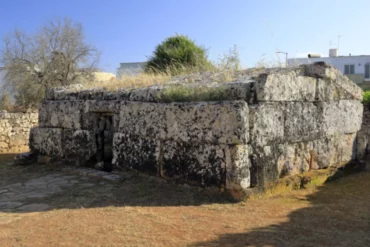
There are two theories about the origin of the name. According to tradition, Corsano combines the words «cor» and «sano», healthy heart: and a red heart, between two intertwined green snakes, is exactly what appears on the village’s coat of arms. Historical studies instead derive it from the name of the Roman centurion Cortius, who is said to have been given the territory. What is certain is that the area has been inhabited since very ancient times, as some «specchie», the ancient stone mounds of Salento, remind us. The first real village probably grew up in the Byzantine period, and it was the Basilian monks, who came from the East, who spread here the cult of Corsano’s two patron saints, Santa Sofia and San Biagio. From 1636 until the abolition of feudalism in 1806, the village belonged to the Capece barons.
The people of Corsano also have a nickname: «calcagni induriti», hardened heels. For centuries they walked barefoot down the cliffs to gather the salt that formed in the hollows of the rock, and carried it back to the village in secret, because making salt was forbidden: they called it «polvere di mare», sea dust. The paths they used, the Salt Roads, are still there, among dry-stone walls and olive trees, and have been nominated several times in FAI’s «I Luoghi del Cuore» census.
Where it is and how to reach it
Corsano is in southern Salento, on the Adriatic coast of the Capo di Leuca, between Tiggiano and Tricase to the north and Alessano and Gagliano del Capo to the south. The village is about 5 km from its sea, the locality of Guardiola; Santa Maria di Leuca is about 12 km away, Tricase 6 km and Lecce about 59 km.
By car: from Lecce take the SS16 to Maglie and then the SS275 towards Santa Maria di Leuca, leaving at the Tiggiano-Corsano exit, near Alessano: about an hour without traffic. From the village the SP187 provincial road runs down to the Otranto-Leuca coast road, which follows the Corsano coast. The streets in the centre are narrow: leave the car in the surrounding streets and explore on foot.
By public transport: national trains arrive in Lecce; from there the FS Sud Est (Ferrovie del Sud Est) regional trains to Gagliano del Capo stop at Alessano-Corsano station, about 2.5 km from the centre: check timetables and any replacement buses. In summer the «Salento in Bus» lines connect many places on the coast: check the current year’s routes and timetables before you set off. The most convenient airport is Brindisi, about an hour and forty minutes by car.
What to do and what to see
Corsano is best discovered in two stages: in the morning in the village, among churches, chapels and the castle, and in the afternoon towards the sea, on foot along the Salt Roads or by car on the coast road, as far as the tower and the Canale del Rio. Here are the experiences not to miss.
1. The church of Santa Sofia (30 minutes)
A few steps from Piazza Umberto I stands the church of Santa Sofia, the village’s historic church and the seat of the parish. The old church, dedicated to the saint since the Middle Ages and later rebuilt in Lecce Baroque style, collapsed on the night between 16 and 17 April 1932, when the bell tower gave way. Today’s church was built between 1934 and 1939 in Leuca stone, with a façade that recalls the Romanesque style. Closed for years because of subsidence, it was consolidated and reopened in 2009: during the works the floor of the old church came to light, and it can now be seen under special glass cases. Inside, with a nave and two aisles, there is a wooden pulpit from 1777, a 19th-century Carrara marble font and the 17th-century wooden statue of San Biagio, to whom the village is deeply attached.
2. San Biagio, the Immacolata and the chapels in the centre (1 hour)
In Piazza San Biagio rises the large church dedicated to the patron saint, inaugurated in 1967: a modern building, with a pentagonal plan and a hexagonal central section supported by six pillars, stained-glass windows made for the 2000 Jubilee and a bell tower rebuilt between 2023 and 2025. Not far away is the church of the Immacolata, known as «la Congrega», which already existed in the 18th century: it has a plain Lecce-stone façade with statues of Sant’Antonio di Padova and San Francesco di Paola, a Baroque altar and a statue of the Immacolata from 1871. From the collapse of Santa Sofia until 1939 it was the village’s mother church. The many small chapels complete the tour: San Bartolo, from 1714, which once marked the edge of the village on the road to Novaglie, San Giuseppe, Santa Teresa and Tutti i Santi.
3. The Castello Capece and its legends (20 minutes)
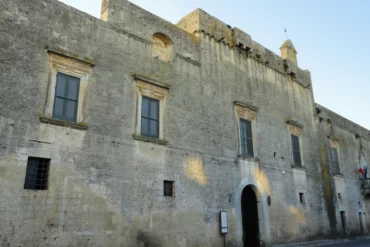
The Castello Baronale Capece was built in the 17th century on the remains of the fortress built in the early 13th century by Fabiano Securo, the first feudal lord, who surrounded the village with walls. Altered several times, it was also used as a store for tobacco processing; inside it keeps star and barrel vaults, a roof garden, remains of frescoes and the bas-reliefs of the «sala del trono» (throne room). Two legends go with it: the secret passage to the countryside, whose existence only the baron was supposed to know, and the «sakàra», a huge grass snake said to live in the underground rooms, whose hissing can supposedly be heard at night. Opposite the castle is the chapel of San Biagio, the first place of worship of the patron saint, with walls and vaults frescoed with the stories of his life: it is privately owned. To find out whether the castle and the chapel can be visited, ask in the village.
4. The Salt Roads, on foot down to the sea (2-3 hours)
A network of ancient tracks of stone and packed earth runs down from the village to the sea; until the early 20th century they were used to carry the salt gathered in the hollows of the cliffs back to the village, and to escape the customs police. Today they are hiking paths that cross olive groves, terraces and Mediterranean scrub down to the coast, with old names such as Scalapreola, Scalamonte and Funnuvojere-Calavedda; one of them links the chapel of Santa Maura to Torre Specchia Grande. Walk them early in the morning or late in the afternoon, with closed shoes, water and a hat, and remember that on the way back you climb: in some stretches the slope is steep. The coast is also followed by the Cammino del Salento, on its Via del Mare, which runs from Marina Serra all the way to Santa Maria di Leuca.
5. Torre Specchia Grande (30-45 minutes)
On a headland above the coast road, about 350 metres from the sea, stands Torre Specchia Grande, Corsano’s watchtower. It was built in the second half of the 16th century at the expense of the village community, to defend against pirate raids, and takes its name from an ancient specchia that probably stood here. It is taller and further from the sea than the other towers on the coast: from here you could see Torre Nasparo to the north and Torre del Ricco to the south. It stayed in use for a very long time, also as a customs post in the 19th century, and in the First World War a barracks was built against it. Today the truncated-cone base, the outside staircase and the small barracks remain, surrounded by olive terraces and scrub; restoration began thanks to the GAIA volunteer association of Corsano, and cultural events and workshops are held there from time to time. Check on site whether it is open: in any case, according to FAI, the view stretches from the Punta Palascia lighthouse, to the north, to the Ciolo, to the south. Also read our guide to the Salento coastal towers.
6. The Canale del Rio, the Torre del Ricco and the Guardiola (1-2 hours)
A little south of the tower, near the coast road, the Canale del Rio opens up, a gorge that runs down between rock walls to the sea. On the edge of the cliff, 62 metres high, stand the ruins of the Torre del Ricco, also called Torre del Rio, built between 1563 and 1569: today only part of the base remains, in very poor condition, but the Canal del Rio and its tower have been nominated several times in FAI’s «I Luoghi del Cuore» census. Next to it is the Guardiola viewpoint, with benches looking out over the cliff, and from here a flight of steps leads down to the sea. Stop at the viewpoint at sunset or, even better, at dawn, when the sun rises out of the sea right in front of you.
7. The countryside: Santa Maura and the Basilian crypt (1 hour)
In the Corsano countryside, among olive trees and dry-stone walls, you come across small, very ancient places of worship. The chapel of Santa Maura, in the hamlet of the same name, probably began as a rock church around the 11th century; today’s chapel was rebuilt in the mid-20th century, and on 1 May a traditional country fair is held in the square in front of it. Along the road to Marina di Novaglie, in the «li Tumari» district, is the Basilian crypt: two rooms carved into the rock, with an altar, graffiti and a sleeping niche, one of the traces left by the monks who came from the East. We did not find any visiting hours: ask in the village before you go.
Salento Prime holiday homes: pick your dates and see at once which are free.
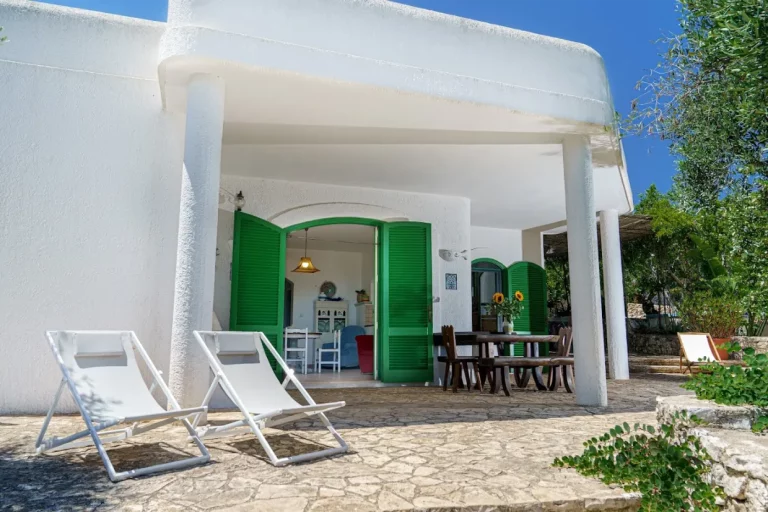 Villa Azzurra / Villa Panoramasleeps 7
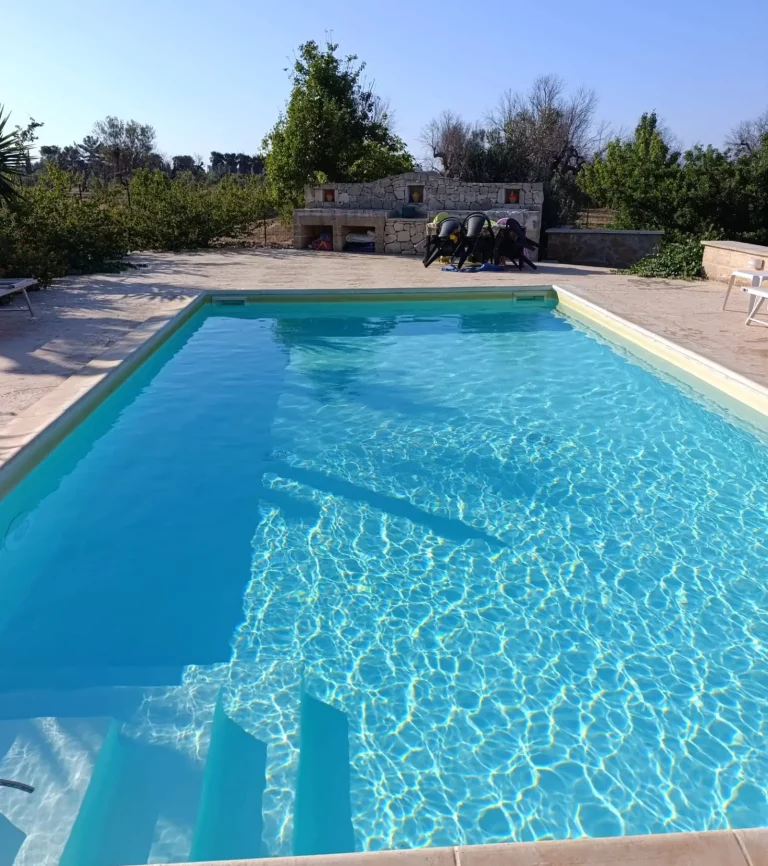 Villa D’Eramosleeps 4 · pool
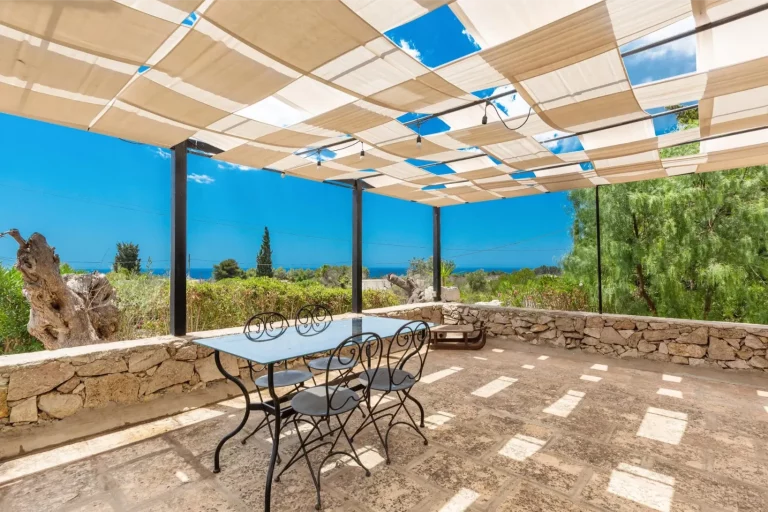 Love Passion con Piscina – Unit 3 – Pescolusesleeps 2
The sea at Corsano and who it suits
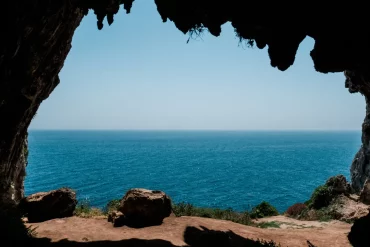
Corsano has about 4 km of coast, all high and rocky, on the wildest stretch of the coast road between Tricase and Leuca. The cliffs, covered with Mediterranean scrub, holm oaks and pines, drop sheer into a deep, crystal-clear sea; along the coast there are underwater and above-water caves, some used since the Palaeolithic. The localities have old names: Scalamasciu, Funnuvojere, Scala Preula and Guardiola. You reach the sea on foot, down steps and paths: at the Guardiola, 4.8 km from the village (8 minutes by car), a flight of steps leads from the coast road to the rocks by the sea; at Funnuvojere you swim from a small cove among the rocks.
Just to the south begins Marina di Novaglie, 5.2 km from the village, with its little harbour cut into the rock, swimming from the low rocks and the Sentiero delle Grotte Cipolliane: until 2010 part of it belonged to Corsano, today it belongs to Alessano. Read our guide to Marina di Novaglie.
The sea at Corsano is perfect for strong swimmers, for snorkelling and for people who love walking between sea and countryside. It is less suited to those travelling with small children or who have difficulty walking, because to reach the water you go down steps and over rocks, and the water gets deep straight away.
Free beach and facilities
There are no sandy beaches on the Corsano coast: you swim freely from the rocks. Do not count on beach clubs or kiosks: check facilities and parking along the coast road on site, and bring water, a small umbrella and water shoes. For a meal after the sea there are bars and restaurants in the village; for more choice there are Tricase and Santa Maria di Leuca. The nearest sandy beaches are on the Ionian coast, such as Pescoluse, 14.5 km away (22 minutes).
Corsano vs other towns in the Capo di Leuca
In the Capo di Leuca the towns are very close to each other. Here is a practical comparison to help you choose:
Corsano vs Alessano
- Corsano: a smaller, more intimate village, with the Salt Roads, the tower and the high coast of the Guardiola a few minutes away
- Alessano: a larger historic centre, with Renaissance palazzi and the places of don Tonino Bello
Corsano vs Tricase
- Corsano: peace and quiet, paths and a wild sea
- Tricase: a small town with more shops and services, the harbour and Marina Serra
Corsano vs Santa Maria di Leuca
- Corsano: a real village, off the tourist trail, with nature on the doorstep
- Leuca: the lighthouse, the de Finibus Terrae sanctuary, the seafront, the boats to the caves and all the services of a seaside resort
When to choose Corsano: if you love walking, are looking for clear, uncrowded water and a quiet base between Tricase and Leuca.
When to choose somewhere else: if you want an umbrella and sunbed on the sand, look at the beaches on the Ionian coast, such as Pescoluse and the Maldives of Salento.
Practical tips
Explore the centre in the morning or late afternoon: in summer it is very hot in the middle of the day and the churches may be closed. Dress appropriately to enter churches and respect services. The Salt Roads and the coast are all in full sun: set off early, with closed shoes, plenty of water and a hat, and remember that the way back to the village is uphill.
For a swim at the Guardiola or at Funnuvojere bring water shoes and a mask. If the sea is rough, do not go down onto the rocks: waves come in suddenly and getting out of the water becomes difficult. Along the coast road, only stop where parking is allowed.
Useful practical information
| 📍 Where | Corsano (Lecce), in the Capo di Leuca, 5 km from the sea at the Guardiola, 12 km from Santa Maria di Leuca and 59 km from Lecce |
|---|---|
| 🚗 Parking | In the streets around the centre, which you explore on foot; on the coast in the spaces along the coast road, in August arrive early |
| ♿ Access | Centre with narrow streets, to explore on foot; you go down to the sea by steps and paths, not suitable for pushchairs |
| 🏖 Beach | No sand: swimming from the rocks at the Guardiola and Funnuvojere; sandy beaches on the Ionian coast, about 15 km away |
| 🌊 Sea | Deep and crystal clear; suits confident swimmers |
| 👟 What to bring | Closed shoes for the paths, water, a hat, water shoes and a mask |
| 🍴 Food | Bars and restaurants in the village; more choice in Tricase and Leuca |
| 📅 Best time | May, June and September; late July-early August for the feast of San Biagio |
When to go and how much time to plan
April and May: the ideal time for the Salt Roads and the coast, with green countryside, the scrub in bloom and mild temperatures. On 1 May there is the Santa Maura country fair.
June: the sea is already pleasant, the Guardiola is quiet and the days are very long.
July and August: the liveliest time, with the big summer feast of San Biagio. It is hot: walk and explore the village early in the morning or in the evening, and arrive early for a swim.
September: in our opinion the best month. The sea is still warm, there are fewer people and walking is a pleasure again.
October to March: Corsano is lived as an everyday village. It is the time of the winter feasts, San Biagio in February and Carnival, and of walks on the paths; when storms hit, the coast is a spectacle, to be watched from a distance.
Events and festivals (indicative dates, check them every year on SalentoMe):
- Feast and fair of San Biagio: around 3 February, with the blessing of throats, the «focareddha» bonfire lit in Piazza San Biagio, the fair and the procession
- Carnival of Corsano and the Capo di Leuca: on the days of Carnival, between February and March, with masked groups competing for the Pro Loco trophy
- Santa Maura fair: 1 May, in front of the chapel in the countryside
- Summer feast of San Biagio: three days between late July and early August, with illuminations, procession, bands and fireworks; it has been recognised as intangible cultural heritage of Puglia
- Feast of San Bartolomeo: 24 August
- Fair of the Santi Medici: 26 September
How much time to allow: half a day is enough for the centre; a whole day if you add the Salt Roads, the tower and a swim at the Guardiola. With three or four days you can add Novaglie, the Ciolo, Leuca and Tricase. A typical day:
- 7:30: on foot along the Salt Roads to Torre Specchia Grande, before the heat
- 10:30: a swim from the rocks at the Guardiola
- 13:30: lunch in the village or at Novaglie
- 17:00: Santa Sofia, San Biagio and the chapels in the centre
- 18:30: the Castello Capece and a stroll through the squares
- 20:00: sunset from the Guardiola viewpoint over the Canale del Rio
- 21:00: dinner in town
Surroundings and extra ideas
Corsano is in the heart of the Capo di Leuca: in a few minutes you can reach the Adriatic coast, the Ionian coast and the other inland villages. Distances and driving times from the centre of Corsano are approximate.
Marina di Novaglie (5 km, 8 minutes): the little harbour cut into the rock, swimming from the rocks and the Sentiero delle Grotte Cipolliane. Read our guide to Marina di Novaglie.
Alessano (4 km, 5 minutes): the Chiesa Madre that was once a cathedral, the Renaissance palazzi, the tomb of don Tonino Bello and Montesardo on the hill. Read our guide to Alessano.
Marina Serra and Tricase (5-6 km, 7-8 minutes): the tower of Marina Serra with its famous natural pool, closed to swimming by an ordinance of 2026 (check before you go), and the centre of Tricase. Read our guide to Marina Serra.
Gagliano del Capo and the Ciolo (5-7 km, 8-11 minutes): the village with its historic centre and the Ciolo gorge, with the bridge and the little pebble bay. Read our guides to Gagliano del Capo and the Ponte del Ciolo.
Santa Maria di Leuca (12 km, 18 minutes): the lighthouse, the de Finibus Terrae sanctuary, the seafront with its nineteenth-century villas and the boats to the caves. Read the guide to Santa Maria di Leuca.
Pescoluse and the Ionian coast (15 km, 22 minutes): the white sandy beaches and the shallow sea of the Maldives of Salento, ideal with small children.
Castro (18 km, 25 minutes): the village on the hill with its castle and the harbour where boats leave for the caves, along the coast road to the north.
Local tip
Corsano faces east: if you wake up early, head down towards the coast for the sunrise. From the Guardiola viewpoint or the terraces around Torre Specchia Grande the sun rises out of the sea, and the morning light lights up the pale rock of the cliffs.
Walk the Salt Roads the opposite way to how the people of Corsano did: go down to the sea on foot, have a swim and then climb back up at your own pace, perhaps getting someone to pick you up by car on the coast road. That way you will really understand why they were called «calcagni induriti».
If you are in the area between late July and early August, do not miss the evening of the feast of San Biagio: the village lights up with illuminations and the whole community comes out into the square. It is the best way to get to know the soul of Corsano.
FAQ
Where is Corsano?
In the Capo di Leuca, in the province of Lecce, on the Adriatic coast, between Tiggiano, Alessano and the sea. Santa Maria di Leuca is about 12 km away, Tricase 6 km and Lecce about 59 km.
What to see in Corsano?
In the village, the church of Santa Sofia, the church of San Biagio, the Immacolata, the chapels in the centre and the Castello Capece; outside the centre, the Salt Roads, Torre Specchia Grande, the Canale del Rio with the ruins of the Torre del Ricco, the Guardiola viewpoint and the chapel of Santa Maura.
Does Corsano have a sea?
Yes: the municipality has about 4 km of high, rocky coast, about 5 km from the village, with the localities of Guardiola and Funnuvojere. There are no sandy beaches: you go down by steps and paths and swim from the rocks, in a deep, crystal-clear sea.
What are the Salt Roads of Corsano?
They are ancient paths of stone and packed earth that run down from the village to the sea among olive trees and dry-stone walls. Until the early 20th century the people of Corsano used them to carry the salt gathered on the cliffs back to the village; today they are routes to walk, best in spring and autumn.
Can you visit Torre Specchia Grande?
The 16th-century tower can be seen from outside, with the view along the coast from Punta Palascia to the Ciolo. Restoration began thanks to a volunteer association and events and workshops are held there from time to time: check on site whether it is open.
Is Marina di Novaglie part of Corsano?
Not any more: until 2010 part of Novaglie belonged to Corsano, today it is the seaside village of Alessano. It lies just south of the Corsano coast, about 5 km from the village.
When is San Biagio celebrated in Corsano?
Twice a year: around 3 February, with the focareddha and the fair, and in summer, with three days of celebrations between late July and early August. The dates change every year: check them before you set off.
When is the best time to go?
May, June and September, when walking is pleasant and the sea is already, or still, pleasant. Between late July and early August there is the summer feast of San Biagio.
Where to stay in Corsano?
On the Corsano coast, in the Guardiola district, there is Salento Prime’s Villa Azzurra / Villa Panorama: up to 7 guests, three double bedrooms, 2 bathrooms, a garden and a sea view, 1.7 km from Novaglie. Tricase and Santa Maria di Leuca are also convenient bases for discovering the Capo di Leuca.
Conclusion
Corsano is the Capo di Leuca of real villages: quiet squares, churches and chapels tied to an ancient devotion, a castle with its legends and, a few minutes away, one of the highest and wildest coasts in Salento. Walk down to the sea along the Salt Roads, climb up to Torre Specchia Grande and stop at the Guardiola viewpoint: you will understand why people come back here.
If you want to stay on the Corsano coast, in the Guardiola district, you will find our Villa Azzurra / Villa Panorama: up to 7 guests, three double bedrooms, 2 bathrooms and a 200-degree sea view. You will find our houses in the area on the page holiday homes in Novaglie and Marina di Corsano.
Discover the available accommodations with Salento Prime. To best organize your base and transfers, contact us here or start a chat on WHATSAPP.
Cover photo: Falk2, CC BY-SA 4.0, via Wikimedia Commons, cropped