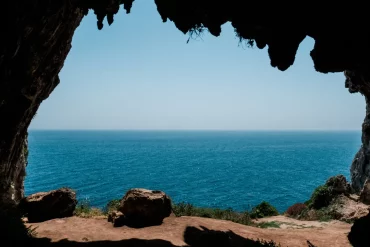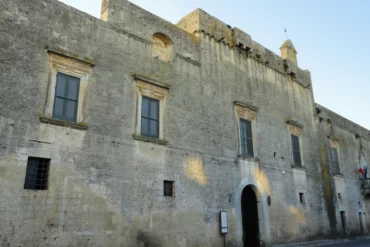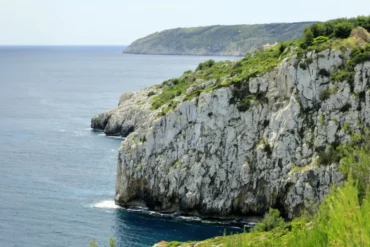
On almost every point of the Salento coast there is a stone tower: have you ever wondered why? This guide tells you about the coastal towers of Salento: when and why they were built, how they passed on the alarm with fires, smoke and messengers on horseback, how to recognise them by their shape and which ones are really worth seeing starting from our houses in Lido Marini, from Torre San Giovanni to Santa Maria di Leuca and up the Adriatic coast to Otranto, with practical tips and local curiosities.
In short
The coastal towers of Salento are watchtowers built mainly in the 16th century, when Salento was part of the Kingdom of Naples ruled by the Spanish viceroys, to defend the coast from raids by the Turks and corsairs. From each tower you could usually see the two neighbouring ones, and the alarm ran along the coast with fire and smoke signals, while the cavallari, the mounted guards, warned the inland towns. Many are round, shaped like a truncated cone, others square. Today some are restored, many are ruins and almost all can only be seen from outside. Near our houses in Lido Marini are Torre Pali, Torre Vado and Torre Mozza.
What are the coastal towers of Salento?
They are the guard towers that dot the Salento coast, from the Ionian to the Adriatic, often just a few kilometres apart. They were part of the great system of coastal towers of the Kingdom of Naples: an inventory of 1748 counted 379 in the whole Kingdom, 80 of them in Terra d’Otranto, the old province that Salento belonged to. Many gave their name to the seaside villages that grew up around them, such as Torre San Giovanni, Torre Mozza, Torre Pali and Torre Vado.
Along the coast of southern Salento the towers are everywhere: one rises from the sea in front of the beach of Torre Pali, one stands on a lawn in Torre Mozza, one has become the black-and-white chequered lighthouse of Torre San Giovanni, others are ruins among the Mediterranean scrub, high on the cliffs of the Capo di Leuca. Seen one after another, they tell the same story: for centuries pirates could arrive from the sea, and someone always had to stand guard.
You don’t need to be a history buff to appreciate them: the towers almost always stand at the most scenic points of the coast, and looking for them is a great way to discover the lesser-known Salento, among sandy beaches, cliffs and small harbours. In this guide you will find the history in brief, how the system worked, how to recognise the towers by their shape and a practical itinerary, tower by tower, with the distances from our houses.
Curiosities and atmosphere
Guard towers on the coasts already existed in the Middle Ages, and it was the Angevins who first thought of a continuous network of towers, each in sight of the next, that would pass on smoke and fire signals. But the project remained largely on paper. So, in the summer of 1480, no warning reached Otranto: on the morning of 28 July the Ottoman fleet was in front of the city, the soldiers landed in the bay that has been called Baia dei Turchi ever since, and on 11 August they entered the city. On 14 August, 813 inhabitants were killed for refusing to convert to Islam: they are the Martyrs of Otranto, proclaimed saints in 2013.
The real system was born in the 16th century, under the Spanish viceroys. In 1532-33 the viceroy Pedro di Toledo, who governed the Kingdom on behalf of the emperor Charles V, ordered the municipalities to build watchtowers at their own expense against attacks from the sea. In 1563 the viceroy Pedro Afán de Ribera, sent to Naples by the government of Philip II, launched the «general construction» of the towers: the State made the decisions, the royal engineers chose the right spots and from 1567 every family in the towns within twelve miles of the coast paid a tax of 22 grana. The danger was real: Castro, on the Adriatic coast, was besieged and sacked by the Turks in 1537 and again in 1573.
In each tower there were the torrieri, the soldiers on guard, sometimes Spanish corporals: at Torre Nasparo the first torriero was corporal Gio. Martinez, appointed in 1583, and at Torre Specchia Grande in 1626 a corporal was killed by lightning. The towers, however, were expensive: a report of 1590 counted 339 in the Kingdom, but many were already showing the first signs of giving way, because of poor workmanship and the meagre pay of the torrieri and cavallari. Around 1846 Ferdinand II, King of the Two Sicilies, disarmed the towers: over time some became customs posts, others lighthouses or private houses. The saying «mamma li turchi!», still used to say that trouble is coming, dates back to those very centuries.
Where it is and how to reach it
The coastal towers mark the whole coast of Salento, on the Ionian and on the Adriatic. In this guide we focus on southern Salento, around our houses: on the Ionian coast from Torre San Giovanni to Santa Maria di Leuca, then along the Adriatic coast of the Capo di Leuca as far as Otranto. From Lido Marini the tower of Torre Pali is less than 2 km away, Torre Vado about 6 km, the Torre dell’Omomorto in Leuca 14 km, Marina Serra 24 km and Otranto about 60 km.
By car: it is the easiest way to see many of them in a short time. On the Ionian side the coast road links Torre San Giovanni, Torre Mozza, Lido Marini, Torre Pali and the seaside villages as far as Torre Vado; from Santa Maria di Leuca the coast road climbs up the Adriatic coast to Otranto and passes many towers. Stop only in lay-bys and car parks: many towers are right by the road, near bends or private entrances.
By public transport: in summer the «Salento in Bus» lines connect many seaside villages; in 2026, for example, line 108 Lecce – Gallipoli – Santa Maria di Leuca also stopped at Torre Mozza and Torre Vado. Check the routes and timetables for the current year before you set off. For the towers on the Adriatic cliffs you will still need a car or a bicycle. The most convenient airport is Brindisi.
What to do and what to see
Here are the towers to see starting from our houses in Lido Marini, in the order you come across them along the coast: first the Ionian, then Santa Maria di Leuca and the Adriatic coast up to Otranto. Distances and driving times from Lido Marini are approximate.
1. Torre Pali, the tower in the sea (30 minutes)
The closest to our houses, 1.8 km from Lido Marini (3 minutes by car). The tower of Torre Pali was completed in 1563 and takes its name from the wooden poles (pali) that the sea left on the beach after storms. Today it is a round stump of stone, largely collapsed, rising from the water a few metres from the shore. 500 metres away lies the Isola della Fanciulla, linked to the legend of a girl kidnapped by the corsair Dragut during a raid. Read our guide to theIsola della Fanciulla and Torre Pali. Look at it from the beach, especially at sunset, and do not climb on the remains.
2. Torre Mozza and Torre San Giovanni (1-2 hours)
Torre Mozza (6.4 km, 10 minutes) is a truncated cone of stone on a lawn a few steps from the beach. At the top the fire was lit to warn the nearby towers, while on the first floor the guards kept the horses ready to ride to Ugento. Its old name was Torre dei Fiumi or Torre Fiumicelli: it collapsed as soon as it was finished, was rebuilt, and later collapses left its top «mozza» (truncated). Sources date its construction to 1565 or to 1583-1584. Read our guide to Torre Mozza.
Torre San Giovanni (12 km, 18 minutes) stands on a small promontory in the heart of the village and is the only octagonal tower on this stretch of coast. It has been turned into a lighthouse, and its cladding of large black and white checks makes it visible from far away, even from the sea. It belongs to the Italian Navy and houses the Coast Guard, so you see it from outside; at its foot there are stretches of Messapian walls from about 2,500 years ago. Read our guide to Torre San Giovanni.
3. Torre Vado and Torre San Gregorio (1 hour)
Torre Vado (5.7 km, 7 minutes) is a tower with a round base on two floors, with windows and loopholes at the top, next to the small harbour. It was a «torre cavallara»: being close to Salve, it had a mounted messenger ready to carry the alarm to the inland towns. In a text of 1619 it appears as Torre Mattefante. After the disarmament it became a customs checkpoint; in 1930 it was bought by private owners and in 1935 restored, so today you see it from outside. Read our guide to Torre Vado.
A little further east, at Marina di San Gregorio (9.6 km, 11 minutes), the 16th-century tower was partly destroyed in a Saracen attack and later demolished: a private house now stands in its place. The name of the seaside village remains; it was the ancient port of the Messapian town of Vereto.
4. Santa Maria di Leuca: Torre Marchiello and Torre dell’Omomorto (1-2 hours)
Between Felloniche and Leuca, on a point 12 metres above the sea near the Tre Porte, stand the ruins of Torre Marchiello (11.7 km, 15 minutes), also called Torre Imbriachelli, shaped like a truncated cone. At the start of the Leuca seafront, on the other hand, rises the Torre dell’Omomorto (13.8 km, 19 minutes), which Luigi Tasselli dates to 1555. Because of its position it was the only tower in Salento in sight of both coasts: it communicated with Torre Marchiello on the Ionian and with the tower of Santa Maria di Leuca on the Adriatic, now gone, where the lighthouse stands today. It has a truncated-cone base topped by a cylindrical body with a crenellated terrace for the cannons; the name comes from the human bones found in a nearby cave. It was abandoned in 1846 and restored after 1878. Read our guide to Punta Ristola.
5. Novaglie, Torre del Ricco and Torre Specchia Grande (half a day)
On the Adriatic coast, at Marina di Novaglie (25.9 km, 30 minutes), above the Grotta del Diavolo stand the ruins of the Torre del Porto, built around 1560 by Giovanni Vincenzo Spalletta of Nardò. When it was partly rebuilt, around 1610, the masons were allowed to mix the lime with seawater, and that is probably what ruined it: by 1777 it was already in ruins. Read our guide to Marina di Novaglie.
A little further north, on the cliff 62 metres above the sea, only part of the base of Torre del Ricco remains (25.5 km, 29 minutes), built between 1563 and 1569. Higher up, about 150 metres above the sea and 350 metres from the shore, is the Torre Specchia Grande of Corsano (27.3 km, 33 minutes), built around 1563 at the town’s expense: a document of 1584 puts its cost at 217 ducats. It stayed in use much longer than other towers, eventually becoming a customs post in the mid-19th century, and today it periodically hosts cultural events and workshops: check first whether it is open.
6. Torre Nasparo, Torre Palane and Torre del Sasso (half a day)
Torre Nasparo (21.6 km, 30 minutes), in Tiggiano, was built in 1565 on a rocky spur 129 metres above the sea, from which the view reaches as far as the Capo d’Otranto; it has a truncated-cone base 11 metres wide, while the upper part has almost entirely collapsed. At Marina Serra (23.7 km, 34 minutes) the Torre Palane, 15 metres high, is built of sandstone blocks quarried on the spot: it has a truncated-pyramid base topped by a square body crowned with stone corbels, and it has been restored. It overlooks the natural pool, closed to swimming since February 2026. Read our guide to Marina Serra.
Above Tricase Porto, on the ridge of the Serra del Mito 116 metres above the sea, is the Torre del Sasso (27.6 km, 42 minutes), documented from 1584: it too is square on a truncated-pyramid base, and today it is partly in ruins. All three lie within the Parco Naturale Regionale Costa Otranto – Santa Maria di Leuca e Bosco di Tricase.
7. From Andrano to Otranto (one day)
Going up the coast, of the tower at Marina di Andrano (30.3 km, 44 minutes) only the cistern remains, and Torre Capo Lupo, above Marittima (32.7 km, 48 minutes), is a private ruin 105 metres above the sea: perhaps built between the end of the 15th and the beginning of the 16th century, it would be one of the oldest in Salento. At Castro Marina the ruin of Torre Diso (34.7 km, 49 minutes), square in plan, recalls the sackings of 1537 and 1573. At Porto Miggiano (39.5 km, 55 minutes) the truncated-cone tower still watches over the small harbour: the records preserve the names of its torrieri, from 1583 to 1777.
Further north, the Torre Minervino in Santa Cesarea Terme (44.5 km, 60 minutes) looks out as far as Punta Palascia, and the Torre Sant’Emiliano (48.3 km, 67 minutes), shaped like a truncated cone, stands 50 metres above the sea between Porto Badisco and Punta Palascia: it needs restoration, so you see it from outside, and you can also reach it on a path from Porto Badisco. Read our guide to Porto Badisco. Finally, at the gates of Otranto, the Torre del Serpe (59.9 km, 70 minutes) is perhaps the oldest of all: it is thought to have been a Roman lighthouse, restored in the time of Frederick II. Only one wall remains, but the legend of the snake that climbed up to drink the oil of the lantern has put it on Otranto’s coat of arms. Read our guide to Otranto.
Salento Prime holiday homes: pick your dates and see at once which are free.
 LE SECCHE SUITE & HOUSE – 5sleeps 4
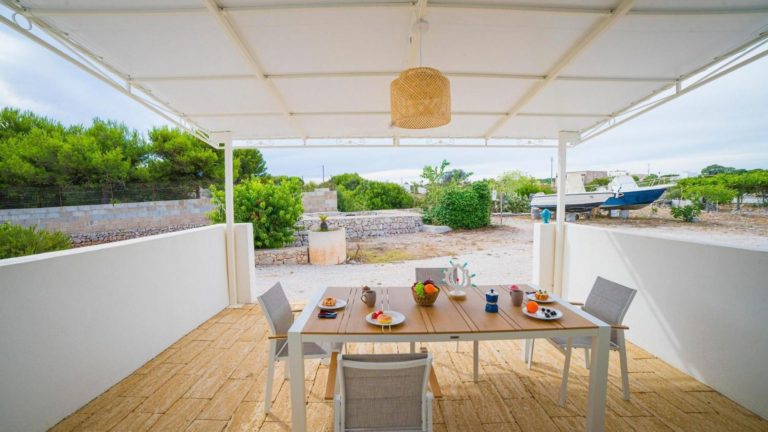 LE SECCHE SUITE & HOUSE – 6sleeps 3
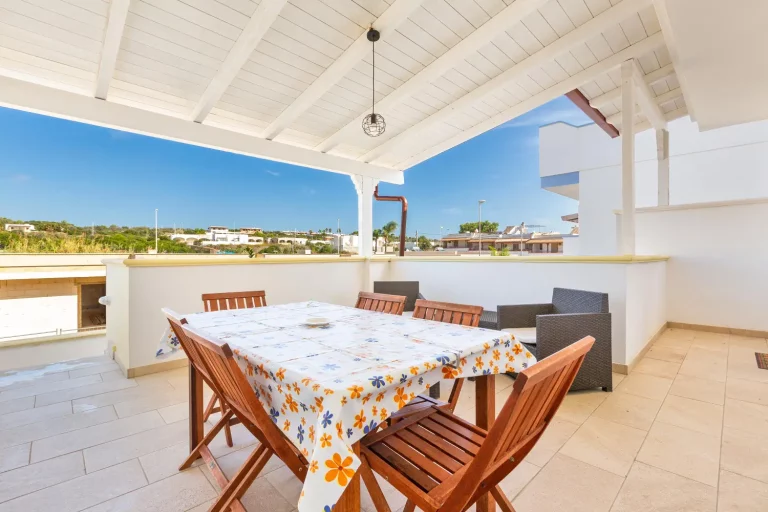 Blu Apartment – First Floorsleeps 4
Shapes, stones and who they suit
Not all towers are the same. Scholars divide those of the Kingdom of Naples into four building phases: before 1532, between 1532 and 1563, between 1563 and 1594, and after 1594. The shapes change too: medium-sized square towers «of the Viceroyalty type», large quadrangular towers known as «a masseria» (like a farmhouse), cylindrical towers and, more rarely, star-shaped towers.
In southern Salento you will mainly see round towers with a truncated-cone base, that is, wider at the bottom, such as Torre Mozza, Torre Pali, Torre Vado, the Torre dell’Omomorto, Torre Nasparo and Torre Sant’Emiliano. Others are square on a truncated-pyramid base, such as Torre Palane, the Torre del Sasso and Torre Diso, and Torre San Giovanni is octagonal. Usually the ground floor held a water cistern and the first floor the torrieri’s room, with the entrance on the landward side; above the door, sometimes, a machicolation allowed it to be defended from above. The stones are local: blocks of carparo, sandstone quarried next to the tower, or irregular rubble bound with red earth.
The towers are perfect for those who love history and landscapes, for photographers, for anyone who walks or cycles along the coast and for families who want to add a curiosity to a day at the beach. They are less suited to those looking for museums and indoor visits, because almost all of them are closed, and to small children on the high Adriatic cliffs, where you need care and closed shoes.
Visits, beaches and services
Most of the towers can only be seen from outside: Torre San Giovanni houses the Coast Guard, Torre Vado and Torre Capo Lupo are private, and many others are ruins or in poor condition. We have found no sources on regular opening hours; the Torre Specchia Grande hosts cultural events and workshops now and then, so check the announcements before you go.
Near the Ionian towers you will find sandy beaches with free stretches, as at Torre Pali and Torre Mozza, and bars and restaurants in the seaside villages. On the Adriatic the towers are often isolated along the coast road, with no services nearby: for food there are Leuca, Tricase Porto, Castro and Otranto. Always bring water and a hat.
Ionian towers vs Adriatic towers
In southern Salento the towers are very close together, but the two coasts are very different. Here is a practical comparison to help you choose:
Ionian towers vs Adriatic towers
- Ionian: on the shore, almost at sea level, inside the seaside villages, with the sandy beach a stone’s throw away
- Adriatic: high on the cliffs, up to 150 metres above the sea, with sweeping views and the Mediterranean scrub all around
Round towers vs square towers
- Round: the most common around here, with a truncated-cone base, such as Torre Mozza and Torre Vado
- Square: the model chosen by the Viceroyalty, on a truncated-pyramid base, such as Torre Palane and the Torre del Sasso
Half a day vs a full day
- Half a day: Torre Pali, Torre Mozza, Torre Vado and Torre San Giovanni, all within 12 km of Lido Marini
- A full day: from Leuca to Otranto along the Adriatic coast road, stopping at every tower
When to choose the Ionian towers: if you are travelling with children and want to combine the towers with the beach and the sunset over the sea.
When to choose the Adriatic towers: if you love views from above, cliffs and walks; for the caves and the deep sea of this coast read our guide to Marina di Novaglie.
Practical tips
Do not climb on the ruins and do not enter closed towers: many are unsafe and some are private property. Look at them from public roads and paths, without climbing over fences. On the Adriatic cliffs keep away from the edge, especially when it is windy, and in rough seas do not go near the tower of Torre Pali.
Choose the right light: the Ionian towers look their best at sunset, the Adriatic ones, which face east, early in the morning. And play the torrieri’s game: from one tower, look for the two neighbouring ones, just as the guards who passed on the alarm used to do.
Useful practical information
| 📍 Where | All along the coast of southern Salento; from Lido Marini Torre Pali is 1.8 km away, Leuca 14 km, Otranto 60 km |
|---|---|
| 🚗 Parking | In the streets of the seaside villages and in the lay-bys along the coast road; never on a bend or in front of private entrances |
| ♿ Access | Ionian towers easy, near roads and beaches; Adriatic towers often high up, with short stretches on uneven ground |
| 🏖 Beach | Sand next to Torre Pali and Torre Mozza; rocks and cliffs on the Adriatic |
| 🌊 Sea | Shallow and sandy on the Ionian, deep and rocky on the Adriatic |
| 👟 What to bring | Closed shoes, water, a hat, binoculars and a camera |
| 🍴 Food | Bars and restaurants in the seaside villages, from Torre San Giovanni to Otranto; almost nothing next to the isolated towers |
| 📅 Best time | Spring and autumn; in summer early in the morning or at sunset |
When to go and how much time to plan
April and May: the ideal time for the Adriatic towers, with mild temperatures, the Mediterranean scrub in bloom and clear light for photos.
June: very long days, the sea already pleasant and late sunsets behind the Ionian towers.
July and August: it is hot and there is no shade near the towers: go early in the morning or towards evening and combine the visit with a swim. There are summer festivals in the seaside villages, including at the foot of the towers.
September and October: in our opinion the best months. There are fewer people, the sea is still warm and the low afternoon light makes the stone warm and golden.
November to March: the seaside villages are almost deserted and the towers have a charm all their own. When storms hit, the waves around Torre Pali are a spectacle, but one to watch from a distance.
Events and festivals (indicative dates, check them every year on the Ugento municipality website and on SalentoMe):
- Summer food festival below the tower of Torre Mozza: two evenings of traditional food and music between late July and early August (the name and dates change from year to year)
- Festa dell’Emigrante in the little square below the tower of Torre San Giovanni: usually the first week of August
- Open-air nativity scene at the foot of the tower of Torre San Giovanni: over the Christmas period
How much time to allow: half a day is enough for the Ionian towers near Lido Marini; one day for Leuca and the Adriatic coast up to Tricase; another for the stretch from Andrano to Otranto. A typical day on the Adriatic:
- 7:30: Torre dell’Omomorto in Santa Maria di Leuca, in the morning light
- 9:00: the ruins of the Torre del Porto in Novaglie and of Torre del Ricco
- 10:00: Torre Specchia Grande and the view over the coast
- 11:30: Torre Palane at Marina Serra
- 13:00: lunch at Tricase Porto
- 16:00: Torre Miggiano and the coast between Castro and Santa Cesarea Terme
- 18:00: Torre Sant’Emiliano and Torre del Serpe
- 20:00: dinner in Otranto
Surroundings and extra ideas
The towers are also a good excuse to discover the towns and places they protected. Distances and driving times from Lido Marini are approximate.
Torre Suda and Torre del Pizzo (22-28 km, 30-40 minutes): going up the Ionian coast beyond Torre San Giovanni you will find two more restored round towers, at Torre Suda, in the municipality of Racale, and at Torre del Pizzo, at the gates of Gallipoli.
Ugento (16 km, 19 minutes): the town that Torre Mozza and Torre San Giovanni belong to, which the mounted guards rode to warn, with its castle and archaeological museum.
The lighthouse of Santa Maria di Leuca (16.5 km, 19 minutes): it stands where the tower of Santa Maria di Leuca, which communicated with the Torre dell’Omomorto, once stood.
Otranto and the Martyrs’ chapel (57.5 km, 67 minutes): in the Cathedral, at the end of the right-hand nave, the chapel keeps the relics of the inhabitants killed in 1480, the most tragic memory of the raids the towers were meant to defend the coast against.
Lido Marini and the seaside villages of Salve: the ideal base for the Ionian towers, among sandy beaches and dunes, with Torre Pali and the Maldives of Salento a few minutes away.
Local tip
Start with the nearest tower: in the evening, walk down to the beach of Torre Pali and wait for the sunset in front of the tower rising from the sea. It is the best way to understand how much the sea has changed this coast.
The next day go to Leuca, to the Torre dell’Omomorto: it is the only tower in Salento from which both coasts could be seen. Look around and try to imagine the smoke rising from here and running, from tower to tower, towards Gallipoli on one side and towards Otranto on the other.
And if you pass through Torre Mozza between late July and early August, look for the food festival below the tower: eating outdoors at the foot of a 16th-century sentinel is an experience that stays with you.
FAQ
What are the coastal towers of Salento?
They are watchtowers built along the coast, mainly in the 16th century, to spot the ships of the Turks and corsairs in time and raise the alarm. They were part of the coastal tower system of the Kingdom of Naples.
When and why were they built?
After the sack of Otranto in 1480, the Spanish viceroys of Naples ordered the towers: first Pedro di Toledo in 1532-33, in the time of Charles V, and then Pedro Afán de Ribera from 1563, in the time of Philip II, with the general construction decided by the State. Many towers of southern Salento date from the years between 1563 and 1590.
How did the towers communicate with each other?
From each tower you could usually see the two neighbouring ones: in case of danger the torrieri lit fires and made smoke signals, which passed from tower to tower along the coast.
Who were the cavallari?
They were the mounted guards of the so-called torri cavallare: when a threat came from the sea, they galloped off to warn the inland towns. Torre Vado was one of these towers.
How many coastal towers are there in Salento?
An inventory of 1748 counted 80 towers in Terra d’Otranto, the old province that included Salento, out of 379 in the whole Kingdom of Naples. Today some are restored, many are ruins and of others no trace remains.
Why are some towers round and others square?
It depends on the period and the design: in southern Salento many towers are round, with a truncated-cone base, while others follow the square Viceroyalty model on a truncated-pyramid base, such as Torre Palane and the Torre del Sasso.
Can you visit them inside?
Usually not: almost all of them can only be seen from outside, because they are private, used by public bodies or unsafe. The Torre Specchia Grande in Corsano hosts cultural events now and then. Never climb on the ruins.
Which is the closest coastal tower to Lido Marini?
The tower of Torre Pali, less than 2 km away: it rises from the sea a few metres from the beach. Torre Vado and Torre Mozza are about 6 km away, the Torre dell’Omomorto in Leuca 14 km.
Where to stay to see the towers of southern Salento?
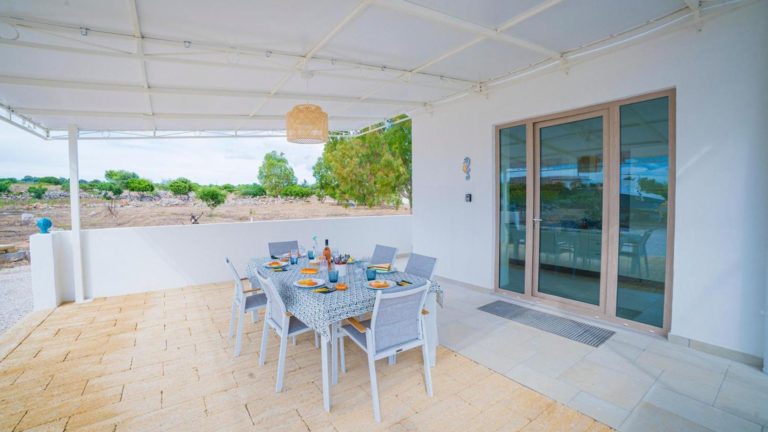
Between Lido Marini and Torre Pali there is Salento Prime’s Le Secche Suite & House – 5: 4 guests, an equipped terrace and private parking, a few minutes from the Ionian towers and about twenty minutes from Santa Maria di Leuca.
Conclusion
The coastal towers are the stone sentinels of Salento: born to defend the coast from Turkish and corsair raids, built under the Spanish viceroys in the 16th century and today partly restored, partly reduced to ruins among the scrub. Look for them along the coast, from the tower in the sea at Torre Pali to the chequered lighthouse of Torre San Giovanni, up to the cliffs of the Capo di Leuca and Otranto: look at them from outside, in the light of dawn or sunset, and try to spot the next tower.
If you want to stay a few minutes from the Ionian towers, between Lido Marini and Torre Pali you will find our Le Secche Suite & House – 5: 4 guests, an equipped terrace and private parking, less than 1 km from the sea. You will find our houses in the area on the page holiday homes in Lido Marini.
Discover the available accommodations with Salento Prime. To best organize your base and transfers, contact us here or start a chat on WHATSAPP.
Cover photo: Fabrizio Garrisi, CC BY-SA 4.0, via Wikimedia Commons, cropped