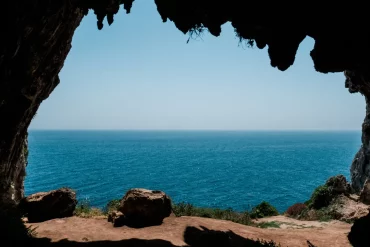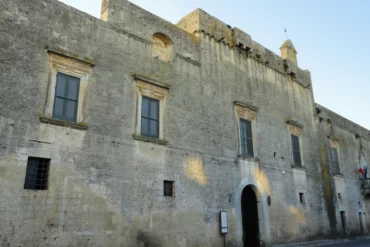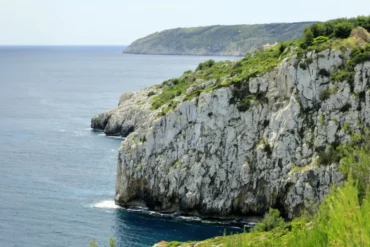
Have you seen, in some photo, that big hole in the ground opening onto a cave and a turquoise sea? It is the Grotta Sfondata, on the coast north of Otranto, in the Baia del Mulino d’Acqua. This guide tells you exactly where it is, what kind of cave it is, how to really see it, that is from the sea and respecting the bans in force on this stretch of cliff, and which are the other sea caves on the Otranto coast, with practical tips and ideas nearby.
In short
The Grotta Sfondata is a semi-submerged sea cave in the municipality of Otranto (Lecce), recorded in the regional cave register of Puglia under number PU 922. It opens in the cliff of the Baia del Mulino d’Acqua, about 3 km north of the centre of Otranto, between Torre Santo Stefano and the Grotta della Monaca. From above you recognise it by the large hole of its collapsed vault. Since December 2023 an ordinance of the Coast Guard (Capitaneria di porto) has banned navigation, stopping, bathing and diving within 50 metres of this cliff, because of the risk of rockfalls: the cave is seen from a distance, from the sea and with a calm sea.
What is the Grotta Sfondata?
It is one of the sea caves on the coast north of Otranto, the stretch that researchers at the University of Salento call «Otranto Nord». The entrance is partly below sea level and the cavity runs horizontally into the cliff for 15-20 metres. The name makes sense when you look at it from above: a few metres from the edge of the cliff, a large, almost round hole opens in the ground, looking right down into the cave and letting the light in.
The coast between Otranto and the Baia dei Turchi is made of low white cliffs, small inlets and emerald water. Within a few hundred metres, around the Baia del Mulino d’Acqua, scientific records list several sea caves: the Grotta Sfondata, the Grotta Verde, the Grotta delle Conchiglie and, a little further south, the Grotta della Monaca. The Sfondata is the best known, because its hole in the ground appears in a great many photos and videos of the area.
But it is a fragile coast. The cliff of the bay has had several collapses, and the Coast Guard has closed the stretch of water below the cliff to boats and swimmers. That is why this guide does not take you inside the cave: it explains where it is, how to see it safely and what to do nearby, from the town of Otranto to the other caves on the coast.
Curiosities and atmosphere
The Grotta Sfondata has a real «identity card»: it is listed in the Cave Register of Puglia, kept by the Federazione Speleologica Pugliese, under number PU 922 and the locality «Le Moniche – Santo Stefano». According to the record, it can be reached from the sea or from land, but only with caving techniques on ropes. A curious fact: in 2015 the cavers could not precisely survey the entrance from the sea, because the coastal authorities did not authorise them to approach and stop with their boat in front of the cave. If the bans apply to them, they apply to us too.
Salento is one of the areas of Italy richest in sea caves. A study by the University of Lecce, «Le grotte marine del Salento» (1999), described 53 of them, divided by sector; in the 2008 census there were already 77. The Grotta Sfondata is one of the «Otranto Nord» caves, together with the Grotta Verde, the Grotta delle Conchiglie and the Grotta della Monaca. Further north, on the headland, stand the ruins of Torre Santo Stefano, built from 1567 onwards to defend the coast from pirates and today inside a holiday village: you see it from outside.
Where it is and how to reach it
The Grotta Sfondata is on the Adriatic coast of Salento, in the municipality of Otranto, about 3 km north of the old town (7 minutes by car), in the Baia del Mulino d’Acqua: it opens in the cliff on the north side of the bay, along via Santo Stefano. To the north the coast continues towards Torre Santo Stefano and the Baia dei Turchi; to the south it heads back towards Otranto past the Grotta della Monaca. Otranto is about 46 km from Lecce.
From the sea: this is the right way to see it. In the warm season, several boat trips leave from the port of Otranto, head north along the coast and pass in front of the Baia del Mulino d’Acqua. Choose only authorised operators, ask before leaving how they respect the 50-metre distance from the cliff, and only set out when the sea is calm. If you go out in your own boat, read the ordinances in force of the Otranto Coast Guard.
From land: on maps, the roads and steps down to the bay mostly cross private property, and we have not found a signposted public access to the cave. The cliff is prone to rockfalls: do not climb down onto the rocks and do not go near the hole or the edge of the cliff, where the ground can give way.
How to get to Otranto: from Lecce, follow the SS16 to Otranto, about 45 minutes without traffic. By train, the Ferrovie del Sud Est run to Otranto station, the end of the line from Maglie; national trains arrive in Lecce. The most convenient airport is Brindisi. In summer the «Salento in Bus» lines connect many places on the coast: check this year’s routes and timetables.
What to do and what to see
You can see the Grotta Sfondata in a short time, but it is the perfect excuse to discover the whole coast of the Otranto caves, north and south of the town. Here are the experiences not to miss.
1. The Grotta Sfondata from the sea (1-2 hours)
From the boat, staying outside the 50-metre strip, you see the white cliff of the Baia del Mulino d’Acqua with the dark opening of the cave on the north side and, in the right light, the emerald colour of the water over the pale seabed. It is an experience for a calm sea, ideally in the morning, together with the other coves of the north coast. Do not enter the cave, neither by boat nor swimming: it is forbidden and dangerous.
2. The «Otranto Nord» caves (1 hour)
In the same bay and nearby there are other semi-submerged caves recorded in the regional register: the Grotta Verde and the Grotta delle Conchiglie, a few metres from the Sfondata, and the Grotta della Monaca, a little further south, towards Otranto. You recognise them as dark openings at the foot of the cliff: the same bans apply here too, so they can only be seen from a distance.
3. Torre Santo Stefano and the Baia dei Turchi (2-3 hours)
Heading north you come to the ruins of Torre Santo Stefano and then the Baia dei Turchi, a small sandy cove enclosed between the pine wood and the sea, inside the protected Alimini area, where according to tradition the Turks landed in 1480. You reach it on foot through the pine wood. Read our guide to the Baia dei Turchi.
4. Otranto and its old town (half a day)
3 km away is Otranto, the easternmost town in Italy: the Cathedral with the great floor mosaic of the Tree of Life and the Chapel of the Martyrs, the Aragonese Castle, the walls and the Byzantine church of San Pietro. Read our guide to Otranto.
5. The caves of Capo d’Otranto (half a day)
South of the town, between the Torre del Serpe, Baia Palombara, Baia dell’Orte and Punta Palascia, the coast hides another group of sea caves, such as the Grotta Lu Fau below the Torre del Serpe and the Grotta Palombara. Many are completely submerged and can only be explored by scuba diving: if you are a diver, rely only on certified diving centres and guides and ask where diving is allowed, because here too some stretches of cliff are off limits due to the risk of rockfalls.
6. Punta Palascia and the lighthouse (1-2 hours)
Punta Palascia is the easternmost point of the Italian peninsula. The lighthouse, first lit in 1867, was abandoned in the 1970s, restored and reopened in 2008. From the road to Porto Badisco a short walk down leads to the lighthouse and the cliff; the interior only opens at certain times, so check first. Here, around the first sunrise of the year, the Alba dei Popoli is celebrated.
7. Porto Badisco and the Grotta dei Cervi (2 hours)
Further south still is Porto Badisco, the small bay where, according to legend, Aeneas landed. Not far away is the Grotta dei Cervi, with its Neolithic paintings: it is closed to the public, but finds and reconstructions can be seen in the Aragonese Castle of Otranto. Read our guide to Porto Badisco.
Salento Prime holiday homes: pick your dates and see at once which are free.
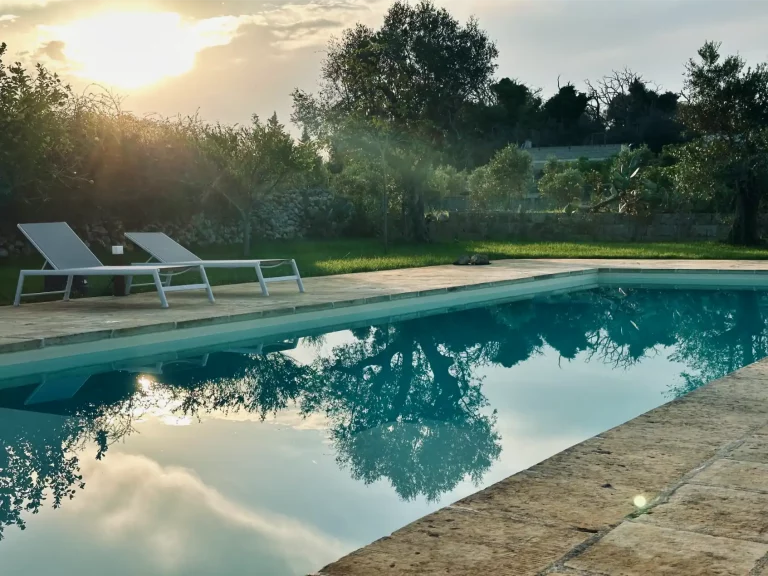 Villetta Arenosa con piscinasleeps 4
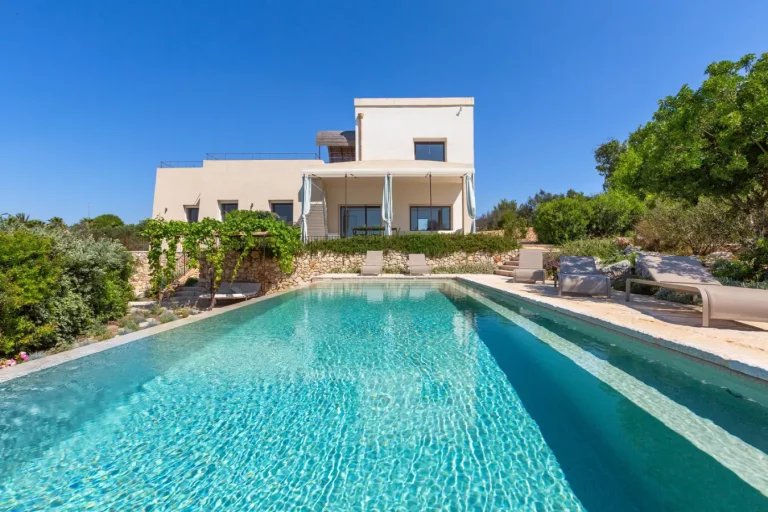 Villa Giada Pescolusesleeps 8 · pool
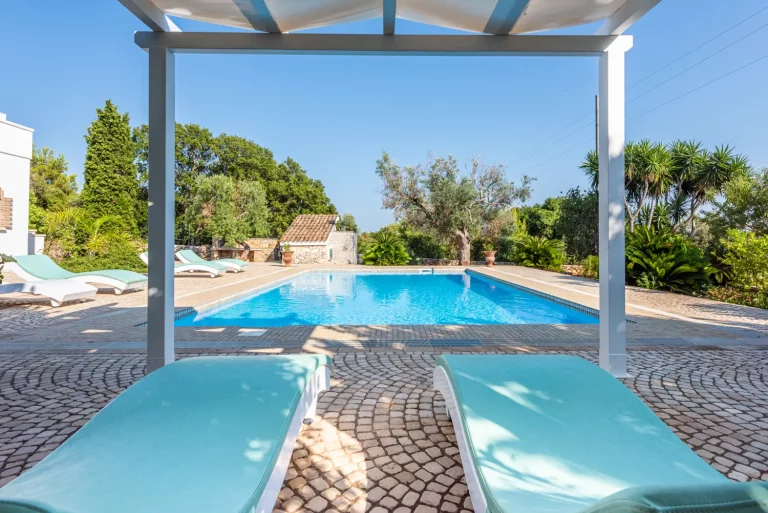 Villa Vanessa of the Southern Dukesleeps 16 · pool
Sea, cliffs and who it suits
The sea of the Baia del Mulino d’Acqua is emerald and turquoise, with a pale seabed you can see from above. The bay is squeezed between cliffs of white, layered rock, with a small sandy beach at the back, below the cliff. But this whole coast is classified as at risk of rockfalls, and the water within 50 metres of the cliff is closed to boats, bathing, fishing and diving.
The Grotta Sfondata appeals to nature and photography lovers, to those taking a boat trip along the coast and to anyone who wants to get to know the wildest side of Otranto. It is not a place for a beach day: if you want a swim, look to the nearby beaches.
Free beach and facilities
There are no facilities at the cave and no beach where you can swim safely: the small beach in the bay is below the cliff, inside the banned area. For swimming you have plenty of alternatives a few minutes away: the sandy beach below the Otranto seafront, with shallow water, the long Alimini beaches to the north and the Baia dei Turchi, where, however, bans also apply near the cliffs. You will find bars, restaurants and trattorias in Otranto, 3 km away.
If you go out by boat, bring water, a hat and sun cream; for photos from the sea your phone is enough, but a waterproof case is useful.
Grotta Sfondata vs other caves in Salento
There are many sea caves in Salento. Here is a practical comparison to help you choose:
Grotta Sfondata vs the Zinzulusa (Castro)
- Grotta Sfondata: seen from outside, from the sea and at a distance, and famous above all for the hole in its vault
- Zinzulusa: one of the best-known coastal caves in southern Italy, in Castro, which you can visit inside on guided tours; boats for the caves of the area leave from the port of Castro. Read our practical guide to Castro
Grotta Sfondata vs the caves of Santa Maria di Leuca
- Grotta Sfondata: a quick stop along the north coast of Otranto
- Leuca: a whole coastline of sea caves to see by boat, between the Ionian and the Adriatic. Read our guide to the Leuca caves
Grotta Sfondata vs the Baia dei Turchi
- Grotta Sfondata: cliff, caves and scenery to look at
- Baia dei Turchi: a small sandy cove in the pine wood, where you go for a day at the sea
When to choose it: if you are taking a boat trip from Otranto and want to see one of the most curious landscapes on the coast, or if you love caves and geology.
When to choose somewhere else: if you are looking for a cave to visit inside, go to Castro; if you want a swim in a cove, choose the Baia dei Turchi or the Alimini.
Practical tips
The best way to see the Grotta Sfondata is to include it in a boat trip along the coast north of Otranto, on a calm sea. Before booking, ask whether the operator is authorised and how it keeps its distance from the cliff; if the sea is rough, postpone: with waves, the rocky coast becomes dangerous for boats too.
If you are on land, respect signs, fences and private property. Never lean out over the cave’s hole or the edge of the cliff: the rock is crumbly and there have already been collapses on this cliff. Do not enter the cave swimming or freediving and do not dive alone: submerged caves are explored only with certified guides and diving centres.
Useful practical information
| 📍 Where | Baia del Mulino d’Acqua, Otranto (Lecce), about 3 km north of the old town |
|---|---|
| 🚗 Parking | No signposted public car park at the bay; for boat trips, park in Otranto (check paid zones and summer ZTL limited-traffic zones) |
| ♿ Access | Seen from the sea; no signposted public access from land, cliff prone to rockfalls |
| 🏖 Beach | Small beach below the cliff, inside the banned area: no swimming |
| 🌊 Sea | Emerald and clear; navigation, stopping, bathing, fishing and diving banned within 50 m of the cliff |
| 👟 What to bring | Water, a hat, sun cream and a waterproof phone case |
| 🍴 Food | No facilities at the cave; plenty of choice in Otranto, 3 km away |
| 📅 Best time | June to September for boat trips, only with a calm sea |
When to go and how much time to plan
June: the sea is already pleasant, the days are very long and the coast is not yet crowded; check when the boat trips start.
July and August: the period with the most boat trips, but also with more boats and more people. Book ahead and choose the morning trips.
September: in our opinion the best month. The sea is still warm, there are far fewer people and the light on the white cliffs is beautiful.
April, May and October: ideal for visiting Otranto and walking along the coast on the paths open to the public; boat trips depend on the weather and the operators, so find out first.
November to March: the coast is almost deserted and in sea storms the sight of the waves on the cliffs is impressive, but it is not the time to get close to the sea or to the edge of the cliffs.
Events and festivals (indicative dates, check every year on the website of the municipality of Otranto and on SalentoMe):
- Feast of San Francesco da Paola in Otranto: late May
- Feast of the Holy Martyrs of Otranto: 13-15 August, with the procession and fireworks at the harbour
- Feast of the Madonna dell’Altomare: first weekend of September, with the fishermen’s procession at sea
- Alba dei Popoli: between December and early January, around the first sunrise of the year
How much time to allow: you can see the cave in a few minutes from the sea; allow half a day for a boat trip along the coast and a full day if you add Otranto. A typical day:
- 9:00: boat trip from the port of Otranto heading north, with the Baia del Mulino d’Acqua and the Grotta Sfondata
- 12:00: a swim at the beach below the Otranto seafront
- 13:30: lunch in Otranto
- 16:30: Cathedral, mosaic and old town
- 19:00: a walk on the bastions and sunset over the harbour
Surroundings and extra ideas
The Grotta Sfondata is a few minutes from Otranto, a convenient base for discovering eastern Salento, with its caves, cliffs, lakes and sandy beaches. Distances and driving times from the centre of Otranto, approximate.
Otranto (3 km, 7 minutes from the bay): the Cathedral with its mosaic, the castle, the old town inside the walls and the seafront. Read our guide to Otranto.
Baia dei Turchi and Laghi Alimini (6-9 km, 13-15 minutes): the small sandy cove in the pine wood and, further north, the two lakes and the long Alimini beaches. Read our guide to the Baia dei Turchi.
Torre del Serpe and the former bauxite quarry (3 km, 5-6 minutes): just south of the town, the tower that appears in Otranto’s coat of arms and the emerald-green pond among the red-earth walls of the former bauxite quarry, surrounded by private land: follow signs and paths.
Punta Palascia (7 km, 13 minutes): the easternmost point of Italy, with the lighthouse and a vast view over the sea.
Porto Badisco (10 km, 13 minutes): the bay where Aeneas landed and the Grotta dei Cervi, closed to the public. Read our guide to Porto Badisco.
Castro and the Grotta della Zinzulusa (22 km, 27 minutes): the harbour where boats leave for the caves, and the village on the hill with its castle. Read our practical guide to Castro.
Santa Maria di Leuca (48 km, just over an hour): the lighthouse, the de Finibus Terrae sanctuary and the sea caves to see by boat. Read our guide to the Leuca caves.
Local tip
Book the boat trip on a calm day, preferably in the morning, when in summer there are fewer boats: the white cliffs stand out against the emerald water. Before you leave, look at a photo of the Baia del Mulino d’Acqua from above: that way, from the sea, you will immediately recognise the opening of the Grotta Sfondata on the north side of the bay.
If the sea is not calm, do not insist: postpone the trip and spend the day in Otranto, at the bauxite quarry and at Punta Palascia. The cave will still be there, and it is more beautiful with a flat sea.
Remember that along this whole coast safety comes before the photo: no swimming below the cliff, no boats inside the 50-metre strip and no leaning out over the hole.
FAQ
Where is the Grotta Sfondata in Otranto?
In the Baia del Mulino d’Acqua, on the Adriatic coast about 3 km north of the centre of Otranto (Lecce), along via Santo Stefano, between Torre Santo Stefano and the Grotta della Monaca. In the regional cave register of Puglia it is recorded under number PU 922.
What kind of cave is it?
It is a semi-submerged sea cave: the entrance is partly below sea level and the cavity runs into the cliff for 15-20 metres. From the ground above the cliff you can see a large, almost round hole that opens onto the cave.
Can you go inside the Grotta Sfondata?
No. Since December 2023 an ordinance of the Otranto Coast Guard has banned navigation, stopping, anchoring, bathing, fishing and underwater activities within 50 metres of the cliff between Torre Santo Stefano and the Grotta della Monaca, because of the risk of rockfalls. The cave is seen from outside, at a distance.
How can you see it?
From the sea, on a boat trip from Otranto along the north coast, with authorised operators and only with a calm sea. From land there is no signposted public access and the cliff is prone to rockfalls.
Can you swim in the Baia del Mulino d’Acqua?
Not within 50 metres of the cliff: bathing is banned by the Coast Guard ordinance. For a swim, choose the beach below the Otranto seafront, the Alimini or the Baia dei Turchi, respecting signs and buoys.
Is it the same Grotta Sfondata as in Vieste?
No. On the Gargano too, near Vieste, there are caves with the same name, but they are at the other end of Puglia. This guide is about the Grotta Sfondata of Otranto, in Salento.
Can you dive in the Otranto caves?
Not below the cliff of the Grotta Sfondata. Other caves of Capo d’Otranto, south of the town, are completely submerged and can only be explored with scuba tanks: contact certified diving centres and guides and check where diving is allowed.
When is the best time to see it?
From June to September, in the boat-trip season, on calm days and preferably in the morning. September combines a still-warm sea with fewer people.
Where to stay near the Grotta Sfondata?
In Marittima, on the coast south of Otranto, there is Salento Prime’s Villetta Arenosa con piscina: 4 guests, 2 rooms, 3 bathrooms and a private pool with a sea view, just over half an hour from the port of Otranto. Otranto itself is the nearest base to the cave.
Conclusion
The Grotta Sfondata is one of the most curious landscapes on the Otranto coast: a sea cave in the white cliff of the Baia del Mulino d’Acqua, with its vault open to the sky and an emerald sea. It is also a fragile coast, closed to boats and swimmers below the cliff: look at it from the sea, with a calm sea and with authorised operators, and make the most of the day to discover Otranto and the other caves on the coast. The rules are those of theordinance issued by the Capitaneria di porto di Otranto: always check for updates on site.
If you want to stay on the same coast, in Marittima you will find our Villetta Arenosa con piscina: 4 guests, 2 rooms, 3 bathrooms and a private pool with a sea view. You will find our houses in the area on the page holiday homes in Marittima.
Discover the available accommodations with Salento Prime. To best organize your base and transfers, contact us here or start a chat on WHATSAPP.
Cover photo: D.belfiore, CC BY-SA 4.0, via Wikimedia Commons, cropped