Looking for a town in inland Salento where a 16th-century castle still stands in its moat, a quarter of an hour from the sea at Sant’Isidoro and twenty minutes from Porto Cesareo? This guide takes you to Copertino, Cupirtinu in dialect, the town of Saint Joseph of Cupertino, the flying saint: the castle with its Angevin keep and four spear-head bastions, the sanctuary built over the stable where the saint was born, the sanctuary of the Grottella among the olive trees, the Chiesa Matrice of Santa Maria ad Nives, the Porta di San Giuseppe, the portals of the palazzi, the olive mills carved into the rock and Copertino DOC wine, with practical tips and local curiosities.
In short
Copertino, Cupirtinu in dialect, is a town of about 22,700 inhabitants in the province of Lecce, in central-western Salento, about 17 km from Lecce and 12 km from Nardò. It is the birthplace of Saint Joseph of Cupertino, the 17th-century Franciscan friar famous for his ecstasies and his “flights”, patron saint of students: here you can visit the little stable where he was born, kept inside his sanctuary, and the sanctuary of the Grottella, where he lived as a young friar. The symbol of the town is the castle, a large fortress from the first half of the 16th century with four spear-head bastions and a moat, built around an Angevin keep: today it belongs to the State and can be visited with a ticket. Copertino has no sea, but the Ionian coast is close: Sant’Isidoro is 13 km away, Porto Cesareo 17 km. The best months are April, May, June and September, with the saint’s feast on 18 September.
What is Copertino?
Copertino is a town in inland Salento, between Lecce, Nardò and Galatina, in a flat countryside of vineyards and olive groves. The old town, elliptical in shape and once enclosed by walls, is gathered between the castle, the Porta di San Giuseppe and the Chiesa Matrice; outside the walls, at the end of the 16th century, the Borgo grew up, the street that leads to the church of the Dominicans. For Catholics all over the world Copertino is the town of Saint Joseph of Cupertino, the saint of students and exams; for wine lovers it is the heart of one of the Negroamaro appellations; for travellers it is a quiet, convenient base between Lecce and the sea of Porto Cesareo and Nardò.
Copertino is a real town, lively all year round, gathered around the castle and the streets of the old town. Just step into the alleys to find Renaissance and Baroque portals, hidden courtyards, churches and chapels on every corner and, under your feet, the ancient olive mills carved into the rock. In September the town fills with festive lights and pilgrims for the feast of its saint.
It is not a seaside town, but the sea is close: in about a quarter of an hour you reach the beach of Sant’Isidoro, in twenty minutes Porto Cesareo and in a little more Porto Selvaggio. Lecce is just over twenty minutes away, Nardò and Galatina a quarter of an hour. This is Salento for those who love castles, stories of saints, wine and towns with few tourists, and for those looking for a convenient base between the Baroque city and the Ionian coast. In this guide you will find how to get there, what to see, where to swim and how to plan your day, including the surrounding area.
Curiosities and atmosphere
According to tradition, Copertino was born from the union of the inhabitants of four small villages in the area, Mollone, Casole, Cigliano and Cambrò, who came together in a single centre, perhaps after the Saracen raids of the 10th century. That is why, so the story goes, the town’s coat of arms shows a pine tree with bare roots between the letters C and P, the initials of «Conventio Populorum», the meeting of different peoples. The name itself is said to have passed from «Conventino» to «Cupertino» and finally to Copertino.
The town’s most famous son is Giuseppe Maria Desa, born here on 17 June 1603 in a stable near the walls, where his mother had taken refuge to escape her husband’s creditors. As a boy he was so absent-minded and slow that the other children called him «Pippi boccaperta»; after becoming a Franciscan friar, he began to have ecstasies during which, according to witnesses, he rose from the ground. His cult has spread around the world: he is the patron saint of students and of those taking exams and the protector of aviators, and his name gave its name to Cupertino, the Californian city twinned with Copertino.
Copertino also holds a lesser-known record: in 1580 the canon Cesare Desa opened the first permanent printing house in the whole of the Terra d’Otranto here. And although the town has no sea today, it was once the people of Copertino who looked after the upkeep of Torre Squillace, on the coast: when the boundaries were redrawn in the 19th century, Copertino was given no seaside village. Finally, a musical curiosity: Giuliano Sangiorgi and Andrea Mariano of Negramaro were born here, and in 2005 the band held a large free concert in the park of the sanctuary of the Grottella.
Where it is and how to reach it
Copertino lies in central-western Salento, in the inland part of the province of Lecce, about 34 metres above sea level. It borders Leverano, Arnesano, Monteroni di Lecce, San Pietro in Lama, Lequile, Galatina, Nardò and Carmiano. Leverano is 6 km away, Nardò 12 km, Galatina 15 km, Lecce 17 km, the beach of Sant’Isidoro 13 km, Porto Cesareo 17 km and Gallipoli 31 km.
By car: from Lecce take state road 101 towards Gallipoli and exit towards Copertino, or go via Monteroni: just over twenty minutes without traffic. From Nardò and Leverano you arrive on provincial road 17, from Galatina on road 18; for the sea, provincial road 114 takes you straight to Sant’Isidoro. Park in the streets around the old town and explore on foot; on the evenings of the September feast arrive early and respect the signs and road closures.
By public transport: Copertino has an FS Sud Est (Ferrovie del Sud Est) station on the Novoli-Gagliano del Capo line; national trains arrive in Lecce. Check timetables and any replacement buses before you set off. The most convenient airport is Brindisi, about 62 km away, an hour by car.
What to do and what to see
You can explore the centre of Copertino on foot in half a day: the castle, the Porta di San Giuseppe, the sanctuary and the saint’s house, the Chiesa Matrice and the portals of the palazzi. With a car you can add the sanctuary of the Grottella, a few minutes away, and the country churches. Here are the experiences not to miss.
1. The castle of Copertino (1-1.5 hours)
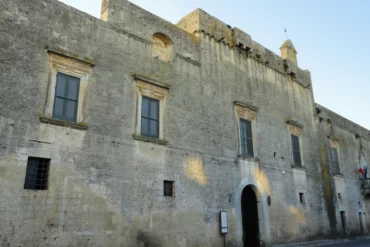
The castle of Copertino, also called the Castello Angioino, is a monumental fortress, one of the most important examples of Renaissance military architecture in Puglia. Its oldest core is the keep, the tall square tower from the 13th century, from the time when the Angevins made Copertino the centre of a county. In the first half of the 16th century the marquis Alfonso Castriota, a general of Charles V, had it enclosed in a new Renaissance fortress, entrusted to the military architect Evangelista Menga: a quadrangular plan with four large spear-head bastions at the corners, a wide moat all around and, on the walls, rows of loopholes. You enter over a stone bridge, in front of the large portal in Catalan-Durazzesque style, decorated with medallions, niches and trophies of arms. In the courtyard you will find the chapel of San Marco, frescoed in the 1560s by the Copertino painter Gianserio Strafella for the new lords, the Genoese Squarciafico family, whose sarcophagi it holds; the portico with the coat of arms of the Pinelli-Pignatelli, a well, the stables and the galleries that lead to the bastions. An open staircase climbs to the «palazzo vecchio», the barons’ residence, where the chapel of the Maddalena opens, with frescoes from the first half of the 15th century found during the restoration work. In the rooms there are also archaeological finds recovered by the Carabinieri and a small collection of Russian and Albanian icons. Since 1956 the castle has belonged to the State and today it is managed by the Direzione regionale Musei nazionali Puglia of the Ministry of Culture: there is an admission fee, the castle is closed on Mondays and on Sundays it opens only on the first and second Sunday of the month. Check opening times and days on the official website before you go.
2. The Porta di San Giuseppe and the column of San Sebastiano (20 minutes)
In front of the castle stands the Porta di San Giuseppe. It was the Porta del Castello, the first gate in the walls built in 1430 by Count Tristano di Chiaromonte, and for a century it was the only way into the town; in the 17th century its inside was frescoed with figures of saints and in the mid-18th century, after the beatification of Giuseppe Desa, it was turned into a triumphal arch in honour of the saint. On the other side of the old town, where the Porta del Malassiso, the second gate in the walls, stood until 1895, rises the votive column of San Sebastiano, the town’s first protector, with its 17th-century statue put back in place in 1925.
3. The sanctuary of Saint Joseph of Cupertino and the little stable (45 minutes)
In the old town, a few steps from the castle, is the sanctuary of Saint Joseph of Cupertino, built by the Universitas, the municipality of the time, right after the saint’s beatification: work, to a design by Adriano Preite of Copertino, began in 1754 and ended in 1758, knocking down a stretch of the walls and an old little church. The church has a concave façade in carparo stone and a central plan, with a bright interior decorated in stucco. The most intimate place is the stalletta, the little stable where Giuseppe Maria Desa was born on 17 June 1603, preserved just as it was in the 17th century: the gabled roof of reeds and tiles, the rough walls, a small fireplace and two little cupboards in the rock. The saint’s heart is kept here, brought from Osimo in 1953. Right opposite the sanctuary is the family home, Giuseppe’s childhood house, which the friars bought in 1753 and turned into a chapel. The sanctuary is in the care of the Conventual Friars Minor and is open every day from morning to evening: go in outside service times, dressed appropriately.
4. The sanctuary of the Grottella (45 minutes)
About 2.5 km from the centre, among the olive trees, stands the sanctuary of the Madonna della Grottella, the place linked to the saint’s youth. Its story begins in the 16th century, when an ancient image of the Madonna and Child was found in a small grotto carved into the rock: according to legend it was discovered by a young shepherd looking for a lost calf. In the last decades of the 16th century the bishop of Nardò had the church built there, where you go down a few steps, almost towards the original grotto; the fresco of the Virgin is set into the high altar. From 1618 the Franciscans built the convent next to it, and among the labourers was a fifteen-year-old boy, Giuseppe Desa. Here the saint lived for years as a young friar, in the smallest and poorest cell, behind the altar, and here many of his ecstasies took place. In the single-nave church there are Baroque altars, a chapel dedicated to the saint and 17th-century frescoes of the Passion; the convent has the cloister of the Samaritan woman. The large park in front of the sanctuary hosts festivals, fairs and concerts.
5. The Chiesa Matrice of Santa Maria ad Nives (30 minutes)
The Chiesa Matrice, the Collegiate Church of Santa Maria ad Nives, is the oldest church in Copertino and the richest in history: it was founded in 1088 by the Norman count Goffredo as a Latin-rite church and, according to tradition, in the 13th century it was dedicated to Our Lady of the Snows, receiving the title of basilica. What you see today is the result of many rebuildings: the pentagonal apse dates from 1576 and the slender bell tower, 35 metres high, with paired columns and capitals carved with human faces, was completed in 1597 by the master builder Francesco Maria Tarantino from Nardò. From 1707 the interior was covered with Baroque stucco work and altars. Inside you will find the “Deposition” and other canvases by Gianserio Strafella, the large “Regina Martirum” by fra Angelo da Copertino, a 17th-century Capuchin painter, and a Baroque altar by Antonio Donato Chiarello that holds a 15th-century fresco of Our Lady of the Snows. In this church, in 1603, the future Saint Joseph of Cupertino was baptised.
6. The old town, the portals of the palazzi and the underground olive mills (1 hour)
Wander unhurriedly through the old town: in the 16th century the wealthiest families built elegant palazzi, and Latin mottos were carved on many lintels. Of their palazzi, mostly the portals remain today: that of Palazzo Pappi, in an alley off via Margherita di Savoia, a Renaissance portal flanked by two stone grilles pierced like lace; the Baroque stucco one of Palazzo Ventura; that of Palazzo Prence, in via Ruggeri, attributed to the sculptor Chiarello, with Saint Michael slaying the dragon; and, in the Borgo, Palazzo Diez-Capozza, with its inscriptions. Next to the Chiesa Matrice are the church and monastery of Santa Chiara, founded in 1545 by Alfonso Castriota, and, just outside the centre, the convent of the Dominicans, with a “Madonna del Rosario” from 1612 by the Gallipoli painter Gian Domenico Catalano. Under and around the ancient walls lie hidden the underground olive mills, carved into the rock because the warmth underground helped with processing the olives: in the 16th century eleven of them were working in Copertino and the oil left from the port of Gallipoli for the countries of the north. Ask locally which ones can be visited.
7. The country churches and Copertino DOC wine (half a day)
The countryside around Copertino holds small treasures. On the provincial road to Nardò, just outside the town, is the church of Santa Maria di Casole, what remains of a medieval village already documented in 1274, rebuilt in the first half of the 16th century, with the ruins of the convent around it. In the countryside to the south, near the Li Monaci masseria, is the crypt of San Michele Arcangelo, entirely carved into the rock in 1314 and frescoed by two painters from Soleto, with a ceiling painted as a starry sky: check locally whether and when it can be visited. All around, as far as the eye can see, are the vineyards: since 1976 Copertino has given its name to a DOC wine, red and rosé, made mainly from Negroamaro, produced in Copertino and some neighbouring municipalities. The castle too has its link with wine: under its courtyards were the county’s cellars, used until the 1950s, and since 2015 there has been a small vineyard on its walls.
Salento Prime holiday homes: pick your dates and see at once which are free.
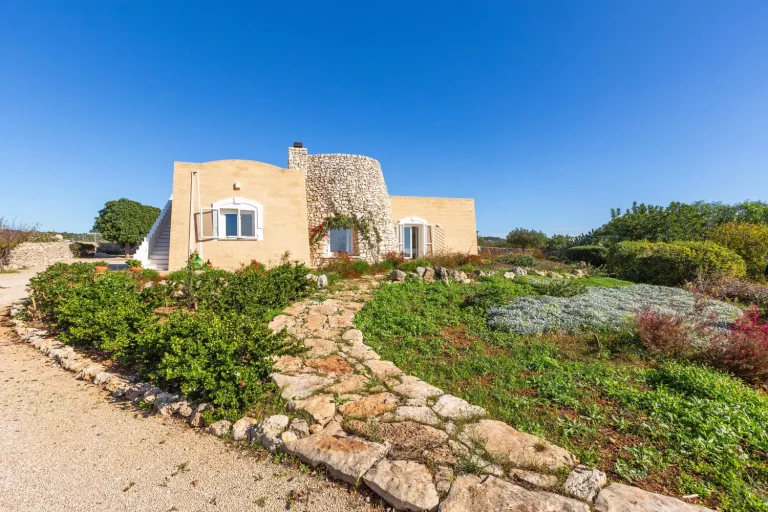
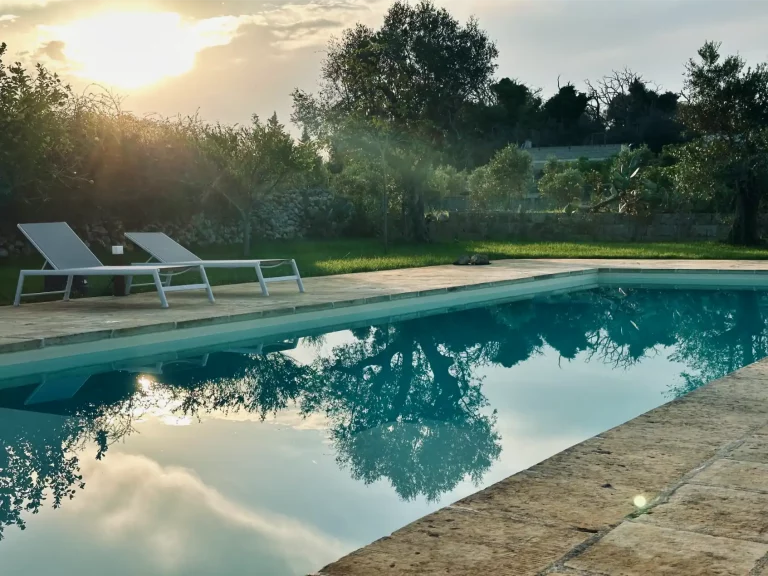 Villetta Arenosa con piscinasleeps 4
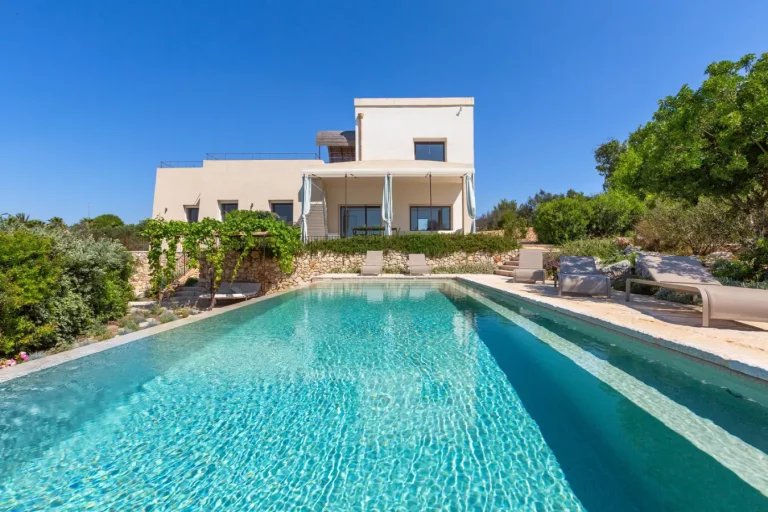
 Villa Aura Maris with poolsleeps 4
 Villa Giada Pescolusesleeps 8 · pool
The sea near Copertino and who it suits
Copertino is inland, but the Ionian coast is a quarter of an hour away. Here are the easiest beaches to reach, all on the Ionian Sea, with distances and driving times from the centre:
Sant’Isidoro (13 km, 17 minutes): the nearest sea, reached by going straight along provincial road 114. It is a seaside village of Nardò, «Santu Sitru» in dialect, with a long sandy beach at the foot of its 16th-century tower. A little further north, 16 km away, is Torre Squillace, the tower that was once entrusted to the people of Copertino.
Porto Cesareo (17 km, 20 minutes): the fishing town facing the Isola dei Conigli, with sandy beaches and shallow water, inside the Porto Cesareo Marine Protected Area, created in 1997. Read our guide to Porto Cesareo.
Torre Lapillo (22 km, 25 minutes): the hamlet of Porto Cesareo with the Torre di San Tommaso, completed in 1568, and a bay of fine, light sand about 4 km long, with a seabed that slopes gently. Read our guide to Torre Lapillo.
Porto Selvaggio (18 km, 23 minutes to the car park): the bay in the Nardò regional nature park, with the pine wood running down to the sea, a pebble beach and the cool water of the springs; from the car park you walk down, about a kilometre through the pines. Read our guide to Porto Selvaggio.
Further south, 19-20 km away, are the rocks of Santa Caterina and Santa Maria al Bagno: read our guide to Santa Caterina. Gallipoli is 31 km away, about half an hour.
Copertino is perfect for those who love castles and old towns, for pilgrims and devotees of Saint Joseph of Cupertino, for those curious about wine and traditions, for those travelling in spring and autumn and for those looking for a quiet, central base, a few minutes from Lecce and the sea. It is less suited to those who want to step out of the door and be on the beach or who are looking for nightlife by the sea: for that there are Porto Cesareo and the seaside villages of the coast.
Free beach and facilities
In Sant’Isidoro, Porto Cesareo and Torre Lapillo, beach clubs with umbrellas, sunbeds and bars alternate with stretches of free beach; at Porto Selvaggio and on the rocks of Santa Caterina there are few services. Check access, parking and any paid areas locally, and respect the rules of the marine protected area and the park. In Copertino you will find bars, pastry shops and restaurants in the centre and around the castle.
On the sand bring an umbrella, water and sun cream; on the rocks, reef shoes and a mask. When the sea is rough, don’t go down onto the rocks, and stay where you can touch the bottom.
Copertino vs other towns of Salento
In central-western Salento the towns are very close to each other. Here is a practical comparison to help you choose:
Copertino vs Nardò
- Copertino: the castle with its moat, the places of Saint Joseph of Cupertino and a quiet town with few tourists
- Nardò: 12 km away, a larger Baroque town, with Piazza Salandra and the Guglia, and 22 km of coast all its own. Read our guide to Nardò
Copertino vs Leverano
- Copertino: a larger town, with the castle, the sanctuaries and the Chiesa Matrice
- Leverano: 6 km away, a smaller town with its tall medieval tower, to combine on the same day. Read our guide to Leverano
Copertino vs Galatina
- Copertino: the 16th-century castle and the town of the flying saint
- Galatina: 15 km away, the basilica of Santa Caterina d’Alessandria covered in frescoes, the story of the tarantate and the pasticciotto. Read our guide to Galatina
When to choose Copertino: if you love castles and history, want to discover the places of Saint Joseph of Cupertino, are interested in Salento wine and are looking for a convenient stop between Lecce and the sea of Porto Cesareo.
When to choose somewhere else: if you want to walk to the beach, look at the seaside villages of the coast, from Porto Cesareo to Santa Caterina; if you are looking for the great city of art, Lecce is twenty minutes away.
Practical tips
Explore the old town in the morning or from late afternoon: in summer it is very hot in the middle of the day and the churches may be closed. For the castle, check days and times a few days ahead: it is closed on Mondays, on Sundays it opens only on the first and second Sunday of the month, and booking is optional. To go into the sanctuaries and churches, dress appropriately and respect the services; the sanctuary of Saint Joseph and that of the Grottella are much-visited places of prayer.
During the days of the feast of Saint Joseph of Cupertino, in mid-September, the centre fills with people and some streets close to traffic: arrive early and park away from the centre. For the sea, set off early in the morning, when the coast is still quiet and parking is easier, and come back to town for sunset and dinner.
Useful practical information
| 📍 Where | Copertino (Lecce), in central-western Salento, 17 km from Lecce, 12 km from Nardò and 13 km from the sea at Sant’Isidoro |
|---|---|
| 🚗 Parking | In the streets around the old town and the castle; respect the parking signs and, in September, the closures for the feast |
| ♿ Access | A town on the plain, with paved alleys; you enter the castle over a stone bridge, at the Grottella you go down a few steps; ask at the ticket office about the accessibility of the rooms |
| 🏖 Beach | No sea in town: sand at Sant’Isidoro, Porto Cesareo and Torre Lapillo, 13-22 km away; the bay of Porto Selvaggio 18 km away |
| 🌊 Sea | On the Ionian coast, shallow and clear on the sandy beaches, deeper on the rocks of Porto Selvaggio and Santa Caterina |
| 👟 What to bring | Comfortable shoes for the old town, suitable clothes for the sanctuaries; a beach umbrella and water shoes for the sea |
| 🍴 Food | Bars, pastry shops and restaurants in the centre and around the castle; the local wine is Copertino DOC |
| 📅 Best time | April, May, June and September; 18 September for the feast of Saint Joseph of Cupertino |
When to go and how much time to plan
January and February: Copertino is a quiet, everyday town. On 20 January the town celebrates San Sebastiano, its first protector.
March and April: the countryside is green and the days are mild, perfect for the old town, the castle and the country churches. On the Tuesday after Easter the Madonna della Grottella is celebrated at her sanctuary, with the fair in the park.
May and June: the heat is not yet strong and the sea starts to be pleasant: the right time to combine the castle, Nardò and your first swim at Sant’Isidoro or Porto Cesareo.
July and August: it is hot, so explore the town early in the morning or in the evening and go to the sea early. At the beginning of August the Madonna della Neve is celebrated, with games between the districts and a procession in period costume.
September: in our view the best month. The sea is still warm, there are fewer people on the beaches and from 16 to 19 September Copertino celebrates its saint, with processions, festive lights, concerts and fireworks.
From October to December: quiet days, with the grape harvest just over and the olive harvest in the surrounding countryside, ideal for the castle, the sanctuaries and walks.
Events and festivals (indicative dates, check them every year on the website of the municipality of Copertino and on SalentoMe):
- Feast of San Sebastiano, co-patron of the town: 20 January
- Feast of the Madonna della Grottella: the Tuesday after Easter, at the sanctuary of the Grottella, with the fair
- Feast of the Madonna della Neve: 5 August, with games between the districts and the historical procession
- Feast of Saint Joseph of Cupertino, patron saint of the town: 18 September, with celebrations from 16 to 19 September
How much time to allow: half a day is enough for the castle and the old town; a full day if you add the Grottella and the country churches. With two or three days you can combine Leverano, Nardò, Galatina, Lecce and the sea at Porto Cesareo. A typical day:
- 9:00: visit to the castle, at opening time
- 10:30: the Porta di San Giuseppe, the sanctuary with the little stable and the saint’s family home
- 11:30: the Chiesa Matrice and the portals of the palazzi in the old town
- 13:00: lunch in town
- 15:00: the sanctuary of the Grottella among the olive trees
- 16:30: swim at Sant’Isidoro or Porto Cesareo
- 20:30: back to Copertino for a stroll in front of the castle and dinner
Surroundings and extra ideas
Copertino is conveniently located: in a few minutes you reach the nearby towns, in a quarter of an hour the sea and in just over twenty minutes Lecce. Distances and driving times are indicative.
Leverano (6 km, 10 minutes): the neighbouring town, with its tall medieval tower and a compact old town, to combine on the same day. Read our guide to Leverano.
Nardò (12 km, 15 minutes): the Baroque town of Piazza Salandra, with the Guglia dell’Immacolata, the Cathedral and the Castello Acquaviva. Read our guide to Nardò.
Sant’Isidoro and Torre Squillace (13-16 km, 17-19 minutes): the nearest sea, with the long sandy beach and the 16th-century towers.
Galatina (15 km, 19 minutes): the basilica of Santa Caterina d’Alessandria, with its walls covered in frescoes, the story of the tarantate and the pasticciotto. Read our guide to Galatina.
Porto Cesareo and Torre Lapillo (17-22 km, 20-25 minutes): the Isola dei Conigli, the marine protected area and the sandy beaches of the Ionian coast. Read our guides to Porto Cesareo and to Torre Lapillo.
Lecce (17 km, 23 minutes): the provincial capital, with its Baroque old town in Lecce stone. Read our guide to Lecce.
Porto Selvaggio (18 km, 23 minutes): the bay in the pine wood of the nature park, with the towers and the prehistoric caves of Uluzzo. Read our guide to Porto Selvaggio.
Gallipoli (31 km, 32 minutes): the old town on an island linked by a bridge and the sandy beaches to the south. Read our guide to Gallipoli.
Local tip
Visit the castle at your own pace and look up: the Angevin keep, rising above the 16th-century walls, tells three centuries of history on its own. A curiosity for those who love mysteries: the date of the fortress is not certain. For centuries 1540 has been repeated, but on the façade, in the inscription, scholars read «MD», that is 1500. Also ask whether the underground cellars can be visited, where the county fermented wine in huge silos, and the spiral staircase rediscovered in 2019 in a bastion, with a small spiral vault that builders of the past used as an exam piece.
Then do as the locals do: from the sanctuary of Saint Joseph, in the centre, take the car to the Grottella, five minutes away, and stop in the park under the olive trees. It is the place where the saint sought silence, and today its park hosts festivals, fairs and concerts.
If you are a student or have an exam coming up, know that in Copertino you will not be the first: Saint Joseph of Cupertino is the patron saint of students and of those taking exams, and many young people stop by his sanctuary to entrust their exams to him. And before you leave, taste a glass of Copertino DOC: it is the simplest way to understand this countryside of vines.
FAQ
Where is Copertino?
In central-western Salento, in the province of Lecce, about 17 km from Lecce, between Leverano, Nardò, Galatina and Monteroni di Lecce. The nearest sea, at Sant’Isidoro, is 13 km away; Porto Cesareo is 17 km away and Gallipoli 31 km. In dialect it is called Cupirtinu.
Who was Saint Joseph of Cupertino?
Giuseppe Maria Desa, born in Copertino on 17 June 1603 and died in Osimo, in the Marche, on 18 September 1663, was a Franciscan friar of the Conventual Friars Minor. He is famous for his ecstasies, during which, according to witnesses, he rose from the ground: that is why he is called the flying saint. He was canonised in 1767 and is the patron saint of students, of those taking exams and of aviators.
Where was Saint Joseph of Cupertino born?
In a small stable near the ancient walls of Copertino, now kept inside the sanctuary dedicated to him, in the old town. The little stable holds the saint’s heart, brought from Osimo in 1953; opposite is his family home, turned into a chapel.
Can you visit the castle of Copertino?
Yes, with a ticket. The castle belongs to the State and is managed by the Direzione regionale Musei nazionali Puglia of the Ministry of Culture. It is closed on Mondays and on Sundays it opens only on the first and second Sunday of the month; days and times may change, so check them on the official website before you go.
What to see in Copertino?
The castle with its Angevin keep and four bastions, the Porta di San Giuseppe, the sanctuary of Saint Joseph of Cupertino with the little stable and the family home, the sanctuary of the Grottella, the Chiesa Matrice of Santa Maria ad Nives with its bell tower, the portals of the palazzi in the old town and, in the countryside, the church of Santa Maria di Casole.
When is the feast of Saint Joseph of Cupertino?
On 18 September, the day of the saint’s death. In Copertino the celebrations usually last from 16 to 19 September, with processions, festive lights, concerts and fireworks. The programme dates change every year.
Is Copertino by the sea?
No, it is inland. The nearest sea is on the Ionian coast: Sant’Isidoro 13 km away, about a quarter of an hour; Porto Cesareo 17 km and Torre Lapillo 22 km, with sandy beaches; Porto Selvaggio, with its bay in the pine wood, 18 km.
Is Leverano a hamlet of Copertino?
No, Leverano is a municipality in its own right, bordering Copertino, about 6 km away. San Donato di Lecce, to the east, is also an independent municipality.
What wine is produced in Copertino?
Copertino DOC, recognised in 1976: a red and rosé wine made mainly from Negroamaro grapes, produced in Copertino and in some neighbouring municipalities, such as Carmiano, Arnesano and Monteroni di Lecce.
Where to stay near Copertino?
Salento Prime has no houses in Copertino. The nearest is the Villetta Arenosa con piscina, in Marittima, on the Adriatic coast, about 50 km and just under an hour’s drive away: 4 guests, 2 rooms, 3 bathrooms and a private pool with a sea view.
Conclusion
Copertino is a town to discover at a leisurely pace: a 16th-century castle still enclosed in its moat, a sanctuary built over the stable where the flying saint was born, the Grottella among the olive trees, a Chiesa Matrice almost a thousand years old and a countryside of vines that gives its name to a wine. Give it at least a morning, then head down to the sea at Sant’Isidoro or Porto Cesareo, a few minutes away.
If you want a base in Salento, in Marittima, on the Adriatic coast, there is our Villetta Arenosa con piscina: 4 guests, 2 rooms, 3 bathrooms and a private pool with a sea view, just under an hour from Copertino. You will find our houses in the area on the page holiday homes in Marittima.
Discover the available accommodations with Salento Prime. To best organize your base and transfers, contact us here or start a chat on WHATSAPP.
Cover photo: Travel dreamer, CC BY-SA 4.0, via Wikimedia Commons, cropped