Looking for an art town in inland Salento, where the Middle Ages, the Baroque and folk traditions live side by side, a few steps from one another? This guide takes you to Galatina, «San Pietru» in dialect: the Basilica of Santa Caterina d’Alessandria with its fifteenth-century frescoes, Piazza San Pietro and the Chiesa Madre, the chapel of San Paolo and the story of the tarantate (women believed to have been bitten by the tarantula), the Museo civico Pietro Cavoti, the pasticciotto, the hamlets and the nearest sea, with practical tips and local curiosities.
In short
Galatina is a town of about 25,000 inhabitants in the heart of Salento (Lecce), 78 metres above sea level and about 25 km from Lecce. Its jewel is the Basilica of Santa Caterina d’Alessandria, built at the end of the fourteenth century by the Orsini del Balzo and almost entirely covered with frescoes from the early fifteenth century: this is why many people compare Galatina to Assisi. In the old town are Piazza San Pietro with the Baroque Chiesa Madre of Saints Peter and Paul, the chapel of San Paolo, linked to the story of the tarantate, and the Museo civico Pietro Cavoti. From 28 to 30 June the town celebrates its patron saints, Peter and Paul. The municipality has three hamlets: Noha, Collemeto and Santa Barbara. The nearest sea is 17 km away, at Santa Maria al Bagno, on the Ionian coast. The best months are April, May, June and September.
What is Galatina?
Galatina, which until 1861 was called San Pietro in Galatina, is a town in inland Salento, in the province of Lecce, between Lecce and Gallipoli. It has held the title of city since 1793 and is known as an art town: the old town, gathered within its ancient gates, is home to one of the most important Gothic churches in Puglia, Baroque churches in Lecce stone, noble palazzi and courtyards. The municipality also includes three hamlets: Noha, to the south-east, almost joined to the town, and Collemeto and Santa Barbara, to the north-west.
Galatina is a small town that is alive all year round, and in the evening its people meet between Piazza San Pietro and Piazza Alighieri. The old town is easy to explore on foot: stone-paved lanes, carved doorways, wrought-iron balconies, courtyards hidden behind the palazzi and, every few steps, a church. At the centre of it all is Santa Caterina d’Alessandria, a basilica that looks plain from the outside and is surprising inside, with walls, vaults and pillars covered in frescoes.
It is not a seaside town, but it lies almost halfway between the two coasts: in less than half an hour you reach the Ionian Sea at Santa Maria al Bagno, Santa Caterina and Gallipoli, and in just over half an hour Otranto, on the Adriatic. Lecce, too, is half an hour away by car. This is the Salento for those who love art, history and folk traditions, and for those who want to understand where the pizzica comes from. In this guide you will find how to get there, what to see, where to swim and how to plan your day, nearby too.
Curiosities and atmosphere
The town’s old name was San Pietro in Galatina: tradition has it that the apostle Peter stopped here on his journey from Antioch to Rome. Only after the Unification of Italy, in 1861, did the town take back the name of Galatina. The hamlet appears in documents at the end of the twelfth century, and in the Middle Ages it was a centre of Greek language and rite, like the neighbouring villages. Today Galatina is not part of the Grecìa salentina, the area where Griko is still spoken, but it borders some of its municipalities, such as Soleto and Corigliano d’Otranto; in Griko its name is «As Pètro». The coat of arms tells this story: the keys of St Peter, granted according to tradition by Pope Urban VI, the owl sacred to Athena, added in the sixteenth century to recall the town’s Greek origins, and the crown. The title of city came in 1793, with a decree of King Ferdinand IV.
Galatina’s great moment came with the Orsini del Balzo: at the end of the fourteenth century Raimondello Orsini del Balzo had the church of Santa Caterina, the convent and the hospital built, and his wife Maria d’Enghien and his son Giovanni Antonio completed the work and had it frescoed. In 1485 the town passed to Giovanni Castriota, son of the Albanian military leader Scanderbeg and first Duke of Galatina. But Galatina is also known throughout Italy for another story, that of tarantism: for centuries, around 29 June, the feast of Saints Peter and Paul, the «tarantate» came here from all over Salento, mostly women who worked in the fields and who believed they had been bitten by the tarantula, to ask St Paul for a grace in his chapel. The people of Galatina, on the other hand, protected by the saint, were said never to be bitten. You will find places and events on the website of the municipality of Galatina.
Where it is and how to reach it
Galatina is in central Salento, in the inland part of the province of Lecce, almost halfway between the Ionian and the Adriatic coasts: it borders Copertino and Lequile to the north, Soleto and Corigliano d’Otranto to the east, Sogliano Cavour, Cutrofiano, Aradeo and Seclì to the south, and Galatone and Nardò to the west. Lecce is about 25 km away, the nearest sea, at Santa Maria al Bagno, 17 km, Gallipoli 24 km, Otranto 33 km and Santa Maria di Leuca about 52 km.
By car: from Lecce take the SS101 towards Gallipoli and come off towards Collemeto and Galatina: about half an hour without traffic. In the old town the streets are narrow and partly pedestrianised: leave the car in the surrounding streets and explore on foot. During the patron saints’ feast, at the end of June, the centre is closed to traffic in the evening: park as soon as you enter the town and continue on foot.
By public transport: Galatina has a station on the Ferrovie del Sud Est Lecce-Gallipoli line, less than a kilometre from the old town: check the timetables and any replacement buses before you set off. National trains arrive in Lecce. Galatina’s airport is a military one with no scheduled flights: the most convenient airport is Brindisi, about 70 km away, just over an hour by car.
What to do and what to see
Galatina is easy to see in a day: in the morning the basilica, the cloister and Piazza San Pietro, in the afternoon the museum, the gates and the Baroque churches, or the sea. Here are the experiences not to miss.
1. The Basilica of Santa Caterina d’Alessandria (1-2 hours)
It is the reason people come all the way here. The basilica, on Piazzetta Orsini, was commissioned by Raimondello Orsini del Balzo, who according to legend had returned from a journey to Mount Sinai with a relic of St Catherine, a finger, still kept in the church treasury; the date 1391 is carved on the lintel of the left-hand side door. The façade, in Apulian Romanesque style, has three gables, a large rose window and three portals carved in Lecce stone: the central one has a small porch on two columns resting on lions and, on the lintel, Christ among the twelve apostles. The interior, about fifty metres long, has five naves and ends in an octagonal choir added around the middle of the fifteenth century by Giovanni Antonio Orsini del Balzo, whose funerary monument is there; that of his father Raimondello is in the presbytery. But the real wonder is the frescoes, commissioned for the most part by Maria d’Enghien in the first half of the fifteenth century from painters of the Giottesque and Sienese schools: the Stories of the Apocalypse, the largest cycle, Genesis, the Seven Sacraments, the Angelic Hierarchies, the Life of Christ, the Stories of the Virgin and, in the presbytery, seventeen scenes from the life of St Catherine. In an ambulatory there is also a St Anthony Abbot signed by a certain «Franciscus de Arecio». A national monument since 1870 and a minor basilica since 1992, it is in the care of the Franciscan Friars Minor. Individual visitors go in freely, without booking; groups must book. The basilica is open every day, in the morning and the afternoon, but visits are suspended during mass and on some days: check the opening times and the list of closures on the basilica’s website.
2. The cloister, the convent and Palazzo Orsini (30-45 minutes)
Next to the basilica is the convent of the Franciscan friars, rebuilt between the sixteenth and seventeenth centuries on the site of the Orsini one. Its cloister, with a well in the middle, was frescoed in 1696 by Fra’ Giuseppe da Gravina with the stories of St Francis and the Franciscan saints. After 1866 the convent became a prison and also housed the carabinieri: only later did it return entirely to the friars. A little further on, in Via Umberto I, Palazzo Orsini was the old hospital of Santa Caterina, founded by Raimondello to take in the sick, the poor and pilgrims: today it is the town hall, and in the entrance hall you can see the coats of arms of the Olivetans and the Aragonese and a high relief with a knight. The basilica also has its own museum: ask at the basilica for opening days and times.
3. Piazza San Pietro and the Chiesa Madre dei Santi Pietro e Paolo (30-45 minutes)
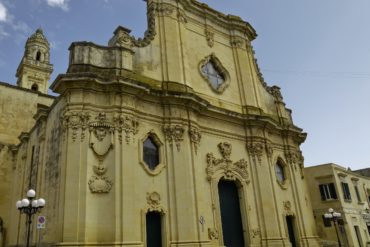
Piazza San Pietro is the heart of the old town. Here rises the Chiesa Madre, dedicated to the patron saints Peter and Paul: it stands where, as early as the mid-fourteenth century, there was a church in which services were held in the Greek rite, until the time of Pope Sixtus IV, at the end of the fifteenth century. It was rebuilt from 1621, became a collegiate church in 1664 and was completed only in 1770, as an inscription on the façade records. The Baroque façade in Lecce stone, on two orders, is full of statues: in the centre the Immaculate Virgin, then St Peter, St Paul, St Joseph and other saints. Inside, with three naves, the vault is frescoed with the stories of St Peter, painted in 1875 by the Neapolitan Vincenzo Paliotti. During the patron saints’ feast, pizzica ronde are played in this square and the surrounding streets until late at night.
4. The chapel of San Paolo and the story of the tarantate (15-30 minutes)
A few steps from the Chiesa Madre, in Via Garibaldi, there is a small private eighteenth-century chapel, built into a palazzo: it is the chapel of San Paolo, which everyone calls the «chapel of the tarantate». According to tradition, this was the site of the house that had given hospitality to the apostle Paul, who, to show his thanks, is said to have given the owner of the house and his descendants the power to heal those bitten by spiders, scorpions and snakes, with the sign of the cross and with water from the well. The Dominican historian Alessandro Arcudi, in 1699, tells of two women healers, Francesca and Polisenna Farina, who left the house to the town on condition that a chapel dedicated to the saint be built there. For centuries, until the end of the 1950s, on 29 June the tarantate came here after days of treatment at home, with players of the tambourine, violin and button accordion: they drank the water from the well, prayed and danced to ask for a grace. In 1959 the anthropologist Ernesto De Martino came to Salento with a group of scholars, including the psychiatrist Giovanni Jervis, the ethnomusicologist Diego Carpitella and the photographer Franco Pinna, and also observed the tarantate in the chapel. That research led in 1961 to «La terra del rimorso» (The Land of Remorse), the book that made tarantism known throughout Italy and that describes it as a religious and cultural phenomenon, in which the tarantula is a symbol rather than a real spider. Today the chapel keeps the altar with the painting of St Paul and the well, now closed; it is private, so ask at the Info Point whether and when you can see the inside. On 29 June it returns to the centre of the festivities, with the re-enactment of the ritual and folk music: watch with respect, because for some people it is still a place of devotion.
5. The gates, palazzi and Baroque churches of the old town (1-2 hours)
The old town was enclosed by walls and five gates; three of them remain. Porta Luce, to the west, rebuilt in 1795, takes its name from the nearby sanctuary of the Madonna della Luce; Porta Nuova, also called Porta San Pietro, to the north, has an eighteenth-century look and the statue of the saint on top; Porta Cappuccini, to the east, was opened in 1725 and rebuilt in 1803. On Via Vittorio Emanuele II you come across the fifteenth-century Palazzo del Sedile, the old seat of the town government, with the town’s oldest coat of arms carved on the façade, and the Torre dell’Orologio, built after the Unification of Italy, which now houses the tourist Info Point. Piazza Alighieri is overlooked by the Palazzo Ducale, which began as a castle in the time of the Castriota Scanderbeg family, with the Spinola coat of arms on its doorway. Between one palazzo and the next you will find the Baroque churches in Lecce stone: the church of the Carmine, with its façade full of statues and a stone nativity scene from 1650, the church of the Addolorata, from 1710, with its coffered ceiling and a large carved altar, the octagonal church of the Anime Sante del Purgatorio, with its papier-mâché statues, and the Dominican church of Santa Maria della Grazia, next to the Palazzo della Cultura. Near the public gardens there is also the «Lampada senza luce» (lamp without light) fountain, by the Galatina sculptor Gaetano Martinez, shown at the Venice Biennale in 1936. Many palazzi are private and you admire them from the outside.
6. The Museo civico Pietro Cavoti (1 hour)
In the Palazzo della Cultura «Zeffirino Rizzelli», the former Dominican convent on Piazza Alighieri, with its entrance from the small square on Via Cafaro, is the Museo civico Pietro Cavoti, founded in 1936. It is named after the Galatina draughtsman and scholar who in the nineteenth century drew the frescoes of Santa Caterina and, as inspector of the monuments of Terra d’Otranto, oversaw their restoration. The rooms hold his drawings, the sculptures of Gaetano Martinez, a picture gallery with paintings from the seventeenth to the nineteenth century, memorabilia of the town’s history, parchments and a gallery of contemporary art. One section is devoted to tarantism, with the photographs taken by Giovanni Valentini in the 1970s, the paintings by Luigi Caiuli and a collection of writings on the phenomenon from the fourteenth to the twentieth century. In February 2026 the museum was open from Monday to Friday, in the morning and the afternoon, and closed at weekends; in summer the hours change: check them on the website of the Polo Bibliomuseale before you go.
7. The Galatina pasticciotto (a break)
Galatina claims to be the birthplace of the pasticciotto, the shortcrust pastry filled with custard that in Salento is eaten for breakfast, even hot or warm. According to a widely told story it was born in 1745 in the shop of a family of Galatina pastry cooks, during the feast of St Paul, from leftover shortcrust pastry and custard baked in a small mould; there are no documents to confirm it, but the tradition is strong, and the local pasticciotto can be recognised by its high dome and amber colour. In 2021 the municipality announced the registration of the «Pasticciotto di Galatina» trademark, and the pasticciotto is among Puglia’s traditional agri-food products. Try it fresh from the oven, in one of the pastry shops in the centre.
The nearest sea and who it suits
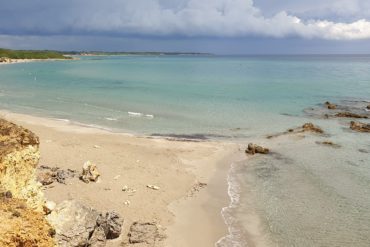
Galatina is inland, but the sea is not far away: the nearest is on the Ionian coast, 17-25 km away, between twenty-five minutes and half an hour by car. The first place you come to, by way of Galatone, is Santa Maria al Bagno, Nardò’s seaside village, 17 km away: a small village by the sea, popular in summer with many families from Galatina, Galatone and Nardò, with the remains of the sixteenth-century tower known as the Quattro Colonne and the Museo della Memoria e dell’Accoglienza (museum of memory and welcome), which remembers the Jewish refugees taken in here between 1943 and 1947. A little further north, 20 km away, is Santa Caterina, with its low, rocky coast and its watchtowers, and just beyond it the Porto Selvaggio Regional Nature Park, with its pine wood and jagged coastline. 24 km away is Gallipoli, with its old town on the island and, further south, the sandy beaches of its coast, as far as Punta della Suina, about 29 km away. Read our guide to Gallipoli. On the Adriatic coast, in just over half an hour you reach Otranto, 33 km away.
Galatina is perfect for those who love art and history, for anyone who wants to get to know the music and folk traditions of Salento, for those travelling in spring and autumn and for those looking for a real town, alive all year round, half an hour from both Lecce and the sea. It is less suited to people who want to step out of the house and be on the beach, or who are looking for the nightlife of the seaside villages: for that there are Gallipoli and the coast.
Free beach and facilities
On the coast between Santa Maria al Bagno and Santa Caterina you reach the sea mostly from the low rocks, with a few small stretches of sand; at Porto Selvaggio the coast is rocky, between the pine wood and the sea. The sandy beaches, with beach clubs and free stretches, are mainly south of Gallipoli. Check access, parking and any paid zones on the spot; in the seaside villages many places are open mainly in summer. In Galatina you will find bars, pastry shops and restaurants all year round.
On the rocks bring reef shoes and a mask; on the sand, an umbrella, water and sun cream. When the sea is rough, don’t go down onto the rocks, and stay where you can touch the bottom.
Galatina vs other towns of Salento
In Salento the art towns and historic villages are very close to one another. Here is a practical comparison to help you choose:
Galatina vs Lecce
- Galatina: a smaller, quieter town, with one of the most important Gothic churches in Puglia, the story of the tarantate and the pasticciotto
- Lecce: the provincial capital, the city of the Baroque, with more museums, bars and evening life, half an hour away by car. Read our guide to Lecce
Galatina vs Soleto and Corigliano d’Otranto
- Galatina: the larger town, with the basilica, the museum and everyday life
- Soleto and Corigliano d’Otranto: two small towns of the Grecìa salentina, 5-15 minutes away, with the Guglia di Soleto and the Castello de’ Monti; in Corigliano Griko is still spoken, especially among older people
Galatina vs Ruffano
- Galatina: the feast of Saints Peter and Paul at the end of June, with the memory of the tarantate and the pizzica ronde in Piazza San Pietro
- Ruffano: a village of the Serre salentine, further south, famous for the Night of San Rocco in Torrepaduli, in mid-August, with the ronde of the pizzica scherma. Read our guide to Ruffano
When to choose Galatina: if you love medieval art and folk traditions, want to see the frescoes of Santa Caterina and are looking for a convenient stop between Lecce and the Ionian Sea.
When to choose somewhere else: if you want the sea on your doorstep, look at the seaside villages of the Ionian coast, from Santa Maria al Bagno to Gallipoli; if you are after cliffs and caves, the Adriatic coast, between Otranto and Santa Maria di Leuca.
Practical tips
Go to the basilica in the morning: in summer it is hot in the middle of the day, churches and museums may be closed and visits stop during mass. Before you set off, check the opening times and closing days on the basilica’s website, and remember that the Museo Cavoti, on its winter timetable, is closed at weekends. To go into a church, dress appropriately and respect the services. At the Info Point, in the Torre dell’Orologio on Via Vittorio Emanuele II, you will find information on the town and its events; it also organises guided tours of the old town for groups.
The weekly market is on Thursdays: you will find the days and towns in our guide to the weekly markets of Salento. If you come for the feast at the end of June, arrive early, leave the car outside the centre and wear comfortable shoes: in the evening the streets are crowded until late. For the sea, remember that Galatina is closer to the Ionian coast: in less than half an hour you are in Santa Maria al Bagno or Gallipoli.
Useful practical information
| 📍 Where | Galatina (Lecce), in central Salento, 25 km from Lecce, 17 km from the sea at Santa Maria al Bagno and 24 km from Gallipoli |
|---|---|
| 🚗 Parking | In the streets around the old town, which you explore on foot; during the feast at the end of June the centre is closed to traffic in the evening |
| ♿ Access | Flat old town, with paved streets; the basilica and the Chiesa Madre have a few steps at the entrance |
| 🏖 Beach | No sea in town: rocks and small stretches of sand at Santa Maria al Bagno and Santa Caterina, 17-20 km away; sand south of Gallipoli |
| 🌊 Sea | Clear on the Ionian coast, with low rocks and sandy beaches; when the sea is rough, stay where you can touch the bottom |
| 👟 What to bring | Comfortable shoes for the lanes, suitable clothes for the churches; reef shoes, an umbrella and sun cream for the sea |
| 🍴 Food | Bars, pastry shops and restaurants in town all year round; in summer in the seaside villages too |
| 📅 Best time | April, May, June and September; from 28 to 30 June for the feast of Saints Peter and Paul |
Where to stay near Galatina
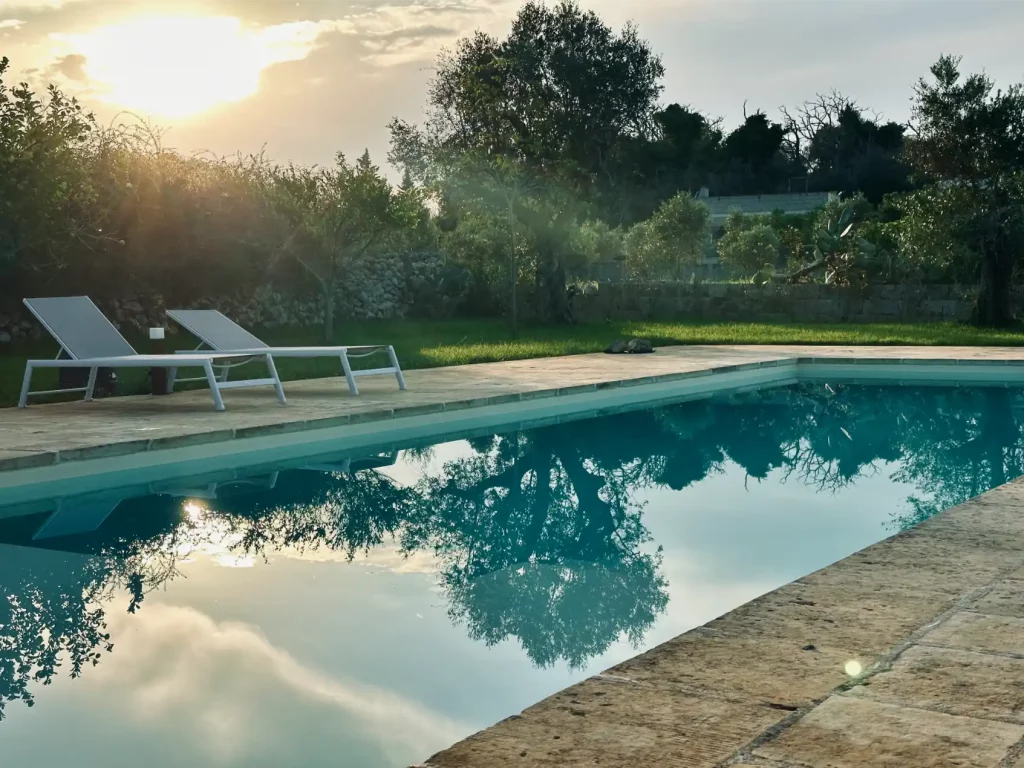
We have no houses in Galatina: ours are all in the south of Salento, and from there Galatina makes a lovely day trip, 40-50 minutes away by car. The nearest is in Marittima, on the Adriatic coast, 34 km from Galatina: our Villetta Arenosa con piscina, for 4 guests, with 2 rooms, 3 bathrooms and 80 m² on two levels, the double bedroom under the star vaults, a large garden with a private sea-view pool, a barbecue and private parking, less than a kilometre from the sea. It is a quiet base for exploring the coast between Castro, Santa Cesarea Terme and Tricase, a few minutes’ drive from the Cala dell’Acquaviva.
If you prefer the town, in the centre of Tricase, 39 km from Galatina, on Corso Roma, near Piazza Cappuccini, is our Casa Amalia – Center of Tricase: a 100 m² apartment renovated in 2024, for 4 guests, with a double bedroom and a bedroom with two single beds, air conditioning, a fully equipped kitchen, washing machine and dishwasher, a few steps from shops, bars and restaurants.
You will find these and our other houses in the area on the pages holiday homes in Marittima and holiday homes in Tricase. Would you like advice on dates, getting around or other houses in the area? Contact us: we will help you choose the right option.
When to go and how much time to plan
April and May: the ideal time for exploring the old town and the surrounding villages, with mild temperatures and the countryside in bloom; the sea is still cool.
June: the sea is already pleasant and the days are very long. From 28 to 30 June Galatina celebrates its patron saints, Peter and Paul: it is the most eagerly awaited moment of the year.
July and August: it is hot, and the town comes alive mainly in the evening. Visit the basilica in the morning and spend the afternoon by the sea, half an hour away by car.
September and October: in our view the best months. In September the sea is still warm, there are fewer people and the late-afternoon light on the Lecce stone is beautiful.
November to March: Galatina remains a lively town, perfect for a cultural day out even in winter. On 25 November St Catherine of Alexandria, to whom the basilica is dedicated, is commemorated, and in December the old town comes alive with Christmas events.
Events and festivals (indicative dates, check them every year on the Galatina municipality website and on SalentoMe):
- Feast of Saints Peter and Paul, the town’s patron saints: 28-30 June, with the procession on the evening of the 28th, folk music and pizzica ronde late into the night, the re-enactment of the ritual of the tarantate on the morning of the 29th and St Paul’s day on the 30th
- Fiera campionaria (trade fair): on the same days, in the exhibition grounds (in 2025 from 27 to 30 June)
- La Notte delle Ronde: at the end of August, the evening after the big concert of the Notte della Taranta in Melpignano, as in 2023 and 2024
- Christmas in town: between December and early January, with nativity scenes, Christmas markets and concerts in the old town
How much time to allow: half a day is enough for the basilica, Piazza San Pietro and the old town; a whole day if you add the Museo Cavoti, Soleto or the sea. A typical day:
- 8:30: breakfast with a warm pasticciotto, in the centre
- 9:30: the Basilica of Santa Caterina d’Alessandria and the cloister
- 11:30: Piazza San Pietro, the Chiesa Madre and the chapel of San Paolo
- 13:00: lunch in the centre
- 15:30: the Museo Cavoti, on its opening days, or a walk among the gates and the Baroque churches
- 17:30: a sunset swim at Santa Maria al Bagno or a stroll through the old town of Gallipoli
Surroundings and extra ideas
Galatina is in the middle of Salento: in a few minutes you reach the villages of the Grecìa salentina and in half an hour Lecce and the sea. Distances and driving times are approximate.
Noha, Collemeto and Santa Barbara (3-10 km, 5-15 minutes): the three hamlets of Galatina. Noha, «Nove» in dialect, is almost joined to the town, to the south-east: it has the church of San Michele Arcangelo, rebuilt in the early twentieth century, with Baroque altars in Lecce stone. Collemeto, to the north-west, along the main road between Lecce and Gallipoli, grew up around an old abbey from the Byzantine period and is surrounded by masserie (farmsteads); Santa Barbara, a little further on, towards Copertino, is a small place that grew up around a sixteenth-century masseria.
Soleto (4 km, 7 minutes): a town of the Grecìa salentina with its Guglia, a bell tower more than 40 metres high linked to the Orsini del Balzo, the same lords who had Santa Caterina built.
Corigliano d’Otranto (9 km, 13 minutes): the Castello de’ Monti, remodelled in the early sixteenth century with four corner towers, and a town where Griko is still spoken.
Lecce (25 km, 30 minutes): the provincial capital, the city of the Baroque, with its old town, its churches in Lecce stone and its museums. Read our guide to Lecce.
Santa Maria al Bagno and Santa Caterina (17-20 km, 25 minutes): the nearest sea, with the Quattro Colonne tower, the Museo della Memoria e dell’Accoglienza and, further north, the Porto Selvaggio nature park, with its pine wood and rocky coast.
Gallipoli (24 km, 29 minutes): the old town on the island, the castle, the cathedral of Sant’Agata and the harbour. Read our guide to Gallipoli.
Ruffano and Torrepaduli (24 km, 30 minutes): the village of the Serre salentine and the Night of San Rocco, in mid-August, with the ronde of the pizzica scherma. Read our guide to Ruffano.
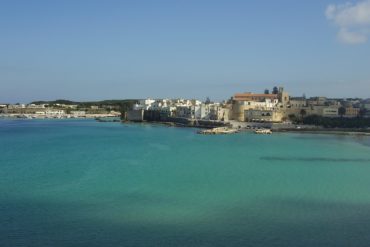
Otranto (33 km, 35 minutes): the historic centre by the sea, the Cathedral with its great floor mosaic and the Aragonese castle.
Marittima and Castro (33 km, 40 minutes): the Adriatic coast of caves and coves, where you will also find our house nearest to Galatina.
Local tip
Go into Santa Caterina and, before looking up, stop for a moment at the back of the nave: the frescoes tell a story to be read in order, from the scenes of the Apocalypse near the entrance to the stories of St Catherine in the presbytery. Take the time to look for the details, such as the soldiers’ clothes and armour; your phone’s zoom helps you see the vaults.
If you can, plan your visit for 28 and 29 June: on the night of the 28th the old town fills with tambourines and ronde, and on the morning of the 29th the town remembers the tarantate in the streets around the chapel of San Paolo. Watch with respect, without flash and without intruding: it is a memory that is still alive for many Salento families.
At the table, as well as the pasticciotto, look for «africani», small biscuits made of egg yolk and sugar, and ask for a glass of Galatina DOC wine. If you get the chance, also try the Sieglinde new potato, typical of the countryside around the town.
FAQ
Where is Galatina?
In central Salento, in the province of Lecce, inland between the Ionian and the Adriatic coasts, between Lecce and Gallipoli. Lecce is about 25 km away, Gallipoli 24 km and the nearest sea, at Santa Maria al Bagno, 17 km.
What is there to see in Galatina?
The Basilica of Santa Caterina d’Alessandria with its frescoes and the cloister, Piazza San Pietro with the Chiesa Madre dei Santi Pietro e Paolo, the chapel of San Paolo, the gates of the old town, the Baroque churches, Palazzo Orsini and the Museo civico Pietro Cavoti.
Why is the Basilica of Santa Caterina so famous?
Because it is one of the most important Gothic churches in Puglia, and its walls, vaults and pillars are almost entirely covered with frescoes from the first half of the fifteenth century, with the stories of the Apocalypse, Genesis, Christ, the Virgin and St Catherine. This is why many people compare Galatina to Assisi.
What is the chapel of the tarantate?
It is the chapel of San Paolo, in Via Garibaldi, near Piazza San Pietro. For centuries, until the end of the 1950s, on 29 June the tarantate came here from all over Salento to drink the water from the well and ask the saint for a grace. In 1959 they were also observed by the anthropologist Ernesto De Martino, who in 1961 published «La terra del rimorso». Today, on 29 June, the feast remembers that ritual with a re-enactment and folk music.
Was the pasticciotto born in Galatina?
Galatina claims it was: according to a widely told story it was born here in 1745, in a pastry shop in the town, but there are no documents to confirm it. The Galatina pasticciotto does have a tradition of its own, though, with its high dome and amber colour, and in 2021 the municipality announced the registration of the «Pasticciotto di Galatina» trademark.
Is Galatina part of the Grecìa salentina?
No: today the Grecìa salentina brings together twelve neighbouring municipalities, including Soleto, Corigliano d’Otranto and Martano. In the Middle Ages, however, Galatina too was a centre of Greek language and rite, and in Griko its name is «As Pètro».
What are the hamlets of Galatina?
There are three: Noha, to the south-east, almost joined to the town, and Collemeto and Santa Barbara, to the north-west, towards Copertino and the main road between Lecce and Gallipoli.
Does Galatina have a coastline?
No, it is inland. The nearest sea is 17 km away, at Santa Maria al Bagno, on the Ionian coast; Gallipoli is 24 km away and Otranto, on the Adriatic, 33 km.
How do you get to Galatina without a car?
By train, on the Ferrovie del Sud Est Lecce-Gallipoli line, which has a station in Galatina, less than a kilometre from the old town. Check the timetables and any replacement buses before you set off; for the sea and the surrounding area, a car remains the most convenient option.
Where to stay near Galatina?
Salento Prime has no houses in Galatina: the nearest is the Villetta Arenosa con piscina in Marittima, about 40 minutes away, for 4 guests, with a private sea-view pool. In the centre of Tricase, about fifty minutes away, there is Casa Amalia, for 4 guests. From there Galatina makes a lovely day trip.
Conclusion
Galatina is the Salento of art and memory: a Gothic basilica covered in frescoes, a Baroque square, a small chapel that tells the story of the tarantate and a pastry that in Salento is eaten for breakfast. Give it at least half a day, without hurrying, and if you can, come back at the end of June for the feast of Saints Peter and Paul.
Our houses are in the south of Salento, 40-50 minutes away by car: in Marittima there is our Villetta Arenosa con piscina, for 4 guests, with a private sea-view pool, and in the centre of Tricase Casa Amalia, for 4 guests. You will find our houses in the area on the pages holiday homes in Marittima and holiday homes in Tricase.
Discover the available accommodations with Salento Prime. To best organize your base and transfers, contact us here or start a chat on WHATSAPP.
Cover photo: Fabrizio Garrisi, CC BY-SA 4.0, via Wikimedia Commons, cropped