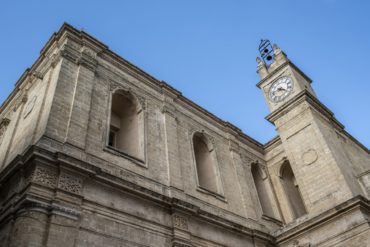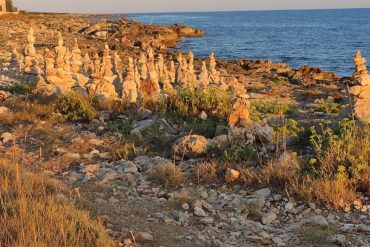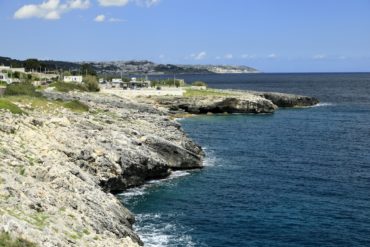
Looking for a bay of turquoise sea enclosed by high rock walls, reached on foot down a long flight of steps? This guide takes you to Porto Miggiano, the small inlet of Santa Cesarea Terme known as the Spiaggia dei 100 scalini, on Salento’s Adriatic coast between Santa Cesarea and Castro: how to get there, how to get down to the little beach, the sixteenth-century Torre Miggiano, the old stone quarries, the spa town and everything there is to see nearby, with practical tips and local curiosities.
In short
Porto Miggiano, also called the Baia di Porto Miggiano or the Spiaggia dei 100 scalini, is a coastal locality of Santa Cesarea Terme (Lecce), on Salento’s Adriatic coast, about 1 km from the town centre and 5 km from Castro. It is a small rocky cove in a U-shaped inlet, with turquoise, crystal-clear sea and a small beach at the foot of the cliff, reached by a flight of about a hundred steps. Next to the bay there are a small tourist harbour and the Torre Miggiano, a sixteenth-century coastal tower now in ruins. There are no beach clubs: arrive early and bring reef shoes. The best months are June and September.
What is Porto Miggiano?
Porto Miggiano is a coastal locality in the municipality of Santa Cesarea Terme, on Salento’s Adriatic side, just south of the spa town, towards Castro. It is inhabited almost only in summer and includes a bay squeezed between high limestone cliffs, with a little beach at the far end, a small tourist harbour, the traces of the old carparo stone quarries and the watchtower built against pirate raids.
Porto Miggiano is a stretch of high coast, where the coast road runs along the top of the cliff and below it an amphitheatre-shaped bay opens up: layered walls of pale rock, Mediterranean scrub, a lone rock in the middle of the water and, at the far end, a small beach of sand and shingle among rocks and blocks of stone. A little further south, on the rocky plateau facing the open sea, are the small harbour and the tower; all around are campsites, hotels and holiday homes. In winter it is almost deserted; in summer it is one of the best-loved spots on the coast between Otranto and Castro.
This is not the place for long beaches with facilities: to get into the water you have to go down the steps and move around on the rocks, and the seabed drops away fairly quickly. In return you get one of the clearest seas on Salento’s Adriatic side, perfect for swimming and looking at the seabed with a mask. In this guide you will find how to get there, how to get down to the little beach, what to see and how to plan your day, in Santa Cesarea Terme and nearby too.
Curiosities and atmosphere
For centuries Porto Miggiano was a place of work rather than of holidays. In the sixteenth century carparo was quarried from its cliffs, a limestone highly resistant to pressure, used for building throughout the county of Castro: on the north side of the inlet you can still see the marks of the cuts in the rock, and, according to the record in the Catalogo generale dei beni culturali, the stone of the nearby tower also comes from here. The Torre Miggiano was probably built precisely to protect the harbour and the quarrymen from pirate landings; the records give the names of its «torrieri», the tower guards, from Corporal Arico Consalvo in 1583 to the disabled soldiers who kept it in 1777. The surrounding coast, after all, has been frequented since very ancient times: the small caves in the cliff were already inhabited in prehistory.
Until 1913 Porto Miggiano was part of the «marine di Vignacastrisi», the stretch of coast of the old fief of Capriglia that reached as far as the grotta Striare at Castro; then, with the creation of the independent municipality of Santa Cesarea, called Santa Cesarea Terme since 1929, it became part of the new municipality. Its recent history has been eventful: in March 2013 the bay was placed under seizure during the works to consolidate the cliff and for years it was not possible to go down to the little beach; in 2020 the Court of Appeal of Lecce acquitted all the defendants and returned the area to the municipality, and since summer 2022 the little beach can be reached again. This place is much loved: the bay has been nominated in the FAI’s «I Luoghi del Cuore» (Places of the Heart) census in eleven editions, from 2003 to 2022, and the tower in four. For information and up-to-date notices, the point of reference is the municipality of Santa Cesarea Terme.
Where it is and how to reach it
Porto Miggiano is on Salento’s Adriatic coast, in the municipality of Santa Cesarea Terme, about 1 km south of the town centre, on the road that runs down towards Castro. Castro is 5 km away, Otranto 17 km, Santa Maria di Leuca 34 km and Lecce about 51 km. The Otranto – Santa Maria di Leuca coast road, here provincial road 358, runs above the bay.
By car: from Lecce take the SS16 to Maglie and then provincial road 363 towards Poggiardo and Santa Cesarea Terme; once on the coast, carry on south, towards Castro, for about a kilometre: just under an hour without traffic. Along the road above the bay there is a paid municipal car park, with blue lines; in July and August it is best to arrive early in the morning.
By public transport: national trains arrive in Lecce; from there the FS Sud Est (Ferrovie del Sud Est) regional trains to Gagliano del Capo stop at Maglie and at Poggiardo, the nearest station, about 11 km away: check the timetables and any replacement buses. In summer «Salento in Bus» line 103, Maglie – Santa Cesarea Terme – Castro – Marina di Andrano, leaves from Maglie station, passes through Poggiardo and also stops at Porto Miggiano, at the «Torre Miggiano» stop (in 2026 from 1 July to 31 August): check this year’s routes and timetables before you set off. The most convenient airport is Brindisi, about an hour and a half away by car.
What to do and what to see
Porto Miggiano can be enjoyed in half a day, but it is worth staying longer: a swim in the bay in the morning, then the tower and the old quarries on the plateau, and in the afternoon Santa Cesarea Terme or the caves of Castro. Here are the experiences not to miss.
1. The descent to the Spiaggia dei 100 scalini (2-3 hours)
It is the reason people come all this way. From the road you go down to the bay by a flight of about a hundred steps, which gives the Spiaggia dei 100 scalini (the beach of the 100 steps) its name. The old path along the rock face is closed and fenced off; today a more recent staircase is used, made safe, but the descent is still long and on the way back you have to climb all the way up again. At the bottom there is a small beach of sand and shingle, which changes shape after storms, surrounded by rocks and blocks of stone where you can settle down. The water is crystal clear, from emerald green to turquoise, and the seabed of sand and rock gets deep after a few metres.
2. The bay from above (30 minutes)
Before going down, stop at the top, near the steps: from here you can see the whole U-shaped inlet, with its layered walls of pale rock, the Mediterranean scrub, the lone rock in the middle of the bay and the colour of the water changing with the light. It is the spot for the best photos, and when the sea is rough it is the show to watch without going down. Always stay behind the fences and away from the edge: the rock is fragile.
3. Snorkelling in the bay (1 hour)
With a mask and snorkel the bay becomes a small aquarium: a seabed of sand and rock, fish, sea urchins and, on the stones, the small umbrella-shaped algae of Acetabularia. Swimming along the rock walls you reach a small cave that opens onto the sea. Only snorkel when the sea is calm, don’t linger under the rock walls and watch out for the boats and SUPs that come into the bay.
4. The Torre Miggiano (30 minutes)
On the rocky plateau next to the small harbour, facing the open sea, stands the Torre Miggiano, a sixteenth-century coastal tower. The exact year it was built is not known, but it already appears in sixteenth-century documents, when it belonged to the fief of Capriglia, under the barony of Vignacastrisi. It has a truncated-cone base built of irregular stones laid in horizontal rows, a stone string course broken by defensive machicolations and, higher up, the wide loopholes from which the tower guards fired at enemy ships. From here the sentries communicated with the Torre di Santa Cesarea to the north and with the defences of Castro to the south. Today the tower is a ruin, with part of its masonry collapsed: admire it from the outside, without climbing on the remains.
5. The old carparo stone quarries (20 minutes)
Take a close look at the rock around the bay: the straight cuts and the squared-off steps are not natural. They are the marks of the sixteenth-century quarries, where blocks of carparo were cut for the towers and buildings of the county of Castro. The clearest traces are on the north side of the main inlet, and the Catalogo generale dei beni culturali has listed the quarry as an archaeological site. Walk slowly and in closed shoes: the ground is uneven and slippery near the water.
6. The small harbour and the coast of caves (1-2 hours)
Next to the tower is the small tourist harbour of Porto Miggiano. Bear in mind that on 26 February 2026 the Capitaneria di porto di Otranto (the coastguard) closed the access channel to the harbour because of concrete blocks just below the surface: navigation, swimming and diving are banned there until repair works are carried out, so check on the spot whether the ban is still in force. To the south the high coast continues as far as Castro, with the Grotta della Zinzulusa and the Grotta Romanelli: for a boat trip along the caves the most convenient base is the harbour of Castro, where excursions leave for the Grotta Azzurra, the Zinzulusa, the Palombara and many others. Read our practical guide to Castro.
7. Santa Cesarea Terme, the spa town (2 hours)
A kilometre further north is Santa Cesarea Terme, «Santa Cisaria» in dialect, the town Porto Miggiano belongs to, built on a ledge of the cliffs overlooking the Strait of Otranto. Here, in four caves connected to the sea, the Gattulla, the Solfurea, the Fetida and the Solfatara, sulphurous, salty and bromine-iodine waters spring out at about 30 degrees, used for baths and mud treatments: the Gattulla spa establishment opened in 1910. According to an ancient myth, the smell of sulphur comes from the bodies of the Leuterni giants killed by Heracles; according to the Christian legend, on the other hand, the young Cesaria, fleeing from her father, hid in a cave by the sea and was saved by the flames that engulfed the man. Stroll along via Roma, the main street, among shops, terraces over the sea and late nineteenth-century villas: Villa Sticchi, built between 1894 and 1900, is one of the finest examples of the Moorish style in Salento, with its great dome and its portico on twisted columns (it is private and can be seen from the outside); not far away are Villa Raffaella and Palazzo Tamborino, perched above the cliffs. In the church of the Sacro Cuore is the papier-mâché statue of Santa Cesaria, the patron saint, and on the hill above the town, among the pines, stands the Torre di Santa Cesarea, or Torre del Belvedere, which communicated with the Torre Miggiano. Read our guide to Santa Cesarea Terme.
Sea, rocks and who it suits
The sea at Porto Miggiano is among the clearest on Salento’s Adriatic coast: turquoise over the sand, emerald green near the rock walls, blue further out. The bay is narrow and sheltered, the seabed is sand and rock and drops away fairly quickly: after a few steps you are out of your depth. When the sea is calm the water looks like a natural swimming pool; in heavy seas, on the other hand, the waves come into the bay and the rocks become dangerous.
It is perfect for those who can swim and love snorkelling, for couples, for photographers and for anyone looking for a natural cove rather than a beach with facilities. It is less suited to small children, because the water soon gets deep, and to those who find walking difficult, because you have to go down and back up about a hundred steps.
Free beach and facilities
At Porto Miggiano it is all free beach: at the bottom of the bay there are no beach clubs or kiosks, there is little room on the sand and the rest is rock and blocks of stone. Above the bay there are a campsite, hotels and a few bars and restaurants, open mainly in summer; for more choice there is Santa Cesarea Terme, a kilometre away, or Castro.
There is no shade at the bottom: bring a small umbrella, water and sun cream, but keep your bag light, because everything that goes down has to come back up the steps.
Porto Miggiano vs other coves of the Adriatic coast
There are other famous inlets along this stretch of coast. Here is a practical comparison to help you choose:
Porto Miggiano vs Cala dell’Acquaviva (Marittima)
- Porto Miggiano: a small beach at the foot of a high cliff, reached by a long flight of steps, turquoise sea
- Acquaviva: a cove squeezed between two rock walls, cool water thanks to the freshwater springs, a little beach of sand and pebbles. Read our guide to the Cala dell’Acquaviva
Porto Miggiano vs Castro
- Porto Miggiano: a natural bay and a quiet swim early in the morning
- Castro: the harbour, bars and restaurants, the boats to the caves and the old village on the hill with its castle
Porto Miggiano vs Santa Cesarea Terme
- Porto Miggiano: sand and natural rocks at the foot of the cliff
- Santa Cesarea Terme: swimming from the beach clubs on the rocks, the spa and the Moorish-style villas
When to choose Porto Miggiano: if you are looking for crystal-clear water, love swimming and don’t mind a long flight of steps.
When to choose somewhere else: if you are travelling with small children or want an umbrella and a sunlounger on the sand, look at the Alimini beaches, north of Otranto, or the sandy beaches of the Ionian coast.
Practical tips
Porto Miggiano is small, and that changes everything: in July and August the parking spaces and the room on the little beach run out early. Arrive by 9, or in the late afternoon, when people leave. Go down in comfortable shoes and with a light bag, and remember that the climb back up in the sun is the most tiring part of the day.
If the sea is rough, don’t go down: the waves come into the bay and getting out of the water becomes difficult. Always respect barriers and signs: in the past the bay stayed closed for a long time and the cliff is still fragile, so don’t linger under the rock walls. Before you go, also check the ordinances in force, such as the one issued by the Capitaneria di porto di Otranto which since February 2026 has banned swimming and boating in the access channel to the small harbour.
Useful practical information
| 📍 Where | Porto Miggiano (Santa Cesarea Terme, Lecce), 1 km from the centre of Santa Cesarea Terme, 5 km from Castro and 51 km from Lecce |
|---|---|
| 🚗 Parking | Paid municipal car park with blue lines above the bay; in July and August arrive early |
| ♿ Access | A flight of about a hundred steps and stretches of rock; not suitable for pushchairs or for people with reduced mobility |
| 🏖 Beach | All free, no beach clubs; a small beach of sand and shingle, the rest is rock |
| 🌊 Sea | Turquoise and crystal clear, with a seabed that drops away quickly; suitable for those who can swim |
| 👟 What to bring | Reef shoes, mask, water, sun cream and a small umbrella |
| 🍴 Food | Bars and restaurants above the bay and in Santa Cesarea Terme; more choice in Castro |
| 📅 Best time | June and September, early in the morning |
Where to stay near Porto Miggiano
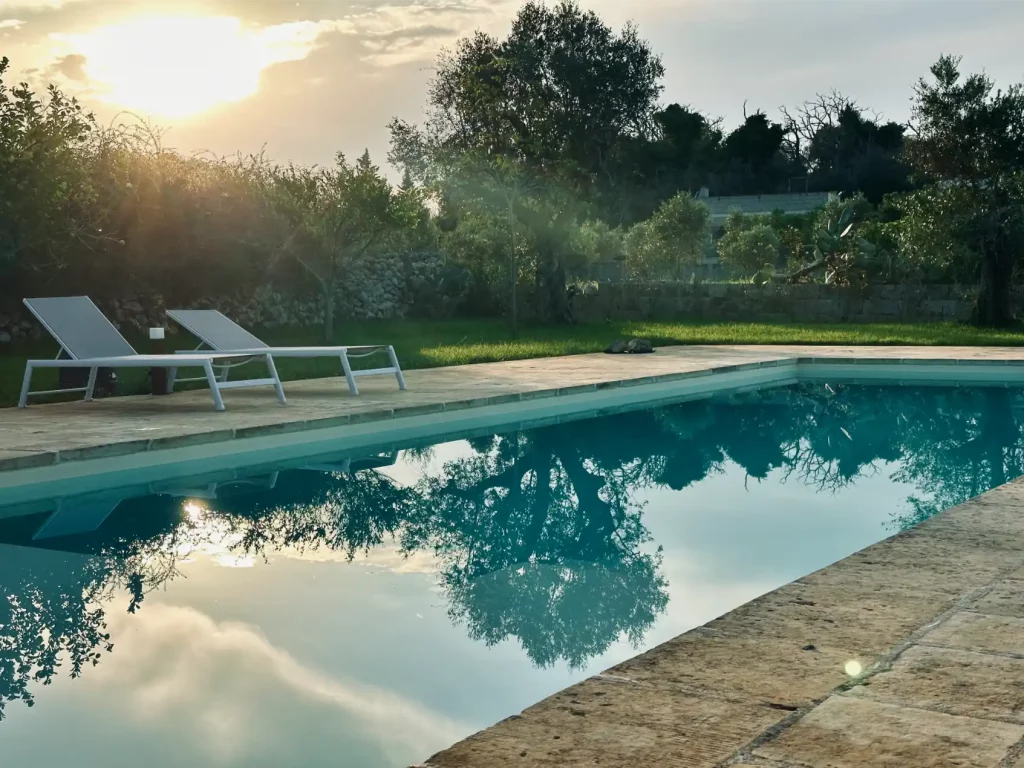
To enjoy the bay early in the morning, it is best to stay nearby. We have no houses in Porto Miggiano, but in Marittima, about 9 km and a quarter of an hour away by car, you will find our Villetta Arenosa con piscina: 4 guests, 2 rooms, 3 bathrooms and 80 m² on two levels, with a double bedroom under the typical star vaults, a bright living room with an equipped kitchenette and a sofa bed, air conditioning, a washing machine and a dishwasher. Outside there is a large private garden with a pool with views of the sea and of Castro, a sun terrace, an outdoor bathroom and showers, a play area with a volleyball net and five-a-side football goals, a barbecue and private parking. The sea is less than 1 km away: it is a quiet base for exploring the coast between Santa Cesarea Terme, Castro and Tricase.
You will find this and our other houses in the area on the page holiday homes in Marittima. Would you like advice on dates, getting around or other houses in the area? Contact us: we will help you choose the right option.
When to go and how much time to plan
June: the sea is already pleasant, the little beach is quiet even at weekends and the days are very long.
July and August: it is the busiest time. The sea is warm, but parking and a spot on the beach have to be claimed early in the morning, and in the middle of the day the climb back up the steps in the sun is hard going.
September: in our view the best month. The sea is still warm, there are far fewer people and Santa Cesarea Terme celebrates its patron saint.
May and October: ideal for photos and for walks between the tower and the town; on warm days you can still swim, if you don’t mind cool water.
From November to April: Porto Miggiano is almost deserted and many facilities are closed. In heavy seas the sight of the waves against the cliffs is impressive, but it is best watched from above, at a distance.
Events and festivals (indicative dates, check them every year on the Santa Cesarea Terme municipality website and on SalentoMe):
- Sagra della Cucuzzata in Vitigliano, a hamlet of Santa Cesarea Terme: early August, in piazzetta degli Angeli, with the «cucuzzata», a loaf made with courgettes, black olives, tomato and chilli, music and pizzica
- Feast of Santa Cesaria, patron saint of Santa Cesarea Terme: 11 and 12 September; on 11 September the procession crosses the town and ends with a parade of boats towards the cave where, according to legend, the saint lived
How much time to allow: half a day is enough for the bay; a whole day if you add the tower, Santa Cesarea Terme and Castro. With three or four days you can combine Otranto, Porto Badisco, Marittima and Tricase Porto. A typical day:
- 8:30: down to the little beach, a swim and snorkelling while the sea is calmest
- 11:30: the tower and the old quarries on the plateau, then the bay from above
- 13:00: lunch in Santa Cesarea Terme or Castro
- 15:30: a visit to the Grotta della Zinzulusa or a boat trip to the caves of Castro
- 18:30: a stroll in Santa Cesarea Terme, along via Roma, past the spa and Villa Sticchi
- 20:30: dinner in the old village of Castro or in Santa Cesarea Terme
Surroundings and extra ideas
Porto Miggiano is well placed for exploring the most spectacular stretch of the Adriatic coast, with its caves, cliffs, towers and small harbours. Distances and driving times are approximate.
Santa Cesarea Terme (1 km, 3 minutes): the spa in the caves by the sea, the Moorish-style villas such as Villa Sticchi and the Torre di Santa Cesarea among the pines. Read our guide to Santa Cesarea Terme.
Castro and the Grotta della Zinzulusa (4-5 km, 7 minutes): the Zinzulusa, between Castro and Santa Cesarea, is one of the best-known coastal caves in southern Italy; Castro is the harbour where the boats leave for the caves and the old village on the hill with its castle. Read our practical guide to Castro.
Vitigliano and Cerfignano (5 km, 8 minutes): the two inland hamlets of Santa Cesarea Terme, among the olive trees. In Vitigliano there are a menhir and the Cisternale, a megalithic monument used to collect rainwater; in Cerfignano a stretch of Roman paved road survives.
Porto Badisco (7 km, 10 minutes): a small bay where, according to tradition, Aeneas landed, and the cave that holds prehistoric paintings.
Marittima and the Cala dell’Acquaviva (9 km, 12 minutes): the inlet between the cliffs where the sea mixes with the fresh water of the springs, near our house. Read our guide to the Cala dell’Acquaviva.
Marina di Andrano and the Grotta Verde (11-12 km, 15 minutes): a rocky coast for swimming and the Grotta Verde, one of the sea caves along this stretch of coast.
Tricase Porto (16 km, 24 minutes): the fishing village around a fifteenth-century harbour, with a small sandy beach and the Torre del Sasso on the hill. Read our guide to Tricase Porto.
Otranto (17 km, 23 minutes): the historic centre by the sea, the Cathedral with its great floor mosaic and the Aragonese castle.
Santa Maria di Leuca (34 km, 48 minutes): the lighthouse, the de Finibus Terrae sanctuary, the seafront with its nineteenth-century villas and the boats to the caves.
Local tip
Porto Miggiano faces east, onto the Strait of Otranto: go early in the morning, when the sun shines into the bay and lights up the turquoise of the water, the sea is perfectly still and there is still room on the little beach. It is the best time to swim with a mask along the rock walls, as far as the small cave.
When the crowds arrive, climb back up at an easy pace and take your time over the tower and the quarries: looking at the cuts in the rock, you realise that this bay, before it was a destination for swimmers, was a stone quarry for centuries.
If you find the sea rough, though, don’t give up on the visit: from above, with the waves breaking against the cliffs, Porto Miggiano is perhaps even more beautiful. Then head up to Santa Cesarea Terme for a coffee overlooking the sea.
FAQ
Where is Porto Miggiano?
On Salento’s Adriatic coast, in the municipality of Santa Cesarea Terme (Lecce), about 1 km south of the town centre, between Santa Cesarea and Castro. Castro is 5 km away, Otranto 17 km and Lecce about 51 km.
Why is it called the Spiaggia dei 100 scalini?
Because the small beach at the bottom of the bay is reached by a flight of about a hundred steps from the road at the top of the cliff. It is also known as the Baia di Porto Miggiano or, simply, the spiaggetta, the little beach.
Can you go down to the beach and swim?
Yes: after years of closure and the works on the cliff, the little beach has been accessible again since summer 2022, by a staircase that has been made safe, while the old path along the rock face is fenced off. Always respect signs and barriers and check the ordinances in force: since February 2026, for example, swimming has been banned in the access channel to the small harbour.
Is there sand at Porto Miggiano?
Not much: at the bottom of the bay there is a small beach of sand and shingle, which changes with the storms, surrounded by rocks and blocks of stone. There are no beach clubs: it is all free beach.
Is Porto Miggiano suitable for children?
With care: to get there you have to go down and back up about a hundred steps, and the water gets deep within a few paces. With small children, sandy beaches with shallow sea are easier.
Where can you park?
Along the road above the bay, in the paid municipal car park with blue lines. In July and August it fills up early: it is best to arrive by 9.
How do you get to Porto Miggiano without a car?
In summer on «Salento in Bus» line 103, Maglie – Santa Cesarea Terme – Castro – Marina di Andrano, which stops at the «Torre Miggiano» stop. FS Sud Est regional trains from Lecce arrive at Maglie and Poggiardo. Check the timetables and any replacement buses before you set off.
Can you visit the Torre Miggiano?
It can be seen from the outside, on the rocky plateau next to the small harbour. It is a sixteenth-century coastal tower now in ruins, with part of its masonry collapsed: don’t climb on the remains.
When is the best time to go?
June and September, when there are fewer people and the sea is already, or still, warm. Early morning is the best time of day.
Where to stay near Porto Miggiano?
In Marittima, about 9 km and a quarter of an hour away by car, there is Salento Prime’s Villetta Arenosa con piscina: 4 guests, 2 rooms and a private pool with a sea view. You will find the other houses on the holiday homes in Marittima page.
Conclusion
Porto Miggiano is Adriatic Salento at its most spectacular: an amphitheatre-shaped bay between the cliffs, turquoise, crystal-clear sea, a sixteenth-century tower and the traces of the quarries its stone came from, a stone’s throw from the spa town. Arrive early, bring your reef shoes and leave time for the climb back up, for the tower and for a stroll in Santa Cesarea Terme.
If you want to stay a quarter of an hour from the bay, in Marittima you will find our Villetta Arenosa con piscina: 4 guests, 2 rooms, 3 bathrooms and a private pool with a sea view. You will find our houses in the area on the page holiday homes in Marittima.
Discover the available accommodations with Salento Prime. To best organize your base and transfers, contact us here or start a chat on WHATSAPP.
Cover photo: Photo2021, CC BY-SA 4.0, via Wikimedia Commons, cropped