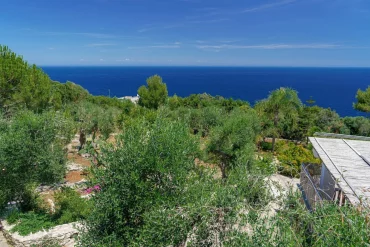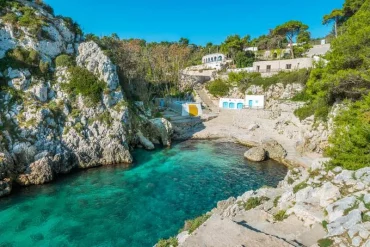
Want to discover one of the most surprising corners of Salento’s Adriatic coast? This guide takes you to Marittima and the Cala dell’Acquaviva, the small inlet among the rocks where the sea mixes with fresh spring water: how to get there, where to swim, what to see in the village and around Castro, with practical tips and local curiosities.
In short
The Cala dell’Acquaviva, also called the Insenatura dell’Acquaviva, is a small rocky inlet at Marina di Marittima (Diso), on Salento’s Adriatic coast, about 3 km from Castro. Freshwater springs keep the sea cool and crystal clear even in August. There are no beach clubs: arrive early and bring water shoes. The best months are June and September.
What is the Cala dell’Acquaviva?
The Cala dell’Acquaviva (or Insenatura dell’Acquaviva) is a narrow inlet between the cliffs of Marina di Marittima (Diso, Lecce), on the Adriatic side of Salento, famous for the freshwater springs that rise between the rocks and keep the sea cool and crystal clear. You reach it on foot from the car park above, down a flight of steps.
Marittima is a small village one kilometre from the sea, between Castro, Andrano and Diso. It has a compact old town, with defensive towers, churches and old palazzi, and it is the starting point for the Cala dell’Acquaviva, one of the best-loved coves on this stretch of coast.
The cove, which many also call the Insenatura dell’Acquaviva, is at Marina di Marittima, the part of the village that faces the sea. It is a small “fjord”: a tongue of sea that runs in between two rock walls, with a small beach of sand and pebbles and a seabed that drops quickly. The secret is in the water: freshwater springs rise between the rocks and mix with the sea, so a swim stays refreshing even on the hottest days. In this guide you will find everything you need to plan your visit, plus a few ideas for exploring the surroundings.
Curiosities and atmosphere
The name Marittima recalls the sea: it may come from the village’s closeness to the coast or, according to another theory, from its first inhabitants, who were seafarers. The first document mentioning the village dates back to 1277, and until 1809 Marittima was an independent municipality; today it is part of Diso, with about 2,150 inhabitants.
Being close to the sea also had a price. In 1537, after taking Castro, the Turks destroyed the village, and raids by Saracen pirates went on for a long time. To defend themselves the inhabitants built towers, and four are still standing: the Torre di Alfonso, the largest, the Torre Baltassara, the Torre di Paolino Russi and the Torre della Piazza, the only one still lived in. The Cala dell’Acquaviva, for its part, was nominated in the FAI’s «I Luoghi del Cuore» (Places of the Heart) census in 2003 and then in every edition from 2012 to 2022: a sign of the affection that locals and visitors have for this place.
Where it is and how to reach it
Marittima is on the Adriatic coast of southern Salento, about 90 metres above sea level and one kilometre from the coast, between Castro, Andrano and Diso. Lecce is about 48 km away. The Cala dell’Acquaviva opens onto the coast of Marina di Marittima, between Castro and Marina di Andrano, about 3 km from Castro.
By car: from Lecce take the SS16 towards Maglie, then continue towards Castro and Diso following the signs for Marittima: about 50 minutes without traffic. Above the cove there is a car park, partly paid in summer; from there you walk down a flight of steps and a short stretch of rock. In July and August it is best to arrive before 9 am.
By public transport: the nearest station is Spongano, on the Ferrovie del Sud Est line; national trains arrive in Lecce. The most convenient airport is Brindisi, about an hour and a half by car. In summer the «Salento in Bus» lines connect many places on the coast: check this year’s routes and timetables before you set off.
What to do and what to see
Marittima is easy to see in a day: the morning at the cove, the afternoon or evening in the village streets. Here are the experiences not to miss.
1. Swimming in the Cala dell’Acquaviva (2-4 hours)
It is the reason people come all the way here. The water is crystal clear, an emerald green that changes with the light, and in some spots it suddenly turns colder: these are the freshwater springs that rise between the rocks and mix with the sea, with cooler and warmer currents taking turns. The seabed drops quickly, so it is a place for confident swimmers. You settle on the small sand and pebble beach or on the rocks at the sides of the cove.
2. Snorkelling among the rocks (1 hour)
With a mask and snorkel the cove becomes a small aquarium: fish, sea urchins and posidonia meadows a few metres from the shore. Swim along the rock walls towards the mouth of the cove, where the water is deeper, and watch out for the boats that come in and out on calm days.
3. The cove from above (30 minutes)
Before going down, or before you leave, stop at the top, above the steps: from there you can see the whole tongue of sea squeezed between the rocks. It is the spot for the best photos, especially in the morning, when the sun lights up the water. Wear closed shoes: the rock is uneven and gets hot in summer.
4. The towers of the old town (1 hour)
In the village you will find the four towers built to defend it from raids from the sea. The largest is the Torre di Alfonso, in via Cellini; the Torre della Piazza is the only one still lived in. Walking through the streets you will also find the Palazzo Baronale, from 1745, the dovecote towers, where pigeons were once raised, and an underground olive mill carved into the rock.
5. The Mother Church of San Vitale and the Sanctuary (45 minutes)
The Mother Church is dedicated to San Vitale, whose feast is on 28 April. It was rebuilt at the beginning of the twentieth century on a sixteenth-century plan; it has a neoclassical interior and a frescoed elliptical dome, and above the high altar San Vitale is shown on horseback. The village also has the Sanctuary of Santa Maria di Costantinopoli, from 1610, with a Baroque doorway; next to it stood a convent built between 1615 and 1619, later turned into a tobacco factory.
6. The Colonna dell’Osanna (15 minutes)
It is a votive column from 1620, rebuilt in 1961. On Palm Sunday palms and olive branches are blessed here: if you are in Salento at that time, it is a tradition worth seeing.
7. A boat trip from Castro (1-2 hours)
From the harbour of Castro, a few minutes’ drive away, boat trips leave along the coast of the caves: Grotta Azzurra, Zinzulusa, Palombara and many more. Some tours go as far as the Acquaviva and stop for a swim: ask about the route when you book.
Sea, seabed and who likes it
The sea at the Acquaviva is among the clearest on this coast. The inlet is narrow and sheltered, the seabed is rock and sand and drops quickly: after a few metres you can no longer touch the bottom. The water is cooler than elsewhere because of the springs, a pleasant surprise in August, a little less so in June.
It is perfect for those who love swimming and snorkelling, for couples and for anyone looking for a swim that is different from the usual sandy beaches. It is less suitable for small children, who can almost never touch the bottom, and for people who have difficulty walking, because to reach the water you have to go down the steps and move across the rocks.
Free beach and facilities
There are no beach clubs at the Cala dell’Acquaviva: it is all free beach. The sand and pebble part is small and fills up early; the rest is rock. Above the cove, among the rocks, a small grove gives a little shade.
Bring water and a small sunshade; for lunch or a coffee you can go up to Marittima or over to Castro, a few minutes away.
Acquaviva vs other coves in Salento
There are other famous inlets along this stretch of coast. Here is a practical comparison to help you choose:
Acquaviva vs Porto Miggiano (Santa Cesarea Terme)
- Acquaviva: a narrow cove between two rock walls, cool water from the springs, a small beach of sand and pebbles
- Porto Miggiano: a small beach at the foot of a high cliff, reached by a long flight of steps, turquoise sea
Acquaviva vs Marina Serra (Tricase)
- Acquaviva: a swim in a small natural cove, where the seabed drops quickly
- Marina Serra: the famous natural pool among the rocks, one of the most photographed places in southern Salento
Acquaviva vs Castro
- Acquaviva: nature, silence and a quiet swim early in the morning
- Castro: harbour, bars and restaurants, boats leaving for the caves, and the village on the hill with its castle and cathedral
When to choose the Acquaviva: if you want clear, cool water, love swimming and prefer a small cove to a large beach with facilities.
When to choose somewhere else: if you are travelling with small children or want a sunshade and sunbed, look at the sandy beaches of the Ionian coast, such as Pescoluse or Torre Pali.
Practical tips
The Cala dell’Acquaviva is small, and that changes everything: in high summer the space on the little beach runs out early. Arrive by 9 am, or in the late afternoon, when the beach empties and the light is softer.
Bring water shoes, a mask and plenty of water. If the sea is rough, choose another beach: in a narrow cove the waves are strong and getting into the water from the rocks becomes awkward.
Useful practical information
| 📍 Where | Marina di Marittima (Diso, Lecce), 3 km from Castro and 48 km from Lecce |
|---|---|
| 🚗 Parking | Above the cove, partly paid in summer; in July and August arrive by 9 am |
| ♿ Access | Steps and a short stretch of rock; difficult with a pushchair and for people with reduced mobility |
| 🏖 Beach | All free, no beach clubs; a small beach of sand and pebbles, the rest is rock |
| 🌊 Sea | The seabed drops quickly and the springs keep the water cool; suitable for confident swimmers |
| 👟 What to bring | Water shoes, a mask, water and a small sunshade |
| 🍴 Food | Bars and restaurants in Marittima and Castro, a few minutes away |
| 📅 Best time | June and September, early in the morning |
Where to stay near the Cala dell’Acquaviva
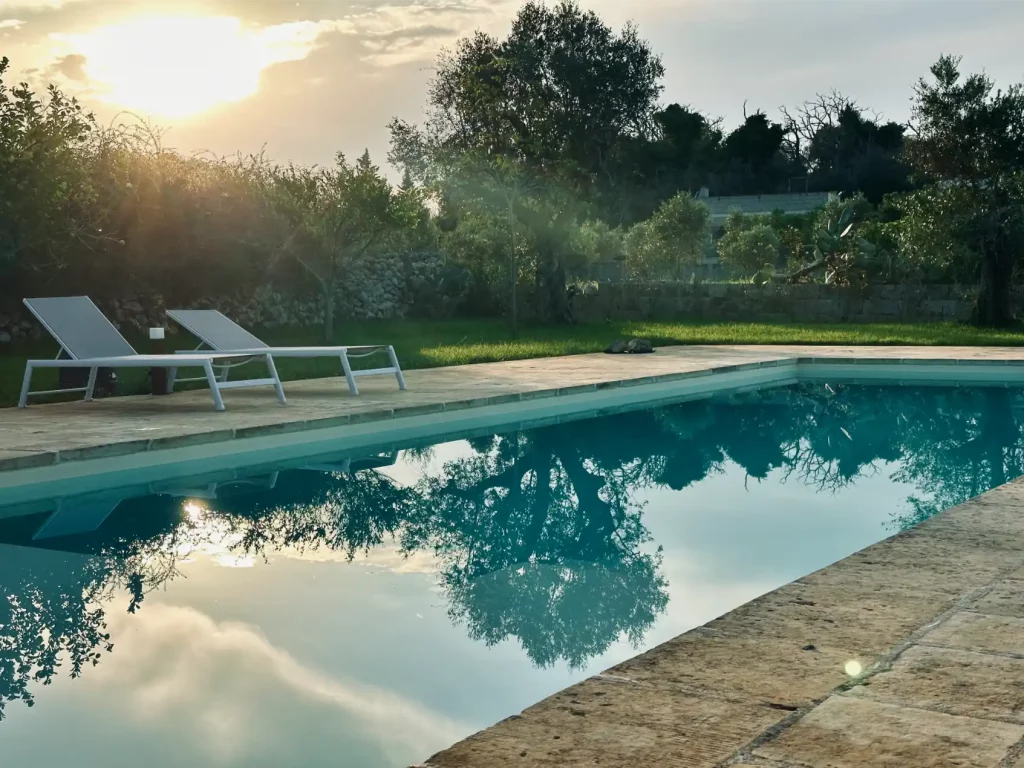
To enjoy the cove early in the morning, it is best to stay nearby. In Marittima, a few minutes’ drive from the Insenatura dell’Acquaviva, there is our Villetta Arenosa con piscina: 4 guests, 2 rooms, 3 bathrooms, 80 m² and a private pool. It is a quiet base for exploring the coast between Castro, Santa Cesarea Terme and Tricase.
Would you like advice on dates, getting around or other houses in the area? Contact us: we will help you choose the right option.
When to go and how much time to plan
June: the sea is already pleasant, the cove is quiet even at weekends and the days are very long. The water is still cool, though, and the springs make it even more refreshing.
July and August: the busiest period. The cool spring water becomes a relief, but you have to claim your spot on the beach early in the morning.
September: in our opinion the best month. The sea is still warm, there are far fewer people and the light is beautiful.
May and October: ideal for photos and for visiting the village; swimming is for those who don’t mind cool water.
From November to April: Marittima is a quiet village, perfect as a stop on a tour of Salento’s villages. In stormy seas the cove changes its face, but it is not the time to go down onto the rocks.
Events and festivals (indicative dates, check them every year):
- Fair of the Madonna di Costantinopoli: first Sunday of March
- Feast of San Vitale: 28 April
- Festa della Frisella: July
- Festa de la Cornula: August
- Fig festival: mid-August
How much time to allow: half a day is enough for the cove; a full day if you add the village and Castro. A typical day:
- 8:30: arrive at the cove, swim and snorkel
- 12:30: lunch in Castro, by the harbour or in the village
- 15:30: boat trip to the caves or a visit to the Grotta della Zinzulusa
- 19:00: stroll through the centre of Marittima, among the towers and the Mother Church
Surroundings and extra ideas
Marittima is well placed for exploring the most spectacular stretch of the Adriatic coast, with its caves, cliffs and small harbours. Distances and driving times are approximate.
Castro (3 km, 5 minutes): the harbour where boats leave for the caves, and the village on the hill, with its castle and a splendid view of the sea. Read our practical guide to Castro, the guide to the Grotta Azzurra and the one to the Grotta della Zinzulusa.
Marina di Andrano and the Grotta Verde (5 km, 10 minutes): a rocky coast for swimming and the Grotta Verde, one of the sea caves along this stretch of coast.
Marina Serra and Tricase (12 km, 15 minutes): the natural pool of Marina Serra and the harbour of Tricase. Discover the best things to do and beaches in Tricase.
Santa Cesarea Terme and Porto Miggiano (12 km, 15 minutes): the spa, the Moorish-style villas and the steps that lead down to the bay of Porto Miggiano. Read the guide to Santa Cesarea Terme.
Porto Badisco and the Grotta dei Cervi (20 km, 25 minutes): a small bay where, according to tradition, Aeneas landed, and the cave that holds prehistoric paintings. Read the guide to the Grotta dei Cervi.
Otranto (30 km, 35 minutes): the historic centre by the sea, the Cathedral with its great floor mosaic and the Aragonese castle.
Marina di Novaglie (17 km, 25 minutes): the little harbour cut into the rock, swimming from the rocks and the Cipolliane trail, on foot above the sea as far as the Ponte del Ciolo. Read our guide to Marina di Novaglie.
Ponte del Ciolo and Santa Maria di Leuca (25-35 km, 30-40 minutes): heading south, the bridge over the Ciolo inlet and then Leuca, where Italy ends. Read our guides to the Ponte del Ciolo and to Santa Maria di Leuca.
Local tip
Go to the Acquaviva early in the morning, when the low sun reaches into the cove and lights up the green of the water: the sea is still and you can see the seabed as if through glass. It is also when you will have the place almost to yourself.
Once in the water, swim slowly towards the inner end of the cove and along the rock walls: at some point you will feel colder currents. These are the freshwater springs, and they are exactly what makes the Acquaviva different from every other cove.
In the evening, after the beach, go up to Marittima: a stroll in the square, at the foot of the Torre della Piazza, and a walk past the village’s other towers, when the air is cooler.
FAQ
Where is the Cala dell’Acquaviva?
In Marina di Marittima, part of Diso (Lecce), on Salento’s Adriatic coast, about 3 km from Castro and 48 km from Lecce. It is also known as the Insenatura dell’Acquaviva.
Why is the water at the Cala dell’Acquaviva so cold?
Because freshwater springs rise between the rocks and mix with the sea. That is why the water stays cool and clear even in August, with colder and warmer currents taking turns.
Are there beach clubs at the Cala dell’Acquaviva?
No, it is all free beach: a small beach of sand and pebbles and the rocks around it. Bring a sunshade, water and water shoes.
Is the Cala dell’Acquaviva suitable for children?
With care: the seabed drops quickly, and to reach the water you have to go down the steps and walk on the rocks. With small children, the sandy beaches of the Ionian coast are easier.
Where can you park?
There is a car park above the cove, partly paid in summer. In July and August it fills up early: it is best to arrive by 9 am.
When is the best time to go?
June and September, when there are fewer people and the sea is already, or still, warm. Early morning is the best time of day.
Can you get there by boat?
Yes: some boat trips leaving from the harbour of Castro pass in front of the cove and sometimes stop for a swim. Ask about the route when you book.
What is there to see in Marittima besides the sea?
The four defensive towers, the Mother Church of San Vitale, the Sanctuary of Santa Maria di Costantinopoli, the Colonna dell’Osanna and the Palazzo Baronale.
Where to stay near the Cala dell’Acquaviva?
In Marittima, a few minutes’ drive from the cove, there is Salento Prime’s Villetta Arenosa con piscina: 4 guests, 2 rooms and a private pool. Castro and Tricase are also convenient bases for exploring this stretch of coast.
Conclusion
Marittima and the Cala dell’Acquaviva are Salento at its most authentic: a village with its towers and festivals, and a small cove where the sea meets the fresh water of the springs. Arrive early, bring water shoes and take the time to discover Castro and the nearby caves too.
If you want to stay a few minutes from the cove, in Marittima there is our Villetta Arenosa con piscina: 4 guests, 2 rooms, 3 bathrooms and a private pool. You will find our houses in the area on the page holiday homes in Marittima.
Discover the available accommodations with Salento Prime. To best organize your base and transfers, contact us here or start a chat on WHATSAPP.