Looking for a historic town in southern Salento with a history that goes back to the Messapians, a Baroque castle and sandy beaches a few minutes away? This guide takes you to Ugento, «Ušèntu» in dialect, the ancient Ozan: the New Archaeological Museum with the copy of the Zeus of Ugento and the Athlete’s Tomb, the castle of the d’Amore marquises, the cathedral, the Messapian walls, the Cripta del Crocefisso, the hamlet of Gemini and its seaside, between Torre San Giovanni, Torre Mozza and Lido Marini, with practical tips and local curiosities.
In short
Ugento is a municipality of about 12,000 inhabitants in southern Salento (Lecce), on a hill 108 metres above sea level, about 7 km from the Ionian Sea, 27 km from Santa Maria di Leuca and 61 km from Lecce. In Messapian times it was Ozan, the largest city in Messapia, enclosed by walls almost 5 km long. Since 2008 the Puglia Region has recognised it as a town of art: in the old town there are the castle of the d’Amore marquises, the cathedral and the New Archaeological Museum, with the copy of the Zeus of Ugento (the original is in Taranto) and the Athlete’s Tomb. Its sea is at Torre San Giovanni, Torre Mozza and Lido Marini, Blue Flag 2026, with the Litorale di Ugento Regional Nature Park behind them. The best months are May, June and September.
What is Ugento?
Ugento is a town in southern Salento, on the Ionian side, the seat of the diocese of Ugento-Santa Maria di Leuca. Its territory, of almost 100 km², stretches from hills of olive trees and vineyards to about 12 km of low, sandy coast: it includes the hamlet of Gemini, Torre San Giovanni, the seaside villages of Torre Mozza and Lido Marini and the locality of Fontanelle. Today’s town stands largely on top of the ancient Messapian city, of which the walls, the necropolises and the finds displayed in the museum remain.
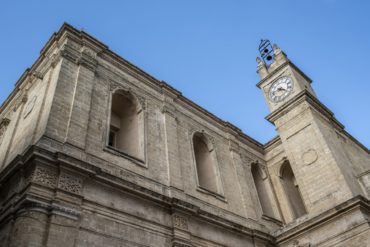
The old town of Ugento is gathered on the highest part of the hill: within less than two hundred metres you will find the castle, the cathedral with its neoclassical façade, the museum in the old Franciscan convent and Piazza San Vincenzo, the heart of the town, with its clock tower. All around there are stone-paved lanes, noble palazzi and small churches, and just outside the centre the large blocks of the Messapian walls emerge among houses and fields.
Ugento is not a seaside town, but the sea is very close: in ten minutes by car you reach Torre San Giovanni, and in a quarter of an hour Torre Mozza and Lido Marini, with long sandy beaches and a shallow, clear sea. This is the Salento for those who love history, archaeology and quiet historic villages, but don’t want to give up the beach. In this guide you will find how to get there, what to see, where to swim and how to plan your day, nearby too.
Curiosities and atmosphere
The name Ugento comes from the ancient Ozan, as it appears on the coins of its mint; it became Uxentum for the Romans and today it is «Ušèntu» in dialect. According to one theory it means «land of Zeus», and here the king of the gods really did leave his mark: on Christmas Eve 1961, while digging the foundations of a house in via Fabio Pittore, some workmen found by chance a bronze statue 74 cm tall, which the townspeople called «il pupo» (the doll). It was the Zeus of Ugento, the work of a Greek artist from Taranto at the end of the sixth century BC, and the person who recognised its value was Sofia Nicolazzo, then president of the Pro Loco. Originally the statue stood on a column, in a sacred area where the faithful called on the god with the Messapian words «Klaohi Zis», «hear, O Zeus»; already in antiquity someone hid it in a pit, covered by its capital. Since 1969 the original has been in the Museo Archeologico Nazionale di Taranto.
The history of Ugento is one of destruction and rebirth: the invasions of the Goths and the Saracens, the Norman fortress and, in 1537, the sack by the troops of Khayr al-Din Barbarossa, after which the castle and churches were rebuilt. Ugento has been a bishop’s seat for centuries: since 1818 its diocese has also included that of Alessano, and don Tonino Bello studied at the Ugento seminary, where he later served as vice-rector for 22 years. In 2008 the Puglia Region recognised Ugento as a town of art; you will find news and services on the website of the municipality of Ugento.
Where it is and how to reach it
Ugento is in southern Salento, on the Ionian side, on a hill at the southern tip of one of the serre salentine, the low ridges of Salento. The sea at Torre San Giovanni is about 7 km away, Gallipoli 25 km, Santa Maria di Leuca 27 km and Lecce about 61 km. The hamlet of Gemini is 4 km away, to the south-east, and Ugento-Taurisano railway station about 4 km away, to the north-east.
By car: from Lecce take the SS101 to Gallipoli and then the SS274 towards Santa Maria di Leuca, leaving it for Ugento: about an hour without traffic. The old town is small and easy to explore on foot: leave the car in the surrounding streets and watch out for signs for any limited traffic zones. For the sea, take the provincial roads to Torre San Giovanni and, via Gemini, to Torre Mozza; along the coast, the coast road links the three seaside villages.
By public transport: national trains arrive in Lecce; from there the FS Sud Est (Ferrovie del Sud Est) regional trains reach Ugento-Taurisano station, on the Novoli – Gagliano del Capo line: check the timetables, changes and any replacement buses. In summer the «Salento in Bus» lines connect many places on the coast: check this year’s routes and timetables before you set off. The most convenient airport is Brindisi, about an hour and a half away by car.
What to do and what to see
You can explore Ugento on foot in half a day, but it deserves more: the museum and the castle in the old town, the churches, the Messapian walls, the frescoed crypt just outside the town and, a few minutes away, the park and the sea. Here are the experiences not to miss.
1. The New Archaeological Museum and the Zeus (1-2 hours)
The museum is housed in the old fifteenth-century Franciscan convent of Santa Maria della Pietà, on Largo Sant’Antonio, in the old town. Founded in 1968 as a civic museum, it reopened in 2009, after a long restoration, as the New Archaeological Museum. On the ground floor you will find the faithful copy of the Zeus of Ugento, made by the Turkish artist Murat Cura, and the Athlete’s Tomb, discovered in 1970 in via Salentina: a painted Messapian tomb from the late sixth to early fifth century BC, with rich grave goods of Greek vases and bronzes, including the strigils and the little jars for the scented oils used by athletes. On the first floor are the rooms devoted to the necropolises, the walls and the Messapian cults, the finds from the ancient port of Torre San Giovanni and the coins of the Ugento mint. Don’t miss the «cappelle murate» (walled-up chapels) of the convent church, with sixteenth-century frescoes rediscovered during the restoration: in one, below the Madonna del Latte, there is a painted fleet of galleys that recalls the Battle of Lepanto of 1571. In the refectory there is a large eighteenth-century Last Supper and, in room 3, an installation for a virtual tour of the Cripta del Crocefisso. Not far away, on via Messapica, in the stables of Palazzo Colosso, you can also visit, by booking, the Collezione Colosso, a nineteenth-century collection of 794 finds discovered in Ugento and the surrounding area.
2. The castle of the d’Amore marquises (1 hour, by booking)
The castle of Ugento stands on the highest point of the town. It began as a fortress in the Norman period, at the end of the eleventh century, on top of older remains; in the fifteenth century the Del Balzo strengthened it with large round towers, perhaps to a design by the Florentine architect Giuliano da Maiano, and it was badly damaged by the Turkish attack of 1537. In 1643 it was bought by the d’Amore marquises, who turned it from a fortress into a rich Baroque residence: the atrium with its long balcony on arches, the grand staircase decorated with stucco and, on the piano nobile, the rooms frescoed at the end of the seventeenth century with scenes from Greek and Roman mythology, the Old Testament and the history of Rome. The common thread is a play on the family name: Venus and Cupid, the gods of love, and Ovid’s Metamorphoses; in the d’Amore coat of arms a pelican opens its breast to feed its three young. After the restoration that began in 2013, part of the castle has become a hotel and the old storerooms a cookery school, while another part can be visited through the town’s Sistema dei Beni Culturali (cultural heritage service), by booking only.
3. The cathedral, the Diocesan Museum and the churches of the centre (1 hour)
The cathedral of Santa Maria Assunta was built at the beginning of the eighteenth century in place of the Gothic church destroyed in 1537, and consecrated in 1745; the neoclassical façade, with a portico of four Ionic columns, dates from 1855. Inside, with a single nave and a Latin-cross plan, are the high altar and the balustrade in polychrome marble from 1740, a choir in olive wood, the altar of San Vincenzo, the town’s patron saint, and a canvas by Paolo Finoglio showing Sant’Andrea. In the underground rooms, used for burials in the seventeenth century, is the Diocesan Museum, with silver chalices, parchment missals, papier-mâché statues and the portraits of the bishops: check on the spot when it is open. A few steps away are the church of Sant’Antonio, next to the museum, with nine altars and canvases by the painter Saverio Lillo, the sanctuary of the Santi Medici, of Byzantine origin, remodelled in Baroque style and enlarged at the end of the nineteenth century, and the former church of Santa Filomena, belonging to the Benedictine nuns’ convent, now a hall for exhibitions and conferences. On the edge of the town, the sanctuary of the Madonna della Luce, rebuilt in 1576, recalls the miracle of a blind priest who, in 1563, on a pilgrimage to Leuca, regained his sight here.
4. The Messapian walls (1 hour)
Around the middle of the fourth century BC, at the time of the wars with Taranto, Ugento enclosed itself within a ring of walls about 4,900 metres long, surrounding 145 hectares: this made it the largest city in Messapia. The walls were up to almost 8 metres thick, with two faces of large squared blocks laid dry and a fill of stones and earth; they had at least eleven gates and were protected by a ditch. After the Roman conquest they were used for centuries as a stone quarry, but about half of their course survives, largely buried. The stretches still visible are in via Tasso, where the 2016-2018 excavations uncovered 70 metres of them, in via Mura Ugentine, via San Francesco and via Bolzano, in the Sant’Antonio area, next to a necropolis with some thirty tombs, and in the Porchiano area, on the road to Taurisano, where the finest stretch survives, up to 2.5 metres high. Some large blocks are also displayed on the first floor of the museum. Check on the spot which stretches are accessible: some are in the countryside, among vineyards and dry-stone walls.
5. The Cripta del Crocefisso and the Madonna di Costantinopoli (1 hour, by booking)
Just over a kilometre north of the old town, along the provincial road to Casarano, a steep flight of steps leads down into the Cripta del Crocefisso, or del Crocifisso: a small church carved into the rock of a quarry already worked by the Messapians, in an ancient rock-cut village. The walls are covered in frescoes from two periods, the thirteenth-fourteenth century, still Byzantine in taste, and the seventeenth century: the Annunciation, St Nicholas, Christ Pantocrator, the Virgin of Tenderness and the Crucifixion above the altar, which gave the crypt its name. The surprise is the thirteenth-century ceiling: red and black shields with crosses, stars and fantastic animals, such as a griffin, a hydra and a sphinx, which some scholars link to the Templars or the Teutonic Knights, although it is more likely that the crypt was the funerary chapel of a wealthy local family. Next to it is the little seventeenth-century church of the Madonna di Costantinopoli, incorporated into a masseria and frescoed throughout, with the Madonna enthroned dated 1619. Visits are by booking.
6. Gemini and its menhirs (1 hour)
4 km from Ugento, on the road to Torre Mozza, is Gemini, «Scèmmine» in dialect, perhaps already inhabited in Roman times: the name probably comes from the cult of the twins Castor and Pollux. When Ugento was destroyed in 1537, part of the population took refuge here. In the small village you can see Palazzo Macrì, Palazzo Piccinno and Palazzo Riso, from the sixteenth century, the eighteenth-century mother church of San Francesco d’Assisi and two menhirs, the ancient stone monoliths driven into the ground: the Menhir della Visitazione and the «Christianised» one in Largo Croce. On 4 October there is the fair of San Francesco.
7. The Litorale di Ugento Regional Nature Park (half a day)
Between Torre San Giovanni and Lido Marini, along about 8 km of coast and up to 3 km inland, stretches the Litorale di Ugento Regional Nature Park, established in 2007: about 1,600 hectares of dunes, pine woods, brackish basins linked to the sea by canals and, further inland, a fossil cliff cut by ravines and the largest area of Mediterranean scrub in Salento. The basins were created by the land reclamation of the 1920s and 1930s, which freed Ugento from malaria, and today they are a stopover for grey herons, little egrets, coots and other waterbirds. You can explore it on foot along the shore, with binoculars at the basins or with the park’s official guides. You will find all the details in our guide to Torre Mozza.
The sea at Ugento and who it suits
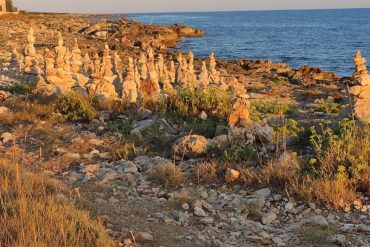
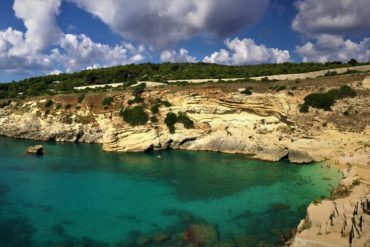
Ugento has about 12 km of coast on the Ionian Sea, almost all low and sandy, with short stretches of rocks, and its three seaside villages, Torre San Giovanni, Torre Mozza and Lido Marini, have the Blue Flag in 2026. Torre San Giovanni, 7 km away, is the main seaside village and was once the port of Messapian and Roman Ugento: around the sixteenth-century tower, now a lighthouse, with its black and white chequered decoration, are the harbour, the low, rocky coast to the north and the sandy beaches to the south. Read our guide to Torre San Giovanni and the one on the Torre San Giovanni lighthouse.
Torre Mozza, 11 km away, has a long beach of fine sand with a shallow sea, the 1565 tower on a lawn by the shore and, behind it, the dunes and basins of the park: read our guide to Torre Mozza. Lido Marini, 15 km away, partly in the municipality of Salve, has a wide beach of fine sand which, towards Santa Maria di Leuca, alternates with very low rocks: read our guide to Lido Marini. Off the coast lie the Secche di Ugento, shallow, uneven seabeds protected as an Oasi Blu (Blue Oasis), where local fishermen work with traditional methods, today a Slow Food Presidium.
Ugento is perfect for those who love history, archaeology and historic villages, for families looking for a quiet base near sandy beaches with a shallow sea, for anyone who wants to alternate the museum in the morning with the beach in the afternoon and for those who want to get around between Gallipoli and Santa Maria di Leuca. It is less suited to people who want the sea on their doorstep or nightlife: for that there are Torre San Giovanni and Gallipoli.
Free beach and facilities
Along the Ugento coast, beach clubs alternate with wide stretches of free beach; check access, parking and any paid zones on the spot. The sandy seabed slopes gently and is ideal with children; when the sea is rough, however, stay where you can touch the bottom. In the town you will find bars and restaurants; in summer the widest choice, especially in the evening, is in Torre San Giovanni.
For the beach, bring an umbrella, water and sun cream: there is no shade on the sand. In the park, don’t walk on the dunes and always use the boardwalks.
Ugento vs other villages of southern Salento
In southern Salento, towns and seaside villages are very close to each other. Here is a practical comparison to help you choose:
Ugento vs Torre San Giovanni
- Ugento: the town, with the museum, the castle and the churches, quiet evenings and the sea ten minutes away
- Torre San Giovanni: the seaside village, with the harbour, the lighthouse, the beach on your doorstep and a livelier evening scene in summer
Ugento vs Gallipoli
- Ugento: a compact, uncrowded old town, with the history of the Messapians and a Baroque castle
- Gallipoli: the old town on an island linked to the mainland by a bridge, much more crowded in summer, with the liveliest evening scene on the Ionian coast
Ugento vs Alessano
- Ugento: on the Ionian side, with the archaeological museum, the castle and sandy beaches a few minutes away
- Alessano: on the Adriatic side of the Capo di Leuca, with its Renaissance palazzi, the places of don Tonino Bello and swimming from the rocks at Marina di Novaglie
When to choose Ugento: if you love history and archaeology, are travelling with children and are looking for a quiet, central base between Gallipoli and Santa Maria di Leuca, with sandy beaches nearby.
When to choose somewhere else: if you want to step out of the house and be on the beach, choose one of the seaside villages, from Torre San Giovanni to Lido Marini.
Practical tips
Book ahead: the castle, the Cripta del Crocefisso, the Madonna di Costantinopoli and the Collezione Colosso can only be visited by booking, through the Sistema dei Beni Culturali della Città di Ugento, which also runs the museum. Opening times change with the seasons: check them before you go, and for the crypt plan to go by car, because it is outside the centre.
The old town is small: the museum, castle, cathedral and Piazza San Vincenzo are a few steps from one another and can be explored on foot. In summer visit it in the morning or towards evening, when it is less hot, and keep the middle of the day for the beach, under an umbrella. To go into the churches, dress appropriately and respect the services. For the walls in the countryside and for the crypt you need comfortable shoes; you reach the crypt down a steep flight of steps.
Useful practical information
| 📍 Where | Ugento (Lecce), in southern Ionian Salento, 7 km from the sea at Torre San Giovanni, 27 km from Santa Maria di Leuca and 61 km from Lecce |
|---|---|
| 🚗 Parking | In the streets around the old town, which you explore on foot; at the sea, in August, arrive early |
| ♿ Access | Compact old town, with stone-paved streets; a steep flight of steps at the Cripta del Crocefisso; walls in the countryside on uneven ground |
| 🏖 Beach | Long beaches of fine sand at Torre San Giovanni, Torre Mozza and Lido Marini, 7-15 km away |
| 🌊 Sea | Shallow and clear, suitable for children; Blue Flag 2026 |
| 👟 What to bring | Comfortable shoes, suitable clothes for the churches; for the sea, an umbrella, water and sun cream |
| 🍴 Food | Bars and restaurants in the town; more choice in Torre San Giovanni in summer |
| 📅 Best time | May, June and September; late September for the feast of the Santi Medici |
Where to stay near Ugento
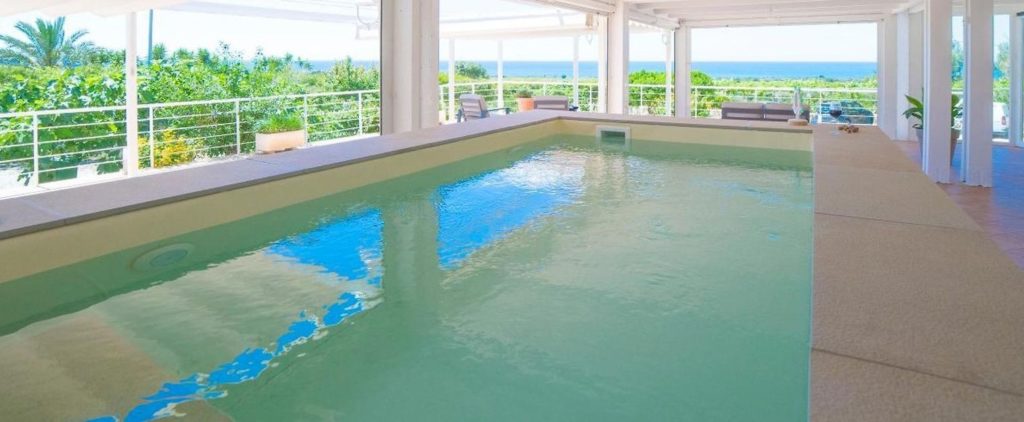
We have no houses in Ugento, but on the coast, between Lido Marini and Torre Pali, about 15 km from the old town and less than twenty minutes by car, you will find our Le Secche Suite & House – 2, La Secca di Ponente: 4 guests, 1 bathroom and 55 m², with a double bedroom and a bedroom with two single beds or a double bed, a private pool with a sea view, an equipped terrace, a garden, air conditioning, a fully equipped kitchen with dishwasher, Wi-Fi and private parking. Small dogs are allowed and the sea is less than 1 km away. It is the right base for alternating the beaches of Lido Marini and Torre Mozza with visits to the centre of Ugento.
The house is part of Le Secche Suite & House, a small complex of six units completed in 2024, with other options for 3 or 4 guests: you will find them all on the page holiday homes in Lido Marini.
Would you like advice on dates, getting around or other houses in the area? Contact us: we will help you choose the right option.
When to go and how much time to plan
April and May: the ideal time for the old town, the museum, the walls and walks in the park, with mild temperatures, green countryside and, at the basins, migrating birds. Swimming is for those who don’t mind cool water.
June: the sea is already pleasant, the beaches are quiet on weekdays and the days are very long: the morning in town, the afternoon by the sea.
July and August: it is high season, with food festivals, feasts and crowded seaside villages. It is hot: visit the old town early in the morning or in the evening and, for the beach, arrive early to find parking.
September: the best month, in our opinion. The sea is still warm, there are fewer people and at the end of the month there is the big feast of the Santi Medici.
October: days that are still mild, perfect for the museum, the crypt and walks among the dunes and olive trees.
November to March: you experience Ugento as an everyday town, ideal for a cultural visit. On 22 January there is the feast of the patron saint, San Vincenzo, and at the park’s basins you can see the birds that spend the winter here.
Events and festivals (indicative dates, check them every year on the Ugento municipality website and on SalentoMe):
- Patron saint’s feast and fair of San Vincenzo in Ugento: 22 January
- Feast of the Madonna della Luce, at the sanctuary: 16 February
- San Giuseppe: 19 March, with the «focareddrhe», bonfires of olive branches, and the tradition of ciciri e tria
- Sagra di ciciri e tria (chickpeas and pasta) in the old town of Ugento: July or August
- Feast of the Madonna dell’Aiuto in Torre San Giovanni: August, with the procession at sea
- Feast and fair of the Santi Medici in Ugento: 26-28 September
- Fair of San Francesco in Gemini: 4 October
How much time to allow: half a day is enough for the old town and the museum; a whole day if you add the castle, the crypt and the walls. With three or four days you can combine the seaside villages, the park, Gallipoli and Santa Maria di Leuca. A typical day:
- 10:00: the New Archaeological Museum, with the copy of the Zeus and the Athlete’s Tomb
- 11:30: a visit to the castle, booked in advance
- 13:00: lunch in town, with a plate of ciciri e tria
- 15:00: beach and a swim at Torre Mozza or Lido Marini
- 18:30: the Cripta del Crocefisso and the Madonna di Costantinopoli, by booking
- 20:00: sunset and a stroll in Torre San Giovanni, between the harbour and the lighthouse
- 21:30: a fish dinner in Torre San Giovanni or in the centre of Ugento
Surroundings and extra ideas
Ugento is in the middle of southern Ionian Salento: in a few minutes you can reach its seaside villages, the park, Gallipoli and the Capo di Leuca. Distances and driving times are approximate.
Torre San Giovanni (7 km, 10 minutes): Ugento’s main seaside village, with the harbour, the black and white chequered lighthouse tower, the remains of the Messapian walls near the tower and the pier where the fishermen sell the fish from the Secche. Read our guide to Torre San Giovanni.
Torre Mozza (11 km, 15 minutes): the 1565 tower left «mozza» (truncated), the long sandy beach with its shallow sea and the park’s basins, full of birds. Read our guide to Torre Mozza.
Lido Marini (15 km, 17 minutes): a long beach of fine sand that alternates with low rocks towards Torre Pali. Read our guide to Lido Marini.
Madonna del Casale (5 km, 6 minutes): a small hill between Ugento and the sea, with an old church which, according to tradition, was built by a shipwrecked sailor saved by the Madonna; after Easter the people of Ugento go up there for a traditional country outing.
Torre Pali and Pescoluse (15-17 km, 18 minutes): the tower on the islet off the shore, the Isola della Fanciulla and the white sand and shallow sea of the Maldives of Salento.
Gallipoli (25 km, 30 minutes): the old town on an island linked to the mainland by a bridge, the harbour and the liveliest evening scene on the Ionian coast.
Santa Maria di Leuca (27 km, 30 minutes): the lighthouse, the de Finibus Terrae sanctuary, the seafront with its nineteenth-century villas and the boats to the caves.
Local tip
Start at the museum and look at the Zeus up close; then step out into Largo Sant’Antonio and look up at the castle, a few steps away. You will understand why the Messapians, the Normans and the d’Amore marquises always wanted to be here, at the top of the hill: from up there you could control the whole surrounding territory, all the way to the sea.
At lunch, ask for ciciri e tria, Ugento’s signature dish: chickpeas and homemade pasta, with some of the pasta fried until crisp, the «frìzzuli», scattered on top. It is traditionally made on 19 March for San Giuseppe, and in summer it has a food festival all of its own in the old town.
Towards evening go down to Torre San Giovanni: at the fishing pier the fishermen sell the fish from the Secche di Ugento every day, when they get back to port, and the sunset over the Ionian Sea ends the day in the best possible way.
FAQ
Where is Ugento?
In southern Salento, in the province of Lecce, on the Ionian side, about 7 km from the sea at Torre San Giovanni, 25 km from Gallipoli, 27 km from Santa Maria di Leuca and 61 km from Lecce. In dialect it is called «Ušèntu».
What is there to see in Ugento?
The New Archaeological Museum, with the copy of the Zeus and the Athlete’s Tomb, the castle of the d’Amore marquises, the cathedral with the Diocesan Museum, the churches of the old town, the Messapian walls, the Cripta del Crocefisso with the Madonna di Costantinopoli and the hamlet of Gemini with its menhirs.
Where is the Zeus of Ugento?
The original, a bronze statue 74 cm tall from the end of the sixth century BC, found in Ugento in 1961, has been in the Museo Archeologico Nazionale di Taranto since 1969. In Ugento’s New Archaeological Museum you can see a faithful copy, next to its capital and the story of the discovery.
Can you visit the castle of Ugento?
Partly, yes: after the restoration part of the castle is a hotel, and another part can be visited through the town’s Sistema dei Beni Culturali, by booking only. The same goes for the Cripta del Crocefisso and the church of the Madonna di Costantinopoli.
Where can you see the Messapian walls?
In a few open-air stretches: in via Tasso, in via Mura Ugentine, via San Francesco and via Bolzano, in the Sant’Antonio area, next to a necropolis, and in the Porchiano area, on the road to Taurisano, where the finest stretch survives. Some blocks are also displayed in the museum.
Does Ugento have a coastline?
Yes: the municipality has about 12 km of low, sandy coast, with the seaside villages of Torre San Giovanni, 7 km away, Torre Mozza and Lido Marini, all Blue Flag 2026, and the Litorale di Ugento Regional Nature Park behind the beaches.
How do you get to Ugento without a car?
By train: from Lecce the FS Sud Est regional trains reach Ugento-Taurisano station, about 4 km from the centre. In summer the «Salento in Bus» lines connect many places on the coast. Always check timetables and changes before you set off.
When is the best time to go?
May, June and September, when it is less hot for exploring the town and the sea is already, or still, pleasant. In late September there is the feast of the Santi Medici, and on 22 January that of the patron saint, San Vincenzo.
Where to stay near Ugento?
Between Lido Marini and Torre Pali, about 15 km away and less than twenty minutes by car, there is Salento Prime’s Le Secche Suite & House – 2: 4 guests, a private pool with a sea view and private parking. You will find the other houses on the holiday homes in Lido Marini page.
Conclusion
Ugento is the southern Salento you don’t expect: the largest city of the Messapians, a bronze Zeus found by chance, a castle turned into a Baroque palace, a crypt frescoed with fantastic animals and, a few minutes away, the sandy beaches of Torre San Giovanni, Torre Mozza and Lido Marini. Give it at least a day, without hurrying, between the museum, the castle and the walls, and leave the afternoon for the sea.
If you want to stay nearby, between Lido Marini and Torre Pali you will find our Le Secche Suite & House – 2: 4 guests, a private pool with a sea view and private parking, less than twenty minutes from the centre of Ugento. You will find our houses in the area on the page holiday homes in Lido Marini.
Discover the available accommodations with Salento Prime. To best organize your base and transfers, contact us here or start a chat on WHATSAPP.
Cover photo: Wikiubik, CC BY-SA 4.0, via Wikimedia Commons