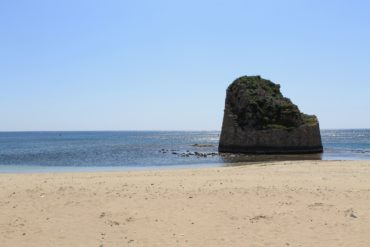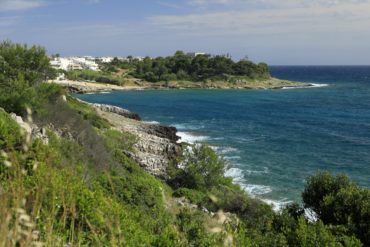
Looking for a sheltered sandy bay, with shallow, clear water, a few minutes from Santa Maria di Leuca? This guide takes you to Marina di Felloniche, or simply Felloniche, on the Ionian coast of the Capo di Leuca: the beach in the bay, the posidonia meadow off the shore, the Baia di Ciardo, Leuca’s western caves by kayak or boat and everything there is to see nearby, with practical tips and local curiosities.
In short
Marina di Felloniche, or simply Felloniche, is a seaside resort on the Ionian coast of the Capo di Leuca, split between the municipalities of Patù and Castrignano del Capo (Lecce), about 4 km from Santa Maria di Leuca. It is a small bay of fine sand enclosed by low rocks, partly sheltered from the wind, with a shallow seabed suited to families. Off the shore lies a protected posidonia meadow. In 2024 and 2025 it had the Blue Flag. The best months are June and September.
What is Marina di Felloniche?
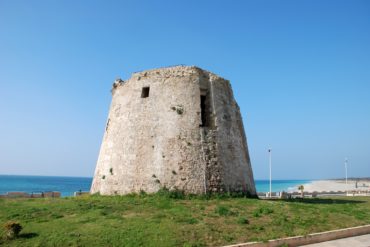
Marina di Felloniche is a resort of little villas and holiday homes on Salento’s Ionian coast, between Marina di San Gregorio to the west and Santa Maria di Leuca to the east. It has grown up since the 1960s around a sandy bay bordered by a coast of low rocks. In the sea off the beach there is a posidonia meadow protected as a habitat of Community interest; towards Leuca the coast becomes rocky, with small coves such as the Baia di Ciardo, the ruins of Torre Marchiello and the western caves.
Felloniche is made up of little white villas, gardens, dry-stone walls and Mediterranean scrub, with a seafront that runs right behind the beach. It is a place born for holidays: in winter it is almost deserted, in summer it fills with families and holidaymakers, who find the sea close at hand and Leuca a few minutes away by car.
Here the rocky coast of the Capo di Leuca opens into a small bay of fine sand: you walk into the water, the seabed stays shallow for a few metres and the water is clear, with the dark patches of posidonia on the bottom. This is the Salento of families with children, quiet swims and kayak trips to the caves. In this guide you will find how to get there, where to swim, what to see and how to plan your day, nearby too.
Curiosities and atmosphere
Felloniche has one peculiarity: it is split between two municipalities. The part towards San Gregorio belongs to Patù, whose roughly 3 km of Ionian coastline are made up precisely of Felloniche and San Gregorio, its two seaside villages; the part towards Leuca belongs to Castrignano del Capo. It is a young resort: its development began in 1960, when the roads and the first services were put in place. In 2024 and 2025 the sea at Felloniche and San Gregorio had the Blue Flag.
The real treasure, though, is underwater. Off the coast, between Capo San Gregorio and Punta Ristola, lies a posidonia meadow of about 270 hectares, protected as a Site of Community Importance in the Natura 2000 network. Posidonia is not a seaweed but a marine plant, with roots, leaves and flowers: its meadows are home to fish and small organisms and are a sign of a clean sea. On land, too, the landscape is protected: the whole territory of Patù is under landscape protection, with Mediterranean scrub, thyme, myrtle, wild orchids, Leuca alyssum and the pajare, the old dry-stone farm buildings. Towards Leuca, on a point 12 metres above the sea, stand the ruins of Torre Marchiello, also called Torre Imbriachelli, a sixteenth-century watchtower built against pirate raids.
Where it is and how to reach it
Marina di Felloniche is on the Ionian coast of the Capo di Leuca, along the coast road that leads from Santa Maria di Leuca to Torre Vado and Pescoluse, just east of Marina di San Gregorio. Santa Maria di Leuca is about 4 km away, the town of Patù 6 km inland, Gallipoli 46 km and Lecce about 80 km.
By car: from Lecce take the SS101 to Gallipoli and then the SS274 towards Santa Maria di Leuca, leaving it for Patù and San Gregorio; once you reach the sea, follow the coast road towards Leuca: just over an hour and a quarter without traffic. You park along the coast road and in the streets near the sea; check the paid zones on the spot. In August it is best to arrive early in the morning.
By public transport: national trains arrive in Lecce; from there the FS Sud Est line to Gagliano del Capo stops at Morciano-Barbarano-Castrignano-Giuliano station and ends at the Gagliano Leuca terminus, the two nearest stations: check the timetables and any replacement buses. In summer «Salento in Bus» line 108, Lecce – Gallipoli – Santa Maria di Leuca, stops at San Gregorio, about 1.5 km away, and in Leuca (in 2026 from 13 June to 13 September): check this year’s routes and timetables before you set off. The most convenient airport is Brindisi, about two hours away by car.
What to do and what to see
Felloniche is about the sand and the sea: a swim in the bay in the morning, a swim with a mask along the rocks at midday, a kayak or boat trip towards the Leuca caves in the afternoon and a stroll along the Leuca seafront in the evening. Here are the experiences not to miss.
1. Swimming in the sandy bay (half a day)
The beach at Felloniche is a stretch of fine sand closed off at the sides by low rocks, in a curved bay that partly shelters it from the wind and the waves. You walk into the water and the seabed stays shallow for a few metres: that is why it is popular with families with small children. The seafront runs right behind the beach, so bars and facilities are close at hand. When the sea is calm the water is clear and you can see the dark patches of posidonia on the bottom.
2. Mask and snorkel over the posidonia and the rocks (1 hour)
At the sides of the bay the sand gives way to low rocks and a mixed seabed of sand, boulders and posidonia: with a mask and snorkel you can watch the fish that live among the leaves of the meadow. Posidonia is protected: don’t pull it up and, if you go out by boat, don’t anchor on the meadow. Bring reef shoes, because the boulders are slippery.
3. The Baia di Ciardo (1-2 hours)
Towards Leuca the coast becomes rockier and opens into small coves. The best known is the Baia di Ciardo, a small inlet of pebbles and rocks with deeper, intensely blue water, which you reach along a little side road off the coast road. It is the right place for those who love swimming, less suited to small children; there are usually fewer people than in the sandy bay, but space is limited, so arrive early.
4. By kayak or boat to the western caves (half a day)
Between Felloniche and Punta Ristola the coast is full of caves that can only be seen from the sea: the Grotta del Drago, about 60 metres deep, with a rock that looks like a dragon’s head; the Grotta delle Tre Porte, with its three entrances, where the molar of a Neanderthal child was found; the Grotta dei Giganti and the Grotta della Stalla. In summer, kayak and boat trips leave from the Felloniche and San Gregorio area: choose a day when the sea is calm and check operators, times and conditions on the spot. Read our guide to the Leuca caves.
5. Torre Marchiello and Punta Ristola (1-2 hours)
Along the coast towards Leuca, on a low point above the sea, stand the ruins of Torre Marchiello, a sixteenth-century watchtower shaped like a truncated cone: today it is little more than a heap of stones, but it tells of the centuries when the sea was watched from here against pirates. A little further on you reach Punta Ristola, the southernmost tip of Salento, where Pope Benedict XVI landed by helicopter in 2008. On the point opens the Grotta del Diavolo, already used in the Neolithic, which you can also reach from land through an opening in the back of the rock. Wear closed shoes: the rock is uneven.
6. Marina di San Gregorio and the ancient port of Vereto (1 hour)
1.5 km to the west is Marina di San Gregorio, Patù’s other seaside village, with a coast of rocks and small coves of sand and pebbles. This was the port of the Messapian city of Vereto: on the headland, stretches of walls made of squared blocks from the second century BC survive, and in the water of the bay an ancient submerged pier built of rubble stone is preserved, visible a few metres down. The sixteenth-century tower that gave the place its name no longer exists: a private house stands in its place today.
7. Patù, the Centopietre and Vereto (2-3 hours)
6 km from the sea is Patù, the town that San Gregorio and the western part of Felloniche belong to, one of the Borghi Autentici d’Italia (authentic villages of Italy) since 2016. Here stands the Centopietre, a ninth-century funerary monument built from a hundred stone blocks taken from the Messapian city of Vereto: according to tradition it is the tomb of the knight Geminiano, killed by the Saracens shortly before the battle of 24 June 877. It has been a national monument since 1873 and inside it preserves traces of fourteenth-century frescoes. Also worth seeing are the church of San Giovanni Battista, from the tenth-eleventh centuries, also built with the stones of Vereto, and the hill of Vereto, where the small seventeenth-century church of the Madonna di Vereto stands on the ancient acropolis.
Sea, sand and who it suits
The sea at Felloniche is clear and, on windless days, as calm as a swimming pool: turquoise over the sand and darker where the posidonia begins. The beach is fine sand, closed off at the sides by low rocks; the seabed slopes gently and stays shallow for a few metres, then becomes a mix of sand, boulders and posidonia. The bay faces south: with the tramontana, the north wind, the sea is usually calm; with the sirocco and the libeccio the waves come in and you need to swim with care.
It is perfect for families with small children, for those looking for a quiet sandy beach near Leuca, for those who love snorkelling and for anyone who wants to explore the caves by kayak. It is less suited to people dreaming of a long beach, which they will find at Pescoluse, about 8 km away, and to those who want bars and nightlife on their doorstep: for that there is the Leuca seafront, a few minutes away.
Free beach and facilities
Along the bay, stretches of free beach alternate with beach clubs that hire out umbrellas and sunbeds; in summer there are also kiosks and inflatables. On the seafront and in the nearby streets there are bars, restaurants and pizzerias, open mainly in summer; for groceries and other services there are San Gregorio, Patù and Santa Maria di Leuca, a few minutes away. Check on the spot which stretches are free.
In the bay, bring an umbrella and sun cream; if you go to Ciardo or onto the rocks, add reef shoes, water and a thick towel, because there is no shade there.
Felloniche vs other seaside villages of the Capo di Leuca
On this stretch of coast the villages are very close to each other. Here is a practical comparison to help you choose:
Felloniche vs Marina di San Gregorio
- Felloniche: a sandy bay with a shallow seabed, easy with children
- San Gregorio: rocks and small coves of sand and pebbles, the remains of the ancient port of Vereto and a sea that is ideal for snorkelling
Felloniche vs Santa Maria di Leuca
- Felloniche: a quiet sandy beach, a few minutes from everything
- Leuca: the lighthouse, the de Finibus Terrae sanctuary, the seafront with its nineteenth-century villas, the harbour with the boats to the caves and every service
Felloniche vs Torre Vado
- Felloniche: more secluded and quiet, with the sandy bay and the western caves nearby
- Torre Vado: the little harbour with its sixteenth-century tower, the freshwater springs among the rocks and a seafront that is lively in the evening
Felloniche vs Pescoluse
- Felloniche: a small sandy bay among the rocks, a few minutes from Leuca
- Pescoluse: the long white sandy beach and the shallow sea of the Maldives of Salento, very crowded in August
When to choose Felloniche: if you are travelling with children, want a secluded sandy beach and like having Leuca and the caves a few minutes away.
When to choose somewhere else: if you are looking for high cliffs and deep sea, look at the Adriatic coast of the Capo di Leuca, such as Marina di Novaglie, about 12 km away; if you want a long sandy beach, go to Pescoluse, about 8 km away.
Practical tips
In July and August get to the sea early in the morning: parking along the coast road and in the nearby streets is limited and the bay fills up quickly. For the Baia di Ciardo and the cave trip, choose a windless day, preferably with the tramontana. If the sea is rough, don’t go down onto the rocks: waves come in without warning and getting out of the water becomes difficult.
Respect the posidonia: it is protected and good for the sea. If in autumn or winter you find heaps of dry leaves on the shore, they are not rubbish but posidonia leaves washed up by storms, which protect the beach from erosion. For the evening, the seafront of Santa Maria di Leuca is a few minutes’ drive away.
Useful practical information
| 📍 Where | Marina di Felloniche (Patù and Castrignano del Capo, Lecce), 4 km from Santa Maria di Leuca and about 80 km from Lecce |
|---|---|
| 🚗 Parking | Along the coast road and in the streets near the sea; few spaces in August, arrive early and check the paid zones |
| ♿ Access | Sandy beach just below the seafront, gradual entry into the water; pebbles and rocks at Ciardo |
| 🏖 Beach | Fine sand in the bay, low rocks at the sides; free stretches and beach clubs |
| 🌊 Sea | Shallow for a few metres and clear, with the protected posidonia meadow |
| 👟 What to bring | Umbrella, sun cream, mask and reef shoes for Ciardo and the rocks |
| 🍴 Food | Bars, restaurants and pizzerias in Felloniche and San Gregorio, open mainly in summer; more choice in Leuca |
| 📅 Best time | June and September; in July and August early in the morning |
Where to stay in Marina di Felloniche
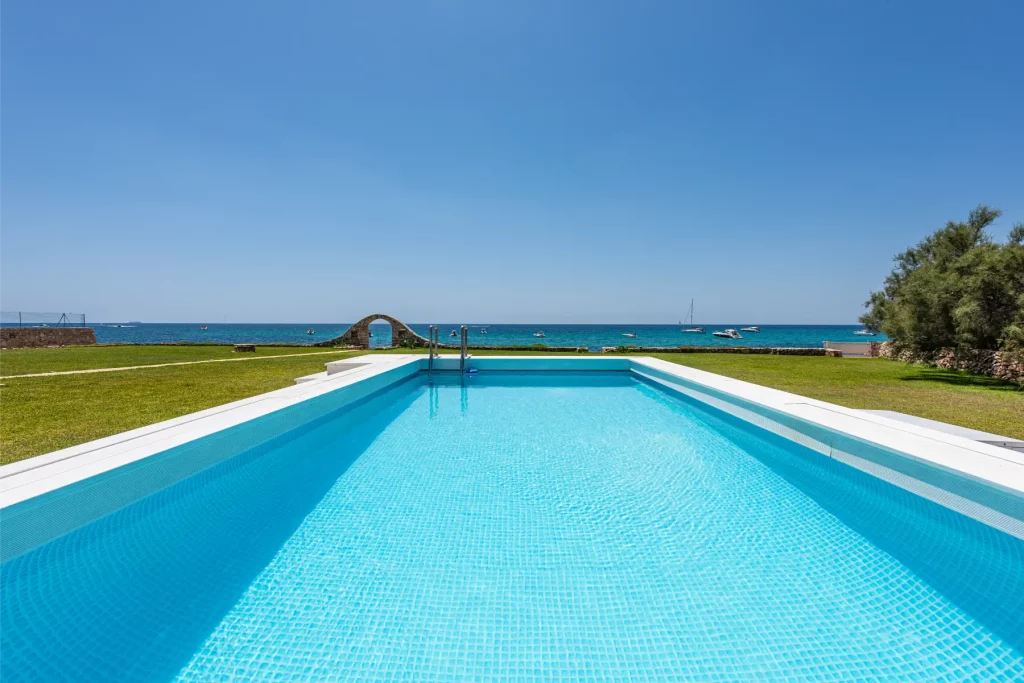
To enjoy the bay early in the morning and the caves when the sea is calm, it is worth staying here. On the seafront, between the Baia di Ciardo and the beach of Felloniche, about 300 metres’ walk from the sand, you will find our Villa Luxury 73: up to 12 guests and 3 bathrooms, in two separate buildings, each with its own kitchen, set in a 3,000 m² garden with a lawn. There is a private pool heated up to 35 °C, pleasant out of season too, with a panoramic hot tub for four adults and a sunset view, two sea-view terraces, a barbecue area, a covered parking space and an outdoor shower; there is also air conditioning and Wi-Fi, and small dogs are allowed.
You will find our other houses in the area on the page holiday homes in Santa Maria di Leuca. Would you like advice on dates, getting around or other houses in the area? Contact us: we will help you choose the right option.
When to go and how much time to plan
June: the sea is already pleasant, the bay is quiet on weekdays and the days are very long: the ideal time with children.
July and August: it is high season. The sea is warm and the bay fills up, especially at weekends and around the Ferragosto holiday: arrive early in the morning or enjoy the beach in the late afternoon. It is also the season for kayak and boat trips to the caves.
September: the best month, in our opinion. The sea is still warm, there are far fewer people and the light over the bay is beautiful.
May and October: the ideal time for walks along the coast towards Leuca and for visiting Patù, the Centopietre and Vereto; swimming is for those who don’t mind cool water.
From November to April: Felloniche is almost deserted and many houses are closed. Storms wash posidonia leaves up onto the shore, and the waves on the rocks towards Leuca are quite a sight, best watched from a distance.
Events and festivals (indicative dates, check them every year on the Patù municipality website and on SalentoMe):
- San Giovanni Battista fair in Patù: 24 June
- Sagra della sciuscella, the carob festival, in Patù: August
- Feast of San Michele Arcangelo in Patù: 29 September
How much time to allow: one day is enough for the bay and the Baia di Ciardo; with three or four days, add the cave trip, Punta Ristola, Leuca and Patù. Felloniche is also a good base for a week in the Capo di Leuca, between the Ionian and the Adriatic coasts. A typical day:
- 8:00: a swim in the bay, when the sea is at its calmest and the beach is still empty
- 10:30: mask and snorkel along the rocks or at the Baia di Ciardo
- 13:00: lunch in Felloniche or in San Gregorio
- 16:00: a kayak or boat trip to the western caves, when the sea is calm
- 19:00: sunset at Punta Ristola
- 21:00: a stroll along the seafront of Santa Maria di Leuca
Surroundings and extra ideas
Felloniche is well placed for exploring the whole tip of the Capo di Leuca, with its caves, coastal towers, sandy beaches and inland villages. Distances and driving times are approximate.
Marina di San Gregorio (1.5 km, 3 minutes): Patù’s other seaside village, with its coves among the rocks and the remains of the ancient port of Vereto.
Torre Marchiello and Punta Ristola (1.5-3 km, 3-7 minutes): the ruins of the sixteenth-century tower and the southernmost tip of Salento, with the Grotta del Diavolo.
Santa Maria di Leuca (4 km, 8 minutes): the 48-metre lighthouse, which dominates the Capo from 102 metres above the sea, the de Finibus Terrae sanctuary, the seafront with its nineteenth-century villas and the boats to the caves. Read the guide to Santa Maria di Leuca and the one to the Leuca caves.
Castrignano del Capo (4.5 km, 7 minutes): the town that Santa Maria di Leuca and the eastern part of Felloniche belong to.
Patù and the Centopietre (6 km, 9 minutes): the village with the Centopietre monument, the church of San Giovanni Battista and the hill of Vereto, the Messapian city destroyed by the Saracens in the ninth century.
Torre Vado (6 km, 7 minutes): the little harbour with its sixteenth-century tower, the freshwater springs among the rocks and a seafront that is lively in the evening. Read our guide to Torre Vado.
Posto Vecchio and Pescoluse (7-8 km, 9-10 minutes): the long white sandy beaches and the shallow sea of the Maldives of Salento, ideal with small children.
Ponte del Ciolo and Marina di Novaglie (12 km, 16-20 minutes): on the Adriatic coast, cliffs, caves and deep sea; the right place to go on sirocco days. Read our guide to Marina di Novaglie.
Local tip
Go to the sea early: in the morning the bay is usually calmer, the water is clearer and with a mask you can get a good look at the posidonia and the fish that live in it. It is also the time when the beach is still empty and the sand isn’t scorching.
Before you plan the kayak or boat trip to the caves, check the wind. With the tramontana the Ionian coast is sheltered and the sea towards Punta Ristola is calm and clear; with the sirocco the waves come in and it is better to move to the Adriatic coast, towards the Ciolo and Novaglie.
And in the evening, before dinner, drive the few minutes to Punta Ristola: from the tip of Salento, the sunset light on the Ionian coast is the best way to end a day at Felloniche.
FAQ
Where is Marina di Felloniche?
On the Ionian coast of the Capo di Leuca, in the province of Lecce, between Marina di San Gregorio and Santa Maria di Leuca: Leuca is about 4 km away, Lecce about 80 km. It is also known simply as Felloniche.
Is Felloniche in the municipality of Patù or of Castrignano del Capo?
In both: the part towards San Gregorio belongs to Patù, the part towards Leuca to Castrignano del Capo. For the municipality of Patù, Felloniche and San Gregorio are its two seaside villages on the Ionian Sea.
Is there a sandy beach at Felloniche?
Yes: it is a small bay of fine sand closed off at the sides by low rocks, with a seabed that stays shallow for a few metres. Towards Leuca there are also coves of pebbles and rocks, such as the Baia di Ciardo.
Is Felloniche suitable for children?
Yes: the sand, the gradual entry into the water and the sheltered bay make it easy for families. On the rocks at the sides and at Ciardo, however, the bottom is uneven and deeper: bring reef shoes and keep an eye on children.
Does Felloniche have the Blue Flag?
It had it in 2024 and 2025, together with Marina di San Gregorio, for the municipality of Patù; in 2026 the Blue Flag was not renewed.
What are the dark patches in the sea at Felloniche?
They are meadows of posidonia, a marine plant: off the coast, between Capo San Gregorio and Punta Ristola, there is a Site of Community Importance of about 270 hectares that protects it. It is a sign of a clean sea: don’t pull it up and, if you are in a boat, don’t anchor on the meadow.
Can you see the Leuca caves from Felloniche?
Yes, from the sea: in summer kayak and boat trips leave from the area for the western caves, such as the Grotta del Drago and the Grotta delle Tre Porte. Go only when the sea is calm and check operators and times on the spot.
How do you get to Felloniche without a car?
In summer on «Salento in Bus» line 108, Lecce – Gallipoli – Santa Maria di Leuca, which stops at San Gregorio, about 1.5 km away, and in Leuca. The nearest railway stations are Morciano-Barbarano-Castrignano-Giuliano and Gagliano Leuca, on the FS Sud Est line.
When is the best time to go?
June and September, when the sea is already, or still, warm and there are fewer people. In July and August go to the beach early in the morning.
Where to stay in Marina di Felloniche?
On the seafront, between the Baia di Ciardo and the beach of Felloniche, there is Salento Prime’s Villa Luxury 73: up to 12 guests, with a heated pool and a hot tub. You will find the other houses in the area on the holiday homes in Santa Maria di Leuca page.
Conclusion
Marina di Felloniche is the quietest side of the tip of the Capo di Leuca: a small sandy bay with shallow, clear water, a protected posidonia meadow off the shore, rocky coves towards Leuca and the western caves to reach by kayak or boat. Choose June or September, or in August arrive early in the morning, and don’t leave without a trip to the caves when the sea is calm.
If you want to stay by the sea, between the Baia di Ciardo and the beach of Felloniche you will find our Villa Luxury 73: on the seafront, up to 12 guests, 3 bathrooms, a heated pool and a hot tub with a sunset view. You will find our houses in the area on the page holiday homes in Santa Maria di Leuca.
Discover the available accommodations with Salento Prime. To best organize your base and transfers, contact us here or start a chat on WHATSAPP.
Cover photo: Falk2, CC BY-SA 4.0, via Wikimedia Commons