Looking for the point where Salento ends, with a lighthouse, a sanctuary and the sea on both sides? This guide takes you to Punta Meliso, the cape of Santa Maria di Leuca: the viewpoint on the square of the Basilica de Finibus Terrae, the lighthouse, the monumental waterfall of the Acquedotto Pugliese on the evenings when it is open, the caves below the headland and everything there is to see nearby, with practical tips and local curiosities.
In short
Punta Meliso, or Punta Mèliso, is the cape of Santa Maria di Leuca, in the municipality of Castrignano del Capo (Lecce), at the southern tip of Salento. On top of the headland stand the lighthouse, one of the most important in Italy, and the Basilica di Santa Maria de Finibus Terrae with its large panoramic square; towards the harbour runs the monumental waterfall of the Acquedotto Pugliese, which is opened only on some evenings. By convention, this is where the Ionian Sea and the Adriatic Sea meet. An hour or two is enough for the visit; the best times are dawn, sunset and the waterfall evenings.
What is Punta Meliso?
Punta Meliso is the rocky headland that closes off the bay of Santa Maria di Leuca to the east, also called Capo Santa Maria di Leuca or Capo di Leuca. It is the second southernmost point of Puglia, after nearby Punta Ristola, but it is here that sailors’ tradition sets the boundary between the two seas. On the cape you can visit the square and the Basilica de Finibus Terrae, the lighthouse, the staircase with the monumental waterfall and the pine wood of the Croce Pietrina; below, the sea caves of Leuca open onto the deep sea.
For many travellers Punta Meliso is the point where the journey through Salento comes to an end: the road climbs through the pines, the large white square opens up in front of the Basilica and, beyond the arches, there is only the sea. On one side you look at the Adriatic coast running back up towards Otranto, on the other at the bay of Leuca with the harbour, the seafront lined with nineteenth-century villas and Punta Ristola. Santa Maria di Leuca, the hamlet of Castrignano del Capo that stretches around the bay, has just under 1,400 inhabitants, but in summer it fills with visitors and pilgrims.
You don’t come here for the beach: Punta Meliso is a high cliff, with deep sea and caves below the headland. You come for the view, for the lighthouse and the sanctuary, to see the waterfall on the evenings when it flows down to the harbour and to set off by boat towards the caves. In this guide you will find how to get there, what to see on and below the cape, when to go and how to plan your day, nearby too.
Curiosities and atmosphere
The name Leuca comes from the Greek leukós, white, perhaps because of the colour of the rocks that drop sheer into the sea; in dialect it is called Lèviche. There is also a legend about Punta Meliso: Meliso was a shepherd who rejected the love of a siren to stay faithful to his beloved. Out of revenge, the siren killed the two young people and separated their bodies; the goddess Minerva, moved, turned them into the two rocky spurs that close off the bay of Leuca, Punta Meliso and Punta Ristola. And it was to Minerva, according to tradition, that the temple on the headland where the Basilica stands today was dedicated: the church still holds a large block of stone called the «Ara di Minerva».
By nautical convention Punta Meliso marks the boundary between the Adriatic Sea, to the east, and the Ionian Sea, to the west, and together with Punta Alice, in Calabria, it closes off the Gulf of Taranto. On some days you can see from the viewpoint a line on the sea separating two different colours: it is where the currents coming from the Gulf of Taranto and the Strait of Otranto meet, but in popular imagination it is the boundary between the two seas. The lighthouse took the place of a sixteenth-century watchtower, demolished during the works: a few courses of its walls remain about forty metres from the lighthouse. The lighthouse of Santa Maria di Leuca was nominated in the FAI’s «I Luoghi del Cuore» (Places of the Heart) census from 2016 to 2022, and since 2006 the whole cape has been part of the Costa Otranto – Santa Maria di Leuca e Bosco di Tricase Regional Nature Park, where the Capo di Leuca cornflower also grows, a very rare plant that lives only in this area.
Where it is and how to reach it
Punta Meliso is at the southern tip of Salento, in the municipality of Castrignano del Capo, at the end of the bay of Santa Maria di Leuca, above the harbour. Punta Ristola, the other point of the bay, is less than 2 km to the west as the crow flies. The town of Castrignano del Capo is about 5 km away, Gagliano del Capo 6 km, Gallipoli 47 km and Lecce about 69 km.
By car: from Lecce take the SS16 to Maglie and then the SS275, which runs all the way to Santa Maria di Leuca and climbs through the pines up to the sanctuary: about an hour and a quarter without traffic. From the Adriatic coast, from Castro and the Ciolo, you get there on the coast road. There are car parks near the lighthouse and the square and another at the foot of the waterfall, near the harbour: check the paid zones on the spot. On the evenings when the waterfall is open and on 15 August, arrive well in advance.
On foot: from the harbour you can climb up to the cape by the monumental staircase that runs alongside the waterfall. Allow a quarter of an hour or a little more for the climb at a gentle pace, with the harbour and the bay behind you.
By public transport: national trains arrive in Lecce; from there the FS Sud Est (Ferrovie del Sud Est) network runs as far as Gagliano del Capo station, about 7 km away: check the timetables and any replacement buses. In summer «Salento in Bus» line 108, Lecce – Gallipoli – Santa Maria di Leuca, ends in Leuca, at Piazzale Le Terrazze (in 2026 from 13 June to 13 September): check this year’s routes and timetables before you set off. The most convenient airport is Brindisi, just under two hours away by car.
What to do and what to see
Punta Meliso is about the view from above and from the sea: the viewpoint, the lighthouse and the Basilica on the square, the staircase and the waterfall running down to the harbour, and then the caves you can only see by boat. Here are the experiences not to miss.
1. The square and the viewpoint over the two seas (30 minutes)
The large square in front of the Basilica, Piazza Giovanni XXIII, is one of the most famous viewpoints in Salento: it is paved with pale stone and enclosed by a long row of arches, and from here your gaze sweeps from the Adriatic coast to the bay of Leuca, as far as Punta Ristola. In the centre rises the column of 1694, commissioned by the Duke of Alessano, Filiberto Aierbo d’Aragona, topped by a small praying Madonna who receives the greeting of the angel placed at the start of the arches. On the edge of the square stands the monumental cross, erected in 1901, and a memorial commemorates the Mass celebrated here by Pope Benedict XVI on 14 June 2008.
2. The Punta Meliso lighthouse (20-30 minutes)
Next to the square stands the lighthouse of Santa Maria di Leuca, a white tower almost 50 metres high, with its lantern 102 metres above sea level. It was designed by the engineer Achille Rossi, a name that also appears among the designers of Leuca’s nineteenth-century villas, and it was lit for the first time on 6 September 1866; until 1937 it ran on petroleum. Today it is managed by the Italian Navy and at night it gives three white flashes every 15 seconds, visible up to about 40 km away. It is usually admired from outside; on rare occasions it has been opened to visitors, with the climb up the 254 steps of the spiral staircase to the lantern. To find out more, read our article on the lighthouse of Santa Maria di Leuca.
3. The Basilica di Santa Maria de Finibus Terrae (30 minutes)
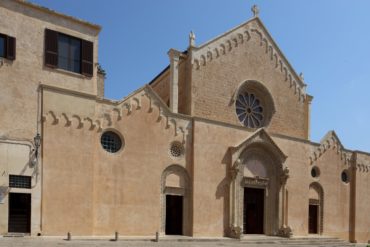
The Basilica, the sanctuary «at the ends of the earth», has been a destination for pilgrims for centuries. The church you see today was rebuilt between 1720 and 1755 by Monsignor Giovanni Giannelli to look like a fortress, to defend it from raids from the sea, and it has been a minor basilica since 1990. Inside, in the single nave, are the painting of the Madonna and Child by Palma il Giovane on the high altar, the «Ara di Minerva» and a bronze plaque for the roughly 700 sailors of the French cruiser Léon Gambetta, sunk off Leuca on the night of 26 April 1915. The three bronze doors are by the sculptor Armando Marrocco, from 2000; next to the church is the Museo Vito Mele, with works of contemporary art. You will find its history and tips in our article on the Sanctuary of Santa Maria de Finibus Terrae; for times and services, see the Basilica website.
4. The monumental waterfall and the staircase (1 hour)
The monumental waterfall, the point where the Acquedotto Pugliese ends, runs down from the cape towards the harbour: work on the aqueduct began in 1906 and the water reached Leuca in 1939, when the project was completed. On opening evenings the water flows down the slope between two staircases and pours into the sea; at the foot of the waterfall, in the basin, stands a Roman column, placed there in 1939 to celebrate the aqueduct. The waterfall is not always open: the municipality of Castrignano del Capo publishes the calendar every year, and in 2026 the waterfall was open mainly on Friday evenings in summer, with the artistic lighting, in use since 2015. Watch it from below, from the little square near the harbour, or from above, near the Basilica square. Even when the waterfall is closed, the two staircases on either side of it link the cape to the harbour.
5. The pine wood, the Croce Pietrina and the Via Crucis (30 minutes)
On the avenue that climbs to the Basilica, among the pines, stands the Croce Pietrina, which commemorates the passage of Saint Peter: according to tradition, the apostle landed at Leuca and began preaching the Gospel from here, before reaching Rome. In the pine wood next to the square, a path with steps follows the fourteen stations of the Via Crucis: it is the shadiest and quietest corner of the cape, pleasant in the heat of the day.
6. By boat below the cape: the Leuca caves (2-3 hours)
The best way to see Punta Meliso is from the sea. In summer, boat trips to the caves leave from Leuca harbour: east of the cape are the eastern caves, such as those of Terradico and the Vore, and to the west the western caves, beyond Punta Ristola. Right below the waterfall opens the Grotta del Morigio, also called the Grotta degli Innamorati, which can only be reached from the sea; near the harbour are the Grotte Cazzafri, which put on a lovely play of light at sunset. The eastern caves are at their best in the morning, the western ones towards evening. Choose a day when the sea is calm and check operators, times and conditions on the spot. Read our guide to the Leuca caves.
7. Dawn and sunset on the cape (1 hour)
Punta Meliso is one of the most beautiful places in Salento to watch the sun rise: from the viewpoint you watch dawn break over the Adriatic Sea, when the square is still empty and the light colours the lighthouse and the façade of the Basilica. In the evening the light moves over to the bay of Leuca and Punta Ristola, towards the Ionian Sea. Bring a sweatshirt: the wind often blows on the cape, even in summer.
Sea, rocks and who it suits
The sea below Punta Meliso is deep and an intense blue, with rock walls dropping sheer into the water and caves opening at sea level. The cape is exposed to the winds: when the sea is calm the water is clear and the boat trip is spectacular; in strong wind the waves break below the lighthouse and the sea is best watched from above. From the viewpoint, on the right days, you can make out the line between the colours of the two seas.
Punta Meliso appeals to everyone: to couples, for the dawn and the sunset; to families, because you can drive right up to the square and the visit is short; to those who love history and photography; to pilgrims. It is less suited to people looking for a beach day under an umbrella, which is best planned on the Leuca seafront or on the beaches of the Ionian coast.
Free beach and facilities
There is no beach at Punta Meliso: the coast is high and rocky and you look at the sea from above. For a swim, go down to the Leuca seafront, towards Punta Ristola, where there are stretches of rocks and a few beach clubs (check on the spot), or swim during the stops on the boat trips to the caves. On the square there is a bar and near the staircase there are paid toilets; at the harbour and on the seafront you will find bars, restaurants and ice-cream shops.
Bring water and a hat: the square is in full sun and the pale stone reflects the light.
Punta Meliso vs other capes and viewpoints in Salento
In this part of Salento there are other places famous for their views. Here is a practical comparison to help you choose:
Punta Meliso vs Punta Ristola
- Punta Meliso: the lighthouse, the Basilica and the square, the waterfall and the conventional boundary between the two seas
- Punta Ristola: the true southernmost point of Puglia, at the other end of the bay of Leuca, more natural, with the western caves beyond the point
Punta Meliso vs Punta Palascia (Otranto)
- Punta Meliso: the southern cape, with the lighthouse and the sanctuary, reachable by car right up to the square
- Punta Palascia: the easternmost point of Italy, with a lighthouse on the cliff near Otranto, about an hour away by car
Punta Meliso vs Ponte del Ciolo
- Punta Meliso: views from above, with monuments and facilities close at hand
- Ciolo: the gorge between towering walls, the bridge and the little pebble bay for a swim, about 7 km away
Punta Meliso vs the Leuca seafront
- Punta Meliso: the viewpoint, the lighthouse and the sanctuary
- Seafront: the nineteenth-century villas, the harbour, the bars and the beach clubs, with a view of the cape
When to choose Punta Meliso: if you want the most famous view of the Capo di Leuca, are interested in history and places of faith or want to see the waterfall on one of its evenings.
When to choose somewhere else: if you are looking for a day of swimming with sand and shallow water, head for the Ionian coast, to places such as Marina di Pescoluse, about 14 km away.
Practical tips
Go up to the cape early in the morning or towards evening: in the middle of the day the square is in full sun and in summer many groups arrive. If you want to see the waterfall, check the calendar on the municipality’s website and arrive at least half an hour early: on opening evenings the harbour and the staircase fill up and finding a parking space becomes difficult. If you can, leave the car in town and walk up.
To go into the Basilica, dress respectfully and don’t disturb the services. For the boat trip to the caves, choose a day when the sea is calm and bring a swimsuit, a mask and water. If the wind is strong, don’t go near the edges of the cliff.
Useful practical information
| 📍 Where | Punta Meliso, Santa Maria di Leuca (Castrignano del Capo, Lecce), at the southern tip of Salento, 69 km from Lecce |
|---|---|
| 🚗 Parking | Near the lighthouse and the square and at the foot of the waterfall, partly paid: check on the spot |
| ♿ Access | By car up to the square, which is paved and level; the staircase and the Via Crucis path have many steps |
| 🏖 Beach | No beach: high, rocky coast; you see the sea from above or from a boat |
| 🌊 Sea | Deep, with sea caves; by convention the Ionian and the Adriatic meet here |
| 👟 What to bring | Comfortable shoes, a hat, water and a light sweatshirt for the wind |
| 🍴 Food | A bar on the square; bars and restaurants at the harbour and on the Leuca seafront |
| 📅 Best time | May, June and September; in July and August early in the morning and on waterfall evenings |
Where to stay near Punta Meliso
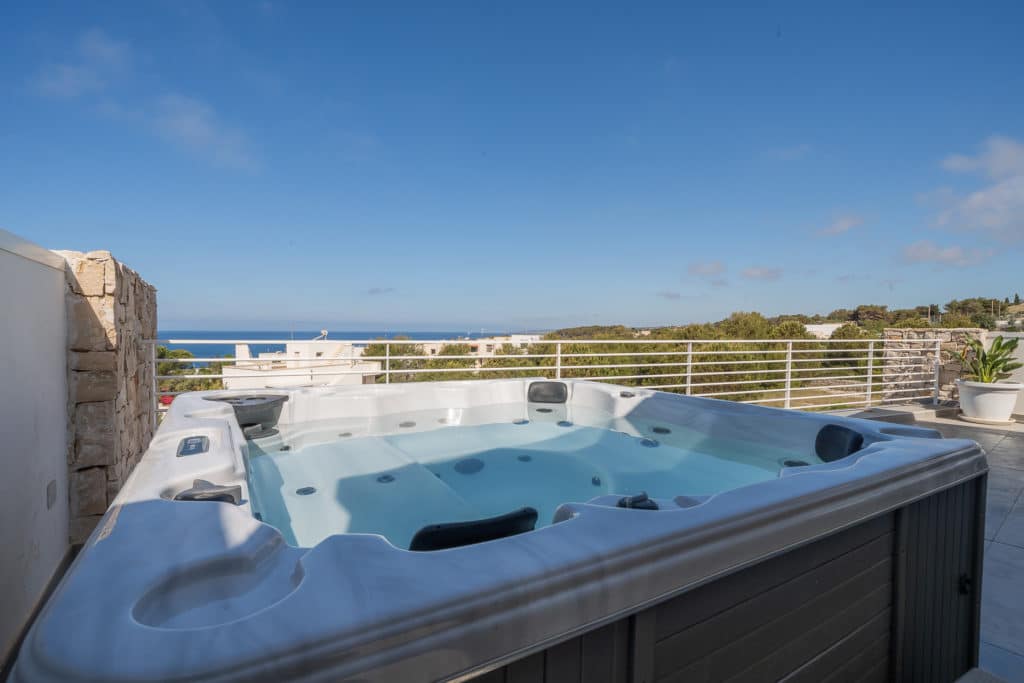
To enjoy the cape at dawn or on waterfall evenings, it is worth staying in Leuca. A few minutes from Punta Meliso, in the western part of the village, towards Punta Ristola, you will find our Penthouse Venere: up to 6 guests, 80 m² on two floors and 2 bathrooms, with a double bedroom, a bedroom with two single beds, a sofa bed and a panoramic terrace with a jacuzzi and sea view. There is also an outdoor area for lunch and dinner in the open air, air conditioning, Wi-Fi, a fully equipped kitchen, a washing machine, a dishwasher, a barbecue and private parking. The sea is a few steps away and by car you reach the lighthouse in 5-6 minutes.
You will find the other houses in the area on the page holiday homes in Santa Maria di Leuca. Would you like advice on dates, getting around or other houses? Contact us: we will help you choose the right option.
When to go and how much time to plan
May and June: the days are long, the square is still quiet on weekdays and the scrub on the headland is green; these months also bring the first openings of the waterfall.
July and August: it is high season. The cape is crowded at almost all hours, but there are the evening openings of the waterfall and the feast of the Madonna di Leuca; go up early in the morning or after sunset and get around on foot when you can.
September: the best month, in our opinion. The sea is still warm for the cave trip, there are fewer people and the waterfall is still opened on some evenings.
April and October: clear light and mild temperatures, ideal for photos and walks; swimming is for those who don’t mind cool water.
November to March: the cape is quiet and often windy. In heavy seas the sight of the waves below the lighthouse is impressive, best watched from a distance; the Basilica remains a destination for pilgrims all year round.
Events and festivals (indicative dates, check them every year on the Castrignano del Capo municipality website and on SalentoMe):
- Openings of the monumental waterfall: from May to September, on some evenings with the artistic lighting; in 2026 on 1 May, three evenings in June and almost every Friday evening in July, August and September
- Special openings of the waterfall on some holidays, such as Easter Monday in 2026
- Feast of the Madonna di Leuca: 14-15 August, with the statue carried from the sanctuary to the church of Cristo Re, the procession through the village and then at sea on the fishermen’s boats, to San Gregorio and back, and fireworks
How much time to allow: an hour or two is enough for the square, the lighthouse and the Basilica; half a day if you walk down to the harbour and take the boat trip to the caves; one more evening if you want to see the waterfall. A typical day:
- 6:00: dawn over the Adriatic from the Punta Meliso viewpoint
- 8:30: the Basilica, the lighthouse and the Croce Pietrina pine wood
- 10:00: walk down the staircase to the harbour
- 10:30: a boat trip to the eastern caves, when the sea is calm
- 13:30: lunch at the harbour or on the seafront
- 17:30: a stroll along the seafront among the nineteenth-century villas
- 19:30: the waterfall on opening evenings, or the sunset over the bay
Surroundings and extra ideas
Punta Meliso is the ideal starting point for exploring the Capo di Leuca, with its seafront, the Adriatic cliffs and the seaside villages of the Ionian coast. Distances and driving times are approximate.
Leuca harbour and seafront (1.5-2 km, 4 minutes; on foot by the staircase): the harbour, the church of Cristo Re and the Lungomare Cristoforo Colombo with its nineteenth-century villas, each in a different style. Read our guide to Santa Maria di Leuca.
Punta Ristola (3 km, 5 minutes): the other point of the bay, the southernmost in Puglia, with the Grotta del Diavolo and, beyond the point, the western caves.
Ponte del Ciolo (6.5 km, 7 minutes): on the Adriatic coast road, the gorge between towering rock walls and the little pebble bay. Read our guide to the Ponte del Ciolo.
Marina di Novaglie (9 km, 11 minutes): the little harbour cut into the rock, swimming from the rocks and the Sentiero delle Cipolliane. Read our guide to Marina di Novaglie.
Marina di Felloniche and Marina di San Gregorio (6-9 km, 10-12 minutes): to the west, on the Ionian coast, the bay of Felloniche and the cove of San Gregorio, with the underwater remains of the Messapian harbour of Vereto. Read our guides to Marina di Felloniche and to Marina di San Gregorio.
Castrignano del Capo (5 km, 8 minutes): the inland town of which Santa Maria di Leuca is a hamlet. Read our guide to Castrignano del Capo.
Torre Vado and Pescoluse (12-14 km, 15-17 minutes): the tower on the little harbour and the freshwater springs of Torre Vado, then the white sand and shallow sea of the Maldives of Salento, ideal with children. Read our guides to Torre Vado and to Marina di Pescoluse.
Local tip
Go up to Punta Meliso at dawn, at least once: the square is empty, the sun rises out of the Adriatic Sea and the lighthouse and the Basilica turn pink. It is also the best time to look, from the viewpoint, for the line between the colours of the two seas.
If you are in Leuca on an evening when the waterfall is open, don’t drive up: walk to the harbour and watch it from below, near the Roman column, where the water pours into the sea. Then, when the crowd starts to thin out, enjoy Leuca lit up from the seafront.
And before the cave trip, check the wind and the time: the eastern caves, east of the cape, are at their best in the morning light; the western ones, towards Punta Ristola, in the afternoon and at sunset.
FAQ
Where is Punta Meliso?
In Santa Maria di Leuca, in the municipality of Castrignano del Capo (Lecce), at the southern tip of Salento: it is the headland that closes off the bay of Leuca to the east, above the harbour, about 69 km from Lecce. It is also known as Capo Santa Maria di Leuca.
Is Punta Meliso the southernmost point of Puglia?
No: the southernmost point is Punta Ristola, less than 2 km to the west. Punta Meliso is the second, but by nautical convention it is here that the Adriatic and the Ionian separate, and together with Punta Alice, in Calabria, it closes off the Gulf of Taranto.
Where do the Ionian and the Adriatic meet?
By convention, right at Punta Meliso, below the lighthouse. On some days you can see from the viewpoint a line on the sea between two different colours, caused by the meeting of the currents.
Can you climb the Leuca lighthouse?
The lighthouse is managed by the Italian Navy and is usually admired from outside, from the square. On rare occasions it has been opened to visitors, with the climb up the 254 steps of the spiral staircase: ask on the spot.
When is the monumental waterfall open?
Only on certain days, according to the calendar that the municipality of Castrignano del Capo publishes every year. In 2026 it was open from May to September, almost every Friday evening in July, August and September, plus a few special openings.
How do you get to the Basilica de Finibus Terrae?
By car on the SS275, which climbs through the pines up to the square, or on foot from the harbour by the monumental staircase that runs alongside the waterfall.
Can you swim at Punta Meliso?
Not from the cape: the coast is high and rocky. For a swim, go down to the Leuca seafront or take advantage of the stops on the boat trips to the caves.
Is Punta Meliso suitable for children and for people who find walking difficult?
Yes: you can drive right up to the square, which is paved and level. The waterfall staircase and the Via Crucis path, however, have many steps.
When is the best time to go?
May, June and September, at dawn or at sunset. In July and August go up early in the morning and pick an evening when the waterfall is open.
Where to stay near Punta Meliso?
A few minutes from the lighthouse, in the western part of Leuca, there is Salento Prime’s Penthouse Venere: up to 6 guests, 2 bathrooms and a panoramic terrace with a jacuzzi and sea view. You will find the other houses on the holiday homes in Santa Maria di Leuca page.
Conclusion
Punta Meliso is the end of Salento and its most famous viewpoint: the white lighthouse, the Basilica de Finibus Terrae on its large square, the waterfall running down to the harbour on its evenings and, below, a deep sea full of caves. Go up at dawn or at sunset, walk down the staircase and, if the sea is calm, see the cape from a boat as well.
If you want to stay a few minutes from the lighthouse, in Leuca you will find our Penthouse Venere: up to 6 guests, 2 bathrooms, on two floors, with a panoramic terrace with a jacuzzi and sea view. You will find our houses in the area on the page holiday homes in Santa Maria di Leuca.
Discover the available accommodations with Salento Prime. To best organize your base and transfers, contact us here or start a chat on WHATSAPP.
Cover photo: Paolo Damiano Dolce, CC BY-SA 4.0, via Wikimedia Commons