Looking for an inland town where Salento still speaks Greek, half an hour from Lecce and twenty-five minutes from the sea at Otranto? This guide takes you to Corigliano d’Otranto, Choriàna in Griko, in the heart of the Grecìa Salentina: the Castello de’ Monti with its four great towers and its Baroque façade full of statues, the old town of alleys and courtyard houses, the Chiesa Madre di San Nicola with its bell tower from 1465 and its mosaic floor, the inscriptions about envy, the Griko language, the villages of the Grecìa Salentina and the Notte della Taranta, with practical tips and local curiosities.
In short
Corigliano d’Otranto, in Griko Choriàna (Χωριάνα) or Koriàna, is a town of about 5,500 inhabitants in the province of Lecce, in central Salento, about 26 km from Lecce. It is part of the Grecìa Salentina, the area where Griko, an ancient language of Greek origin, is still spoken. Its symbol is the Castello de’ Monti, a fortress with four round towers and a deep moat, strengthened in the early sixteenth century and embellished in the seventeenth century with a Baroque façade full of statues: today it belongs to the municipality and, with the Castello Volante project, hosts visits, exhibitions and events. Around it lies an old town of paved alleys, courtyards and palazzi, with the Chiesa Madre di San Nicola and its mosaic floor. In recent years the touring festival of the Notte della Taranta has started right here. The nearest sea is at Otranto, 24 km away. The best months are April, May, June and September, and summer for the music and the festivals.
What is Corigliano d’Otranto?
Corigliano d’Otranto is a town in inland Salento, between Maglie, Galatina and Martano, in flat countryside planted with olive trees. It is one of the nine municipalities of the Grecìa Salentina where Griko is spoken, and one of those where the language holds out best: it is still used or understood mainly by adults and older people. The old town, once enclosed by sixteenth-century walls, gathers around the castle and Piazza San Nicola, and is a tangle of alleys, courtyard houses and palazzi in Lecce stone. With the railway station a short walk from the centre, it is also a convenient base for touring the Grecìa Salentina, Lecce and the Adriatic coast.
Corigliano is a quiet town where life revolves around two squares: Piazza San Nicola, with the Chiesa Madre, the Torre dell’Orologio and Palazzo Comi, and the large paved space in front of the castle. Just step into the alleys to find carved portals, hidden courtyards, underground olive mills and inscriptions carved on the lintels, many of which speak, with irony, of envy.
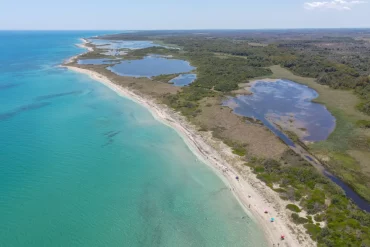
It is not a seaside town, but the sea is close: in about twenty-five minutes you reach Otranto, and in half an hour the cliffs of Castro and Santa Cesarea Terme. Lecce is less than half an hour away, and all the other villages of the Grecìa Salentina are a few minutes away. This is Salento for those who love castles, stories, folk music and ancient languages, and for those looking for a central base away from the coastal traffic. In this guide you will find how to get there, what to see, where to swim and how to plan your day, including the surrounding area.
Curiosities and atmosphere
The name Corigliano probably comes from the Byzantine Greek «chorìon» or «chòra», meaning village, land, farm: hence the Griko name Choriàna. The town’s coat of arms, on the other hand, shows a heart (cuore), chosen only for its resemblance to the word, while another tradition links the name to a Roman centurion, Corelius. Greek was long everyone’s language here: when in 1525 the friar Leandro Alberti passed through Corigliano in the retinue of the master general of the Dominicans, he wrote that the guards who welcomed the caravan spoke only Greek. In the ninth century there was a Basilian monastery in Corigliano dedicated to San Giorgio, with a school of Greek language and culture that left numerous manuscripts, now kept in major libraries.
Griko is still alive, especially among older people, and is recognised by the State as a minority language. It has words close to modern Greek, such as «tàlassa», the sea, and «calocèri», summer. Since 2008 Corigliano has been twinned with Ilion, in Greece, and in the garden of the great valonia oak on Via Moncenisio, which in Griko is called «valani», meetings and evenings devoted to Griko culture have been held for years.
In the sixteenth century Corigliano was a small military citadel, defended by its walls, the castle and its artillery. According to local history, in 1480, when the Turks took Otranto and sacked many inland villages, on coming within sight of Corigliano they did not dare to approach; and tradition says that the great iron clock of the Torre dell’Orologio was taken from the Turks in 1632, when the people of Corigliano, led by their feudal lord Giorgio de’ Monti, defeated them at Castro. One last curiosity: around the old town you will find several inscriptions about envy. On the Caporta, the old south gate, is the motto «Invidia inopia fa», that is, envy makes you poor, and on the façade of Palazzo Coia, dating from 1563, you can read «Contra raggion invidia non ha loco».
Where it is and how to reach it
Corigliano d’Otranto lies in central Salento, inland, about 26 km south-east of Lecce, 97 metres above sea level. It borders Soleto, Zollino and Martano to the north, Castrignano de’ Greci and Melpignano to the east, Maglie and Cutrofiano to the south, and Sogliano Cavour and Galatina to the west. Maglie is 7 km away, Galatina 9 km, Otranto 24 km, Gallipoli 33 km and Santa Maria di Leuca 48 km.
By car: from Lecce you take the SS16 towards Maglie and Otranto and exit towards Corigliano: less than half an hour without traffic. From the south, from Leuca and the Capo, you drive up the SS275 to Maglie and then continue for a few kilometres. The old town is a limited traffic zone controlled by electronic gates: leave the car in the surrounding streets, following the signs, and explore on foot. On festival and concert evenings, at the end of July and in August, arrive early.
By public transport: Corigliano has an FS Sud Est (Ferrovie del Sud Est) station on the Zollino-Gagliano del Capo line, about 400 metres from the centre; national trains arrive in Lecce. Check timetables and any replacement buses before you set off. On the night of the big concert of the Notte della Taranta, in Melpignano, special trains and buses are usually laid on: check that year’s programme. The most convenient airport is Brindisi, about 72 km away, just over an hour by car.
What to do and what to see
You can walk around the centre of Corigliano in half a day: the castle, Piazza San Nicola with the Chiesa Madre and the Torre dell’Orologio, the alleys with their courtyards, arches and inscriptions, and a little further on Piazza Vittoria. With an extra day you can discover the villages of the Grecìa Salentina, all a few minutes away. Here are the experiences not to miss.
1. The Castello de’ Monti (1-1.5 hours)
The historian Bacile di Castiglione called it the «finest monument of military and feudal architecture of the early sixteenth century in Terra d’Otranto». The Castello de’ Monti is in fact a castle within a castle: inside you can still see three square towers of the medieval core, with sharp corners and battlements, and around them the Renaissance fortress commissioned by the Marquis Giovan Battista de’ Monti between the end of the fifteenth century and the first decades of the sixteenth, when the arrival of cannons made the old towers too fragile. It has a square plan, a deep moat and four round towers with gun ports, each entrusted to a saint and a virtue: San Michele and Fortitude, Sant’Antonio Abate and Temperance, San Giorgio and Prudence, San Giovanni Battista and Justice. In the second half of the seventeenth century the new lords, the Trane family, turned the fortress into a palace, and the façade facing the square filled up with allegorical statues, busts of great military leaders and Latin mottos by the Corigliano poet Andrea Peschiulli; in the centre is the statue of Francesco Trane between Justice and Charity, above a balcony with a balustrade carved with fantastic animals and flowers. Later the castle became a mill, a pasta factory, an olive mill and finally a tobacco factory: on the entrance portal you can still read the words «Mulino a vapore San Nicola». It has belonged to the municipality since 1999 and today, with the Castello Volante project, it is a cultural space with guided tours, exhibitions, concerts, a library and a bistro on the terraces. There is an admission charge and the castle is closed on Mondays: check opening times and days on the castle’s website before you go.
2. Piazza San Nicola, the Torre dell’Orologio and Palazzo Comi (30 minutes)
From the castle, following the alleys, you reach Piazza San Nicola, the heart of the village. On one side rises the civic Torre dell’Orologio (clock tower), with three tiers marked by cornices and a small bell gable at the top: rebuilt in 1644 and altered in 1770, it keeps the inscriptions of Andrea Peschiulli and the old sundial, and according to tradition it is the tower of the clock seized from the Turks. Opposite is Palazzo Comi, from 1755, with an angel holding up a false mullioned window and, on the first floor, the statue of the Immacolata carved by Gaetano and Orazio Carrone of Corigliano; on the ground floor a fragment of an inscription in Greek characters survives, one of the few remains of the town’s Byzantine past. A little further on is a column with the statue of the Madonna delle Grazie, its base dated 1848.
3. The Chiesa Madre di San Nicola, the bell tower and the mosaic (45 minutes)
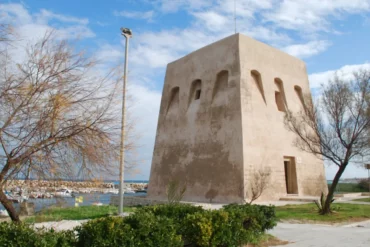
The Chiesa Madre is dedicated to San Nicola, the patron saint of Corigliano. It was built in the second half of the sixteenth century and restored in 1622: the façade is simple, with a portal from 1573 topped by statues of the Redeemer, the Virgin and San Nicola. Next to it rises the bell tower, which was originally a lookout tower of the medieval walls: on its façade the year 6973 of the Byzantine calendar, that is 1465, is carved in Greek characters. It looks very much like the Guglia di Soleto, but was left unfinished, without the top storey and the lantern. Inside, besides the Baroque altars, such as that of San Nicola carved in 1716 by Gaetano Carrone, and an organ from the early eighteenth century, is the real surprise: the mosaic floor made in 1878 by the Maselli brothers of Cutrofiano, with stories from the Bible along the branches of a great Tree of Life, as in the mosaic of Otranto Cathedral. Read our guide to Otranto. Go into the church outside service times and dressed appropriately.
4. The old village: the Caporta, the Arco Lucchetti and the inscriptions (1 hour)
Next to the castle is the Caporta, the town’s south gate, from the Griko «cau», below, and «porta», gate: it is topped by the town’s coat of arms and that of Giovan Battista de’ Monti, with two winged Victories and the motto «Invidia inopia fa», and it is an open-air monument, always accessible. On the other side of the town stood the Anuporta, the north gate, in front of the Chiesa Madre; stretches of the sixteenth-century walls, with their characteristic raised stone string course, can still be seen on Via Don Bosco. In Vico Freddo, a dead-end alley a few steps from Piazza San Nicola, is the Arco Lucchetti, the entrance to a courtyard made of three large blocks of Lecce stone carved like lace, with human figures, fantastic animals, flowers and fruit: the decoration is medieval, and the arch was reassembled here in 1497 by master Nicola Robi. Then wander unhurriedly among the courtyard houses, typical of all the villages of the Grecìa Salentina, the portals of the palazzi, such as the sixteenth-century Palazzo de’ Monti and Palazzo Peschiulli, from 1781, and the inscriptions on the lintels, many of them dated from the sixteenth to the eighteenth century.
5. Piazza Vittoria, the valonia oak and the other churches (45 minutes)
Just outside the old town is Piazza Vittoria, a large public garden shaded by holm oaks, which the people of Corigliano still call «ezzumero», the place outside the walls. The weekly market was once held here and, every year, the San Giorgio fair; under the square there are two old underground olive mills and many public cisterns, and on the north side some stretches of the walls can be made out. According to legend, a Turkish general who died during the siege of the town is buried here. On Via Moncenisio you will see the great valonia oak, a centuries-old tree about 15 metres tall with a crown 20 metres wide, one of the few specimens left in Salento. Among the other churches, the seventeenth-century Madonna delle Grazie holds a Byzantine fresco of the Madonna di Costantinopoli; the small fifteenth-century Cappella di San Leonardo has an eight-spoked rose window and a bell gable; the neo-Gothic church of the Addolorata dates from the twentieth century. On the little hill of the Serra, to the north-west, you can see from afar the great aqueduct tower, about 40 metres high, the unmistakable landmark of Corigliano’s skyline.
6. Folk music and the Notte della Taranta (one evening)
Corigliano is one of the towns of the Notte della Taranta, the great festival of Salento folk music born in 1998, which every summer brings free concerts to the squares of Salento and ends with the big concert in Melpignano, 4 km from here. In recent years the first stop of the touring festival has been held right here in Corigliano: in 2026 the festival started here on 30 July, with twenty stops before the big concert on 22 August. On summer evenings the castle also hosts concerts, exhibitions and talks. Programmes and dates change every year: check them on the website of the Fondazione La Notte della Taranta and on the castle’s calendar.
7. The villages of the Grecìa Salentina and the dolmens (half a day or a full day)
The Grecìa Salentina is a linguistic island of nine neighbouring municipalities where Griko is spoken: Calimera, Castrignano de’ Greci, Corigliano d’Otranto, Martano, Martignano, Melpignano, Soleto, Sternatia and Zollino. It is what remains of a much larger area of Greek language and culture which in the Middle Ages stretched from the Ionian to the Adriatic. Since the 1990s these towns have worked together to protect their language and traditions, and in 2001 they founded a Union of municipalities, which over the years has been joined by some neighbouring municipalities that do not speak Griko, such as Carpignano Salentino and Cutrofiano. Today Griko can still be heard, especially among older people, in Sternatia, Martignano, Calimera, Corigliano, Zollino and Martano, while in Melpignano and Soleto it is no longer spoken. From Corigliano they are all a quarter of an hour away or a little more: Melpignano, the town of the big concert, 4 km; Castrignano de’ Greci 5 km; Zollino and Martano 7-8 km; Soleto, with its Guglia more than 40 metres high, 9 km; Sternatia 10 km; Martignano and Calimera 12-15 km. Just outside the town, to the south-east, about 2 km by road, is the Caroppo double dolmen, two prehistoric dolmens side by side among the olive trees: check access on the spot, look at them without climbing on them and wear comfortable shoes.
The nearest sea and who it suits
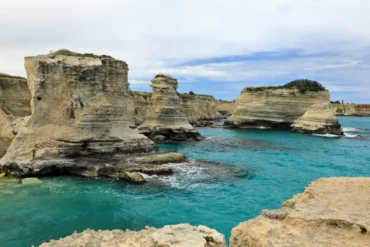
Corigliano is inland, but the Adriatic coast is less than half an hour away. The fastest road leads to Otranto, 24 km and about twenty-five minutes away: the old town by the sea, the harbour and, a little further north, the long sandy beaches of the Alimini, about 35 minutes away. South of Otranto the cliff coast begins: Porto Badisco, Santa Cesarea Terme and Castro, 25-27 km and about half an hour away, with deep, crystal-clear water, suited to confident swimmers. Read our guides to Otranto and to Castro. Further north, about 35-40 minutes away, is the Melendugno coast, with San Foca and Torre dell’Orso: read our guide to San Foca. For the beaches of the Ionian coast, such as those of Gallipoli, 33 km away, allow about 40 minutes.
Corigliano is perfect for those who love castles and historic centres, for those curious about languages, traditions and folk music, for those travelling in spring and autumn and for those looking for a quiet, central base, with a railway station, a few minutes from the whole Grecìa Salentina and half an hour from Lecce and the sea. It is less suited to those who want to step out of the house and be on the beach, or to those looking for seaside nightlife: for that there are Otranto and the coastal villages.
Free beach and facilities
At Otranto, the Alimini and San Foca, beach clubs with umbrellas, sunloungers and bars alternate with stretches of free beach; between Porto Badisco and Castro you swim mostly from the rocks and in small coves, with few facilities. Check access, parking and any paid zones on the spot, and always respect signs and swimming bans. In Corigliano you will find bars, pastry shops and restaurants in the centre and around the castle.
On the sand bring an umbrella, water and sun cream; on the rocks, reef shoes and a mask. When the sea is rough, don’t go down onto the rocks, and stay where you can touch the bottom.
Corigliano d’Otranto vs other towns of Salento
In the heart of Salento the towns are very close to each other. Here is a practical comparison to help you choose:
Corigliano d’Otranto vs Melpignano
- Corigliano: the Castello de’ Monti, an old town rich in courtyards and inscriptions, and Griko still spoken, especially by older people
- Melpignano: 4 km away, the town of the final big concert of the Notte della Taranta, at the end of August; Griko is no longer spoken here
Corigliano d’Otranto vs Galatina
- Corigliano: a small, quiet town, with the castle and the Griko language
- Galatina: a larger town, 9 km away, with the Basilica of Santa Caterina d’Alessandria covered in frescoes and the story of the tarantate. Read our guide to Galatina
Corigliano d’Otranto vs Maglie
- Corigliano: a village to explore on foot, between the castle and Piazza San Nicola, with all the villages of the Grecìa Salentina a few minutes away
- Maglie: a small town 7 km away, with shops and services, the Baroque bell tower of the Chiesa Madre, the museum of prehistory and the Mercatino del Gusto in August. Read our guide to Maglie
When to choose Corigliano d’Otranto: if you love castles and history, want to get to know the Grecìa Salentina and its language, follow folk music in summer and are looking for a convenient stop between Lecce and Otranto.
When to choose somewhere else: if you want to walk to the beach, look at the seaside villages of the Adriatic coast, from San Foca to Otranto and Castro; if you are looking for sandy beaches with shallow water, the Ionian coast, between Gallipoli and Pescoluse.
Practical tips
Explore the old town in the morning or from late afternoon: in summer it is very hot in the middle of the day and the churches may be closed. For the castle, check days and times a few days beforehand: it is closed on Mondays, and guided tours for groups must be booked. At the castle’s infopoint you will also find the opening times of the village churches. Dress appropriately to enter the churches and respect the services.
The old town is a limited traffic zone with electronic gates: do not drive in, park in the surrounding streets and walk. On the evenings of the Notte della Taranta and of the feast of San Nicola, at the end of August, the town fills up: arrive early and, for the big concert in Melpignano, consider the special trains and buses. For the sea, set off early in the morning, when the coast is still quiet and parking is easier.
Useful practical information
| 📍 Where | Corigliano d’Otranto (Lecce), in the Grecìa Salentina, 26 km from Lecce, 7 km from Maglie and 24 km from Otranto |
|---|---|
| 🚗 Parking | In the streets around the old town, which is a limited traffic zone with electronic gates; follow the parking signs |
| ♿ Access | A town on flat ground, with paved alleys; the castle has audio guides, videos in LIS (Italian Sign Language) and a virtual tour; some churches have steps at the entrance |
| 🏖 Beach | No sea in town: sand at Otranto, the Alimini and San Foca, rocks between Porto Badisco, Santa Cesarea Terme and Castro, 24-30 km away |
| 🌊 Sea | Deep and clear off the rocks on the Adriatic coast, for those who can swim; sandy beaches north of Otranto |
| 👟 What to bring | Comfortable shoes for the old town and the dolmen countryside, suitable clothing for the churches; beach umbrella and water shoes for the sea |
| 🍴 Food | Bars, pastry shops and restaurants in the centre; a bistro on the castle terraces, open on some days |
| 📅 Best time | April, May, June and September; late July and August for the Notte della Taranta and the feast of San Nicola |
Where to stay near Corigliano d’Otranto
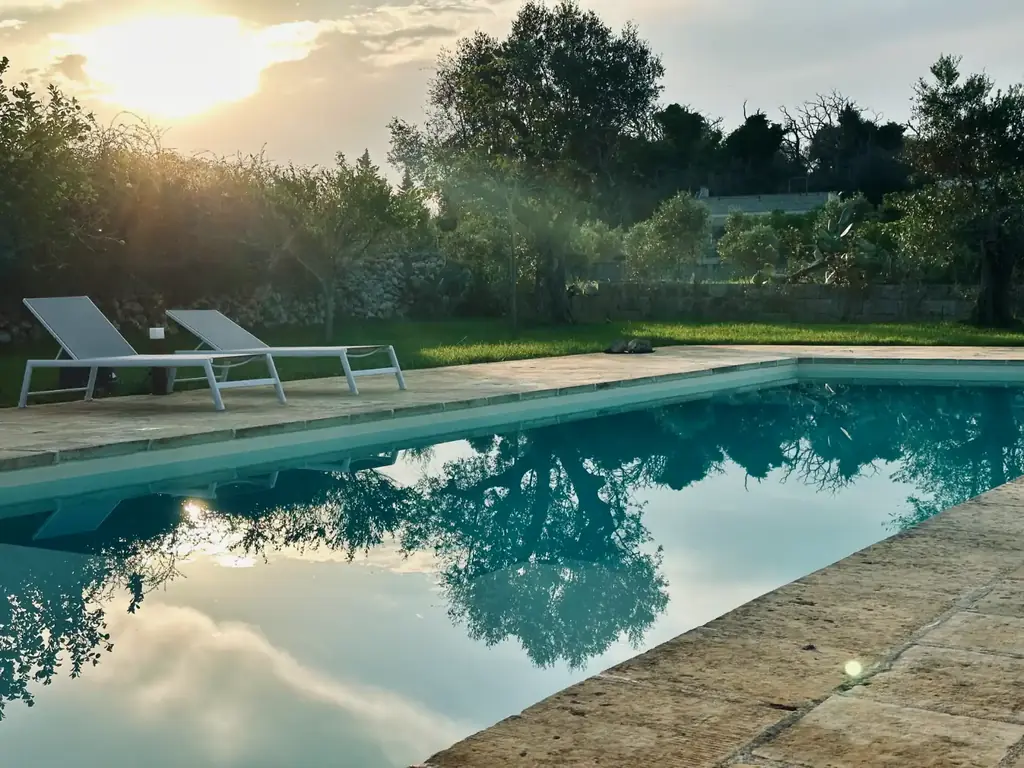
We have no houses in Corigliano: the nearest is in Marittima, on the Adriatic coast, about 26 km and half an hour away by car, and from there Corigliano and the Grecìa Salentina make a lovely half-day trip. It is our Villetta Arenosa con piscina: 4 guests, 2 rooms, 3 bathrooms and 80 m² on two levels, with a double bedroom under the typical star vaults, a bright living room with an equipped kitchenette and a sofa bed, air conditioning, a washing machine and a dishwasher. Outside there is a large private garden with a pool with views of the sea and of Castro, a sun terrace, an outdoor bathroom and showers, a play area with a volleyball net and five-a-side football goals, a barbecue and private parking. The sea is less than 1 km away: it is a quiet base for exploring the coast between Otranto, Santa Cesarea Terme and Castro and the inland Grecìa Salentina.
If you prefer a town, in the centre of Tricase, about 30 km and 35 minutes from Corigliano, there is Casa Amalia – Center of Tricase: a 100 m² apartment renovated in 2024, for 4 guests, with a double bedroom and a bedroom with two single beds, air conditioning, a fully equipped kitchen, washing machine and dishwasher, a few steps from shops, bars and restaurants.
You will find these and our other houses in the area on the pages holiday homes in Marittima and holiday homes in Tricase. Would you like advice on dates, getting around or other houses in the area? Contact us: we will help you choose the right option.
When to go and how much time to plan
March and April: the countryside is green and the days are mild, perfect for exploring the old village and the towns of the Grecìa Salentina. At the end of April, around the feast of San Giorgio, the town holds its traditional fair.
May and June: the heat is not yet strong and the sea is starting to be pleasant: the right time to combine the castle, the nearby villages and your first swim at Otranto or Castro.
July and August: it is hot, so explore the town early in the morning or in the evening and go to the sea early. It is the season of music: between late July and August the Notte della Taranta passes through, the castle hosts exhibitions and concerts and, at the end of August, Corigliano celebrates its patron saint San Nicola, while the big concert is held in Melpignano.
September: in our view the best month. The sea is still warm, there are fewer people and the castle offers guided tours and experiences in the villages of the Grecìa Salentina too.
October and November: quiet days, with the olive harvest in the surrounding countryside, ideal for the castle, the churches and walks.
December to February: Corigliano is lived as an everyday town, quiet and peaceful, and it is the right time to explore the village at a leisurely pace.
Events and festivals (indicative dates, check them every year on the website of the municipality of Corigliano d’Otranto and on SalentoMe):
- Feast and fair of San Giorgio: at the end of April, around 23 April, with the market fair
- Notte della Taranta, touring festival: between late July and August, with free concerts in the squares; in recent years the first stop has been in Corigliano (on 30 July in 2026)
- Big concert of the Notte della Taranta in Melpignano: at the end of August (on 22 August in 2026)
- Patronal feast of San Nicola: around 22-23 August, with the procession, the band, the luminarie and fireworks
- Exhibitions, concerts and festivals at the Castello Volante: mainly from July to October
How much time to allow: half a day is enough for the castle and the old town; a whole day if you add Melpignano, Soleto and the other villages of the Grecìa Salentina. With three or four days you can combine Lecce, Otranto, the cliff coast as far as Castro, and Galatina. A typical day:
- 9:30: visit to the Castello de’ Monti, at opening time
- 11:00: the Caporta, Piazza San Nicola, the Chiesa Madre with its mosaic and the Arco Lucchetti
- 13:00: lunch in the town
- 15:00: tour of the nearby villages, from Melpignano to the Guglia di Soleto
- 17:00: swim at Otranto or on the rocks between Porto Badisco and Castro
- 20:30: back to Corigliano for a stroll in front of the castle and dinner
Surroundings and extra ideas
Corigliano is at the centre of the Grecìa Salentina: in a few minutes you reach the nearby villages, in twenty-five minutes the Adriatic coast and in less than half an hour Lecce. Distances and driving times are approximate.
Melpignano (4 km, 7 minutes): the village of the Grecìa Salentina that hosts the final big concert of the Notte della Taranta every year at the end of August.
Maglie (7 km, 10 minutes): the birthplace of Aldo Moro, with the Baroque bell tower of the Chiesa Madre, the museum of the prehistory of Salento and the Mercatino del Gusto in August. Read our guide to Maglie.
Soleto (9 km, 10 minutes): the town of the Guglia, the bell tower more than 40 metres high that Corigliano’s bell tower resembles.
Galatina (9 km, 11 minutes): the Basilica of Santa Caterina d’Alessandria, with its walls covered in frescoes, the chapel of the tarantate and the pasticciotto. Read our guide to Galatina.
Martano, Sternatia, Zollino, Martignano and Calimera (7-15 km, 10-20 minutes): the other villages of the Grecìa Salentina where Griko can still be heard, with courtyard houses and quiet old centres.
Vernole and Acaya (20-29 km, 27-34 minutes): to the north-east, the town of Vernole and its hamlet of Acaya, a fortified village with its castle. Read our guide to Vernole.
Melendugno and San Foca (21-25 km, 28-35 minutes): the town of Melendugno and its coast, with the beaches and cliffs of San Foca, Roca and Torre dell’Orso. Read our guides to Melendugno and to San Foca.
Otranto (24 km, 25 minutes): the old town by the sea, the Cathedral with the great floor mosaic of the Tree of Life and the Aragonese Castle; further north, the sandy beaches of the Alimini. Read our guide to Otranto.
Castro and Santa Cesarea Terme (25-26 km, 30 minutes): the spa baths in the sea caves, the harbour of Castro with boats to the caves and the hilltop village with its castle. Read our practical guide to Castro.
Lecce (26 km, 26 minutes): the provincial capital, with its Baroque old town in Lecce stone. Read our guide to Lecce.
Local tip
Visit the castle twice: the first time by day, at your leisure, to read the statues, busts and mottos on the façade and discover the halls and courtyards; the second in the evening, when the façade is lit up and the square in front fills with people, music and, in summer, exhibitions and concerts. If you are here at the end of July or in August, check the Notte della Taranta programme: an evening of pizzica in the square, a few steps from the castle, is the best way to understand the Grecìa Salentina.
In the old town, look up: on the lintels of doors and windows there are inscriptions in Latin and Italian, some almost five hundred years old, and many speak of envy. Look for them starting from the Caporta and ending at Palazzo Coia, then step into Vico Freddo to see the Arco Lucchetti.
If you want to hear Griko, stop in the square or at a bar in the morning and listen to the older people talking: with a bit of luck you will hear it. And before you leave, take an hour for Melpignano and Soleto, ten minutes away: in one morning you will understand why this little island of villages is so special.
FAQ
Where is Corigliano d’Otranto?
In central Salento, in the province of Lecce, about 26 km south-east of Lecce, between Soleto, Zollino, Martano, Castrignano de’ Greci, Melpignano, Maglie, Cutrofiano, Sogliano Cavour and Galatina. Otranto is 24 km away, Gallipoli 33 km and Santa Maria di Leuca 48 km.
What is Corigliano d’Otranto called in Griko?
Choriàna, written in Greek Χωριάνα, or Koriàna; in Salento dialect it is called Curiànu. The name probably comes from the Byzantine Greek «chorìon», village.
What to see in Corigliano d’Otranto?
The Castello de’ Monti with its four great towers and Baroque façade, the Caporta, Piazza San Nicola with the Torre dell’Orologio and Palazzo Comi, the Chiesa Madre di San Nicola with its 1465 bell tower and the Tree of Life mosaic, the Arco Lucchetti, the inscriptions of the old town, Piazza Vittoria and the valonia oak.
Can you visit the Castello de’ Monti?
Yes, with a ticket: today the castle belongs to the municipality and, with the Castello Volante project, hosts guided tours, exhibitions, concerts and a library. It is closed on Mondays; days and times change, so check them on the castle’s website before you go.
Which are the municipalities of the Grecìa Salentina?
They are the nine Griko-speaking municipalities: Calimera, Castrignano de’ Greci, Corigliano d’Otranto, Martano, Martignano, Melpignano, Soleto, Sternatia and Zollino. Some neighbouring municipalities that do not speak Griko, such as Carpignano Salentino and Cutrofiano, later joined the Union of municipalities of the Grecìa Salentina.
Is Griko still spoken in Corigliano?
Yes, especially among adults and older people: Corigliano is one of the towns where the language holds out best, together with Sternatia, Martignano, Calimera, Zollino and Martano. In Melpignano and Soleto, on the other hand, it is no longer spoken.
Does the Notte della Taranta pass through Corigliano d’Otranto?
Yes. Corigliano is one of the stops of the touring festival, which in recent years has started right here: in 2026 on 30 July. The final big concert is held at the end of August in Melpignano, 4 km away. Dates change every year.
Is Corigliano d’Otranto by the sea?
No, it is inland. The nearest sea is on the Adriatic coast: Otranto, 24 km and about twenty-five minutes away, with the sandy beaches of the Alimini further north; Porto Badisco, Santa Cesarea Terme and Castro, with rocks and deep water, about half an hour away.
How do you get to Corigliano without a car?
By train, with FS Sud Est: Corigliano station is on the Zollino-Gagliano del Capo line, about 400 metres from the centre, and national trains arrive in Lecce. Check timetables and any replacement buses before you set off.
Where to stay near Corigliano d’Otranto?
In Marittima, on the Adriatic coast about half an hour away, there is Salento Prime’s Villetta Arenosa con piscina: 4 guests, 2 rooms and a private pool with a sea view. In the centre of Tricase, about 35 minutes away, there is Casa Amalia, for 4 guests.
Conclusion
Corigliano d’Otranto is the heart of the Grecìa Salentina: a castle that looks like a palace, a village of courtyards and inscriptions that speak of envy, a bell tower with its date written in Greek, an ancient language still heard in the square and, in summer, the music of the Notte della Taranta. Give it at least a morning, at a relaxed pace, and if you can, come back one evening to see the castle façade lit up.
If you want to stay nearby, in Marittima, on the Adriatic coast about half an hour away, there is our Villetta Arenosa con piscina: 4 guests, 2 rooms, 3 bathrooms and a private pool with a sea view. You will find our houses in the area on the pages holiday homes in Marittima and holiday homes in Tricase.
Discover the available accommodations with Salento Prime. To best organize your base and transfers, contact us here or start a chat on WHATSAPP.
Cover photo: Acquario51, CC BY-SA 4.0, via Wikimedia Commons, cropped