Looking for a seaside village on Salento’s Adriatic coast with a harbour, an old tower and sandy beaches just steps from the village? This guide takes you to San Foca, the seaside village of Melendugno between Torre Specchia Ruggeri and Roca: the two beaches north and south of the harbour, the rocks and islets off the seafront, the sixteenth-century tower, the marina, surfing and everything you need to know to plan your day, with practical tips and local curiosities.
In short
San Foca, «As Fukà» in Griko, is a seaside village in the municipality of Melendugno (Lecce), on Salento’s Adriatic coast, 7 km from the town and about 25 km from Lecce. It began as a fishing village and today is a seaside resort with a marina awarded the Blue Flag, a coastal tower from 1568 and two sandy inlets, north and south of the harbour, with low rocks and small islets off the shore. There are beach clubs and stretches of free beach and, on the seafront, an accessible free beach for people with severe motor disabilities. Roca and the Grotta della Poesia are 2-3 km away, Torre dell’Orso 4 km. The best months are June and September.
What is San Foca?
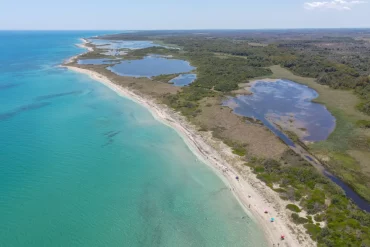
San Foca is a coastal hamlet of Melendugno, on Salento’s Adriatic coast, between Torre Specchia Ruggeri to the north and Roca to the south. It has just under four hundred inhabitants and in summer it fills up with families and boats: its marina is one of the most important on the coast between Brindisi and Otranto. It has a seafront overlooking beaches and rocks, a sixteenth-century watchtower and clear water, with a mostly sandy seabed. In 2026 both its beaches and its harbour have the Blue Flag.
San Foca is a simple, lived-in seaside village: low houses, the seafront, fishing boats moored next to pleasure craft and, off the shore, the flat rocks and islets that all have a name here. North of the harbour is the Fontanelle beach, with the Brigantini rocks and the «scoglio dell’otto»; to the south is the Marangi beach, which continues towards Roca.
It is not a beach isolated in nature: it is a seaside village with its beach clubs, holiday homes and village life, handy if you want the sea and services close at hand. It is also a good base for exploring the Melendugno coast, with the Grotta della Poesia, Torre dell’Orso and the sea stacks of Sant’Andrea. In this guide you will find how to get there, where to swim, what to see and how to plan your day, including the surroundings.
Curiosities and atmosphere
The name comes from Saint Phocas of Sinope, venerated as the protector of sailors, and it is a typically Byzantine name; in Griko the village is called «As Fukà». This stretch of coast has been frequented since the distant past: in the 1970s stone tools from 10,000-14,000 years ago were found here, and in Roman times there was already a small fishing settlement. At the Museo Castromediano in Lecce, in the section devoted to the sea, Roman objects found in San Foca are on display, such as a terracotta die from the second to third century AD. After the Turkish raids of 1480 and the destruction of nearby Roca, some of its inhabitants who lived from the sea took refuge in the caves of San Foca. The village parish is still called «Roca Nuova in San Foca» today, because in 1925 the parish of the abandoned village of Roca Nuova was transferred here.
San Foca has also lent its sea to the cinema: in 2013 Ferzan Özpetek shot some scenes of «Allacciate le cinture» here, together with nearby Torre Specchia. The village was nominated in the «I Luoghi del Cuore» census run by the FAI in six editions, from 2012 to 2022.
The name of San Foca is also linked to a more recent story. Just over a kilometre north of the harbour is the landfall of the TAP gas pipeline (Trans Adriatic Pipeline), which brings natural gas to Italy from the border between Greece and Turkey, through Albania and across the floor of the Adriatic. The pipe passes under the coast through a microtunnel, about ten metres below the beach, and continues underground to the terminal in the countryside of Melendugno; it has been in operation since 2020. The choice of San Foca as the landfall point, approved by the Ministry of the Environment in 2014, was long opposed by local committees, mayors of the area and the Regione Puglia.
Where it is and how to reach it
San Foca is on Salento’s Adriatic coast, in the municipality of Melendugno, between Torre Specchia Ruggeri to the north and Roca to the south. The town of Melendugno is 7 km away, Lecce about 25 km and Otranto about 22 km by road, heading south along the coast road.
By car: from Lecce take the provincial road to Vernole, then the one to Melendugno and from there provincial road 145 to San Foca: about half an hour without traffic. From Otranto head north along the coast road, past the Alimini lakes and Torre dell’Orso, in about 35 minutes. In the village there is paid parking near the seafront and the harbour and a few parking areas further out; in some summers the municipality has opened an outlying car park on viale Europa, with a shuttle to the beaches. In August it is best to arrive early in the morning.
By public transport: mainline trains arrive in Lecce. In San Foca there are stops for intercity buses and, in summer, for seasonal lines linking the seaside villages: routes and timetables change every year, so check them before you set off. The most convenient airport is Brindisi, about 70 km away, just over an hour by car.
What to do and what to see
San Foca is enjoyed between the sea and the village: a swim among the rocks and the sand in the morning, a break in the shade in the hottest hours, a stroll along the seafront and around the harbour in the evening. Here are the experiences not to miss.
1. A swim at the Fontanelle, among the Brigantini and the scoglio dell’otto (2-3 hours)
North of the harbour lies the Fontanelle beach, a sandy inlet along the seafront. Low, flat rocks rise off the shore, and here they have their own names: the Brigantini, the scoglio del sale and the «scoglio dell’otto», which looks like an 8 written sideways. When the sea is calm the water is clear and transparent, and swimming from one rock to the next with a mask is the best way to discover the seabed. Along this stretch there are several beach clubs and a few stretches of free beach.
2. The Marangi beach (2-3 hours)
South of the harbour, less than ten minutes on foot from the tower, is the second sandy inlet, the Marangi beach, which continues along the coast towards Roca. It is San Foca’s other «home» beach, with a few beach clubs and free stretches: handy if you want to alternate swimming with a walk towards the cliffs of Roca.
3. The Tower of San Foca (20 minutes)
Next to the harbour stands the Tower of San Foca, also called Torre di San Fucà or Torre di Capo di Sapone. It was built in 1568 by master builder Antonio Saponaro of Lecce to spot the ships of Turkish pirates: it has a square base, a body shaped like a truncated pyramid and a wall that slopes outwards at the base, known as a scarp. In 1576 the mayor of Lecce gave it a falconet, a small cannon, and from here the sentries communicated with Torre Specchia Ruggeri to the north and with the tower of Roca to the south. Today it has been restored and houses offices of the Capitaneria di porto, the harbour authority: you see it from the outside, and it is the symbol of the village.
4. The marina (30 minutes)
The harbour of San Foca is one of the most important on the coast between Brindisi and Otranto: after the works of the early 2000s it has a 200-metre quay and three floating pontoons, for about 150 berths, and in 2026 it has the Blue Flag among tourist harbours. Walk along the quay early in the morning, when the harbour is still quiet, or in the evening, when the lights come on. In summer boat trips along the Melendugno coast also leave from here: check the offers and sea conditions on the spot.
5. The islets north of the village (1 hour)
Walking north, beyond the Fontanelle, the coast becomes low and jagged, with small beaches between the rocks and more islets a few metres from the shore, such as the scoglio della balena and the Isoletta di Manfredi, about a quarter of an hour on foot from the tower. Further on, the coast continues towards Torre Specchia Ruggeri. It is a lovely stretch for a walk early in the morning or at sunset and, when the sea is calm, for a swim with a mask; when the sea is rough, keep away from the rocks.
6. Surfing when the wind blows (half a day)
When the wind blows and the waves arrive, San Foca changes face. Together with Torre dell’Orso it is considered one of the best-loved surf spots in Puglia, in summer and in winter too, and the municipality chose it for an Info-Surf Point, set up with a federation surf school. If you want to try, ask on the spot about surfing and stand up paddle lessons; if you don’t surf, watching the boards on the waves from the seafront is already a show.
7. The seafront in the evening (1 hour)
In the evening the seafront is the heart of the village: people stroll from the harbour to the tower and along the beaches, have an ice cream and watch the sea grow dark. On very clear days, from the Melendugno coast you can sometimes see the island of Saseno and the mountains of Albania with the naked eye, on the other side of the Strait of Otranto.
Sea, beaches and who will love it
The sea at San Foca is clear, with a mostly sandy seabed and, in places, rock. A meadow of posidonia grows off the coast: at certain times the sea piles its leaves up on the shore in dark banks, and they are part of the natural life of this sea. The two main beaches are sandy inlets between stretches of low, rocky coast, with rocks and islets sheltering the water; with strong wind and rough sea, however, the waves break full on the shore and you need to be careful near the rocks.
It is perfect for anyone looking for a seaside village with everything close at hand, for families, for those who love snorkelling around the rocks and for surfers. It also works well with children, because in the inlets you enter the water from the sand, but on days with rough sea choose the most sheltered stretches and stay near the lifeguard stations. It is less suited to those looking for a wild, quiet beach in August.
Free beach and facilities
In San Foca beach clubs alternate with stretches of free beach, both at the Fontanelle and at the Marangi and to the north: check on the spot which stretches are equipped that year and where the lifeguards are. The municipality of Melendugno organises a lifeguard service along its whole coast together with the beach operators. In the village there are bars, restaurants and a tourist info point with seasonal opening hours; for more choice there are Torre dell’Orso and Lecce.
On lungomare Matteotti there is also the «Tutti al mare!» Terrace of the project Io Posso, opened in 2015: an accessible free beach with assistance and equipment for people with ALS or severe motor disabilities and for those who accompany them. In summer 2026 it was open from 14 June to 13 September, from 9:30 to 19:00, with a limited number of places and only by telephone booking: check the dates for the current year.
San Foca vs the other seaside villages of Melendugno
On this stretch of coast the resorts are very close together but different from one another. Here is a practical comparison to help you choose:
San Foca vs Torre dell’Orso
- San Foca: a seaside village with a harbour, two sandy inlets among the rocks and the islets
- Torre dell’Orso: a long bay of very fine sand with the two sea stacks of the Due Sorelle, very busy in summer, 4 km away. Read our guide to Torre dell’Orso
San Foca vs Roca and the Grotta della Poesia
- San Foca: the place to swim, from the sand or from the rocks
- Roca: the cliffs, the archaeological area and the Grotta della Poesia, where swimming and diving are forbidden: you visit, you don’t swim. Read our guide to the Grotta della Poesia
San Foca vs the Baia dei Turchi (Otranto)
- San Foca: a beach in the village, with services and the car nearby
- Baia dei Turchi: a sandy bay between dunes and pine wood, with no houses on the sea, reached on foot from the car parks, about half an hour’s drive south. Read our guide to the Baia dei Turchi
When to choose San Foca: if you want sand and rocks a few steps from your house, you like village life and you are looking for a convenient base for the coast between Lecce and Otranto.
When to choose somewhere else: if you are looking for a long beach of fine sand, choose Torre dell’Orso; if you want a more natural setting, with no houses on the sea, the Baia dei Turchi.
Practical tips
Check the wind before you set off. When the sea is calm the Fontanelle and the Marangi are at their best, with transparent water around the rocks; with strong wind and waves it is a day for surfers, while for swimming it is best to stay within your depth, near the lifeguards, and respect the flags. In July and August arrive early in the morning for parking and a spot on the free beach.
Bring a mask and water shoes for the rocks, and an umbrella if you choose the free beach. For up-to-date ordinances, services and notices, the official source is the municipality of Melendugno.
Useful practical information
| 📍 Where | San Foca (Melendugno, Lecce), 7 km from Melendugno and about 25 km from Lecce |
|---|---|
| 🚗 Parking | Paid parking near the seafront and the harbour; in August arrive early |
| ♿ Access | Sandy beaches reached from the seafront; free accessible Io Posso beach, by booking |
| 🏖 Beach | Two sandy inlets, north and south of the harbour, with beach clubs and free stretches; low rocks to the north |
| 🌊 Sea | Clear, with a mostly sandy seabed and islets near the shore; Blue Flag 2026 |
| 👟 What to bring | Mask, water shoes for the rocks, sun cream and an umbrella for the free beach |
| 🍴 Food | Bars and restaurants in the village and at the beach clubs; more choice in Torre dell’Orso and Lecce |
| 📅 Best time | June and September for the sea; windy days, in winter too, for surfing |
Where to stay near San Foca
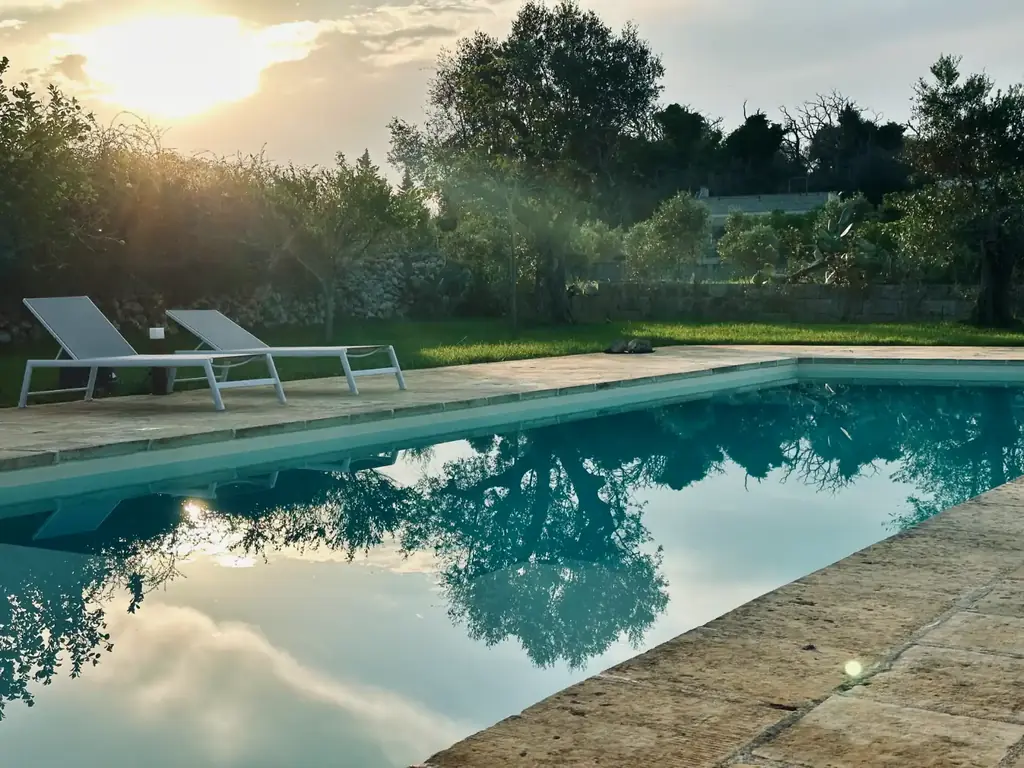
We have no houses in San Foca or in the other seaside villages of Melendugno: the nearest is further south, in Marittima, about 44 km by road and just under an hour by car. If you would like a quiet base near Castro, with San Foca, Roca and Torre dell’Orso as a day trip, in Marittima you will find our Villetta Arenosa con piscina: 4 guests, 2 rooms, 3 bathrooms and 80 m² on two levels, with a double bedroom under the typical star vaults, a bright living room with an equipped kitchenette and a sofa bed, air conditioning, a washing machine and a dishwasher. Outside there is a large private garden with a pool with views of the sea and of Castro, a sun terrace, an outdoor bathroom and showers, a play area with a volleyball net and five-a-side football goals, a barbecue and private parking.
From here Castro, its caves and the Cala dell’Acquaviva are a few minutes away, and in the same holiday you can alternate the cliffs of Adriatic Salento around Castro with a day of sand and rocks in San Foca. You will find this and our other houses in the area on the page holiday homes in Marittima. Would you like advice on dates, getting around or other houses in the area? Contact us: we will help you choose the right option.
When to go and how much time to plan
June: the sea is already pleasant, the beaches are still quiet on weekdays and the days are very long, with the sun rising early out of the sea.
July and August: this is high season. The houses are all open, the seafront is lively until late and the beaches fill up, especially at weekends: for parking and a spot on the free beach go early in the morning.
September: in our opinion the best month. The sea is still warm, there are far fewer people and the light on the rocks is beautiful.
April, May and October: the ideal time for walking along the coast towards Roca and Torre Specchia Ruggeri; swimming is for those who don’t mind cool water, and many beach clubs are still closed.
November to March: San Foca goes back to being a fishing village, quiet and a little melancholy. With the wind come the waves and the surfers; during storm surges the sight is impressive, but it should be watched from a distance.
Events and festivals (indicative dates, check them every year on the website of the municipality of Melendugno and on SalentoMe):
- Feast of the Madonna di Roca in Roca Vecchia: second Sunday in May
- Surfest in San Foca: a surf and punk music festival, in August, with dates that change from year to year
- Patron saint’s feast of San Foca: 18 and 19 August
- Feast of the patron saint San Niceta in Melendugno: mid-September
How much time to allow: half a day is enough for a swim and the harbour; a full day if you add Roca and the Grotta della Poesia. A typical day:
- 7:30: sunrise over the sea from the seafront and a walk to the harbour and the tower
- 8:30: a swim at the Fontanelle, with a mask among the Brigantini and the scoglio dell’otto
- 13:00: lunch in San Foca
- 16:30: Roca Vecchia and the Grotta della Poesia, 5 minutes by car
- 18:30: a last swim at the Marangi or a walk north, among the islets
- 20:30: a stroll along the seafront and around the tower
Surroundings and extra ideas
San Foca is well placed for discovering the Adriatic coast between Lecce and Otranto, with its towers, caves, sea stacks and nature reserves. Distances and driving times are approximate, calculated from San Foca.
Roca Vecchia and the Grotta della Poesia (2-3 km, 5 minutes): the archaeological area by the sea, inhabited since the Bronze Age, and the karst caves flooded by the sea with their ancient inscriptions; in summer (in 2026 from 18 July) there is an entrance fee and swimming is forbidden. Read our guide to the Grotta della Poesia.
Torre Specchia Ruggeri (4 km, 7 minutes): the northernmost seaside village, split between Melendugno and Vernole, with its sixteenth-century tower on the cliff and its small beaches.
Torre dell’Orso (4 km, 8 minutes): the long bay of very fine sand with the sea stacks of the Due Sorelle. Read our guide to Torre dell’Orso.
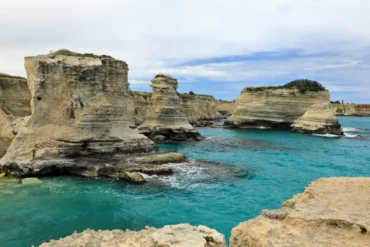
Sant’Andrea (7-8 km, 15 minutes): the seaside village famous for its sea stacks; the best-known arch collapsed in February 2026, but the landscape is still among the most beautiful on the coast.
Melendugno (7 km, 10 minutes): the town San Foca belongs to, with the star-shaped castle of the D’Amely barons and the countryside dotted with dolmens. Read our guide to Melendugno.
Le Cesine and Acaya (9-13 km, 20 minutes): the Le Cesine nature reserve, with its coastal marshes, and the fortified village of Acaya with its castle, in the municipality of Vernole. Read our guide to Vernole.
Lecce (25 km, 30 minutes): the baroque, the churches and the squares of Salento’s main city. Read our guide to Lecce.
Baia dei Turchi (16 km, 30 minutes): the sandy bay between the pine wood and the dunes of the Alimini lakes. Read our guide to the Baia dei Turchi.
Otranto (22 km, 35 minutes): the old town by the sea, the Cathedral with its mosaic and the Aragonese Castle. Read our guide to Otranto. On foot, San Foca is also a stage of the Cammino del Salento: the Via del Mare sets off again from here towards Otranto, about 24 km along the coast.
Local tip
San Foca faces east: if you wake up early, the sun rises right out of the sea, behind the islets. At dawn the seafront is empty, the harbour is silent and the sea, on days without wind, is at its calmest of the day.
Take your first swim at the Fontanelle with a mask, when the water is still and transparent: between the Brigantini rocks and the scoglio dell’otto you can see the seabed as if in an aquarium. Then, when the heat arrives and the beach fills up, take the car and go to Roca, five minutes away, for the Grotta della Poesia.
If the wind turns and the waves arrive, don’t give up: sit on the seafront and watch the surfers. It is the least-known side of San Foca, and in winter it is what keeps it alive.
FAQ
Where is San Foca?
On Salento’s Adriatic coast, in the municipality of Melendugno (Lecce), between Torre Specchia Ruggeri and Roca, 7 km from Melendugno, about 25 km from Lecce and 22 km by road from Otranto.
Is San Foca a municipality?
No, it is a hamlet and seaside village of Melendugno, like Torre dell’Orso, Roca, Sant’Andrea and Torre Specchia Ruggeri. It began as a fishing village and today is a seaside resort with a marina.
Are there sandy beaches in San Foca?
Yes: the two inlets north and south of the harbour, the Fontanelle and the Marangi, are sandy, with low rocks and small islets off the shore. To the north the coast becomes rockier, with small beaches between the rocks.
Is it a free beach or are there beach clubs?
There are both: beach clubs and stretches of free beach alternate along the seafront and to the north. Check on the spot which stretches are equipped that year.
Is San Foca good for children?
Yes, because in the inlets you enter the water from the sand and the village has all its services close by. With wind and rough sea, choose the most sheltered stretches and stay near the lifeguards.
What to see in San Foca?
The Tower of San Foca, built in 1568 against pirates, the marina, the rocks with their names, such as the Brigantini and the scoglio dell’otto, and the seafront. A few minutes away are Roca Vecchia with the Grotta della Poesia and Torre dell’Orso.
Is there a beach accessible to people with disabilities?
Yes: on the seafront there is the «Tutti al mare!» Terrace of the Io Posso project, an accessible free beach with assistance for people with ALS or severe motor disabilities and those who accompany them, open in summer by telephone booking.
Is it true that the TAP gas pipeline comes ashore at San Foca?
Yes: the TAP gas pipeline, in operation since 2020, comes ashore just over a kilometre north of the harbour, passing under the coast through a microtunnel, and continues underground to the terminal in the countryside of Melendugno. The choice of landfall was long opposed by local committees and local authorities.
When is the best time to go?
June and September for the sea, when there are fewer people and the water is already, or still, warm. On windy days, in summer and in winter too, it is time for surfing.
Where to stay near San Foca?
Salento Prime has no houses in the seaside villages of Melendugno: the nearest is the Villetta Arenosa con piscina, in Marittima, about 44 km and just under an hour away by car, for 4 guests, with 2 rooms and a private pool with a sea view. You will find the other houses on the holiday homes in Marittima page.
Conclusion
San Foca is the simplest, most lived-in face of the Melendugno coast: a fishing village turned seaside resort, with its harbour, its sixteenth-century tower, two sandy beaches among the rocks and clear water, a few minutes from Roca and Torre dell’Orso. Go in June or September, swim early in the morning with a mask and keep the evening for the seafront.
If you want a base on the Adriatic coast, with San Foca and the seaside villages of Melendugno as a day trip, in Marittima you will find our Villetta Arenosa con piscina: 4 guests, 2 rooms, 3 bathrooms and a private pool with a sea view, just under an hour from San Foca. You will find our houses in the area on the page holiday homes in Marittima.
Discover the available accommodations with Salento Prime. To best organize your base and transfers, contact us here or start a chat on WHATSAPP.
Cover photo: Fabrizio Garrisi, CC BY-SA 4.0, via Wikimedia Commons, cropped