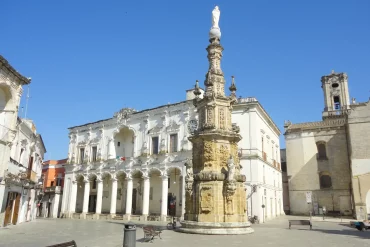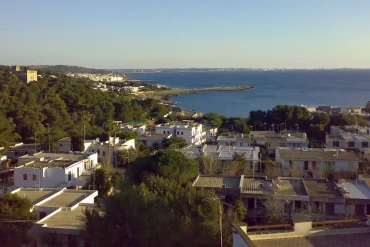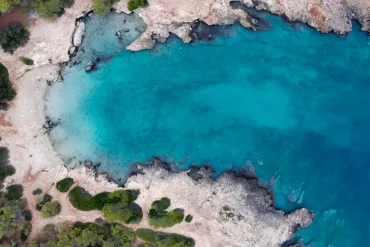
Looking for a small seaside village on the Ionian coast, with a sheltered bay, a seafront promenade, sunsets over the water and a history worth knowing? This guide takes you to Santa Maria al Bagno, the seaside village of Nardò famous for the Quattro Colonne, the remains of a sixteenth-century tower, and for the Museo della Memoria e dell’Accoglienza (Museum of Memory and Welcome), which tells the story of the years when the village took in thousands of Jewish refugees: where to swim, what to see, how to get there and how to plan your day, with practical tips and local curiosities.
In short
Santa Maria al Bagno, which the people of Nardò often call simply «Santa Maria», is a small seaside village in the municipality of Nardò (Lecce) on Salento’s Ionian coast, about 9 km from Nardò and 11 km from Gallipoli. It has a bay with a little sandy beach among the low rocks, a villa-lined seafront that continues all the way to Santa Caterina and, at the southern end, the Quattro Colonne, the four surviving bastions of the Torre del Fiume di Galatena. On the seafront stands the Museo della Memoria e dell’Accoglienza, devoted to the camp that, from the end of 1943 to July 1947, housed thousands of Jewish survivors of the Shoah. The best months for the sea are June and September; the museum can be visited all year round.
What is Santa Maria al Bagno?
Santa Maria al Bagno is a coastal hamlet of Nardò, in Ionian Salento, between Santa Caterina to the north and Gallipoli to the south. It is a holiday village that grew up around a small bay, with villas from the nineteenth and twentieth centuries, a little sandy beach, low rocks and the Quattro Colonne, the symbol of the village. Here you will also find the Museo della Memoria e dell’Accoglienza, which preserves the murals painted by a Jewish refugee in Camp No. 34.
Santa Maria al Bagno is a small village, best explored on foot: a crescent-shaped bay with the little beach in the middle, the seafront with its palm trees and pastel-coloured buildings, a square with the church and, behind it, the houses climbing the hill among the pines. In summer it fills up with families, many of them from Nardò, Galatone and the other nearby towns, and in the evening the seafront becomes one long stroll, ice cream in hand, as the sun sets into the sea.
It is not a place of big beaches with facilities: there is little sand and the rest of the coast is low rock, from which you swim in clear sea. What makes Santa Maria different from the other seaside villages is its history: the tower reduced to four columns and, a few steps away, the museum that recalls how this village, at the end of the Second World War, became a place of rebirth for thousands of people. In this guide you will find how to get there, where to swim, what to see and how to plan your day, including in the surrounding area.
Curiosities and atmosphere
The village’s old name was Sancta Maria de Balneo, «St Mary of the Bath». People have frequented this coast since very ancient times, as the prehistoric finds from the nearby Grotta del Fico show, but the village you see today is recent: after centuries of abandonment, at the end of the nineteenth century some families from Galatone decided to turn it into a holiday resort, and along the coast rose the villas and grand houses that still look out over the sea.
The symbol of Santa Maria is the Quattro Colonne. In fact they are what remains of the Torre del Fiume di Galatena, a sixteenth-century coastal tower built to defend a freshwater spring where pirates, too, used to take on water. It was a large square tower with four bastions at the corners, about 16 metres high; the central part collapsed, probably not long after it was built, and only the four bastions were left standing, which from a distance really do look like four columns by the sea.
Then there is the more recent history, the one that gave this small village a place in Europe’s memory. Between the end of 1943 and July 1947 the Allies set up Displaced Persons Camp No. 34 across Santa Maria al Bagno, Cenate and Mondonuovo, a «dispersed» reception camp for Jewish survivors of the Shoah on their way to Palestine, where the State of Israel would be founded in 1948. For the welcome given in those years, on 27 January 2005 the President of the Republic, Carlo Azeglio Ciampi, awarded the town of Nardò the Gold Medal for Civil Merit. The street names remember it too: piazzale dell’Accoglienza, piazza Shalom, via Anna Frank. You can find out more on the website of the Museo della Memoria e dell’Accoglienza.
Where it is and how to reach it
Santa Maria al Bagno lies on Salento’s Ionian coast, in the municipality of Nardò, between Santa Caterina to the north and Gallipoli to the south. Nardò is about 9 km away, Galatone 8 km, Gallipoli 11 km and Lecce about 33 km; Santa Caterina begins practically where the seafront ends, and a little further north is the Parco di Porto Selvaggio.
By car: from Lecce take the SS101 dual carriageway towards Gallipoli, leave it at Galatone and continue on the SP90 provincial road Galatone – Santa Maria al Bagno down to the sea: about 35-40 minutes without traffic. In summer the centre of the village is crowded and finding a space is difficult: in summer 2026 the municipality provided a free car park on via Edrisi, at the entrance to the village, with a free shuttle to Santa Maria from 9am to 3am. Check every year whether the service is running.
By public transport: national trains run to Lecce; from there FS Sud Est (Ferrovie del Sud Est) lines go to Nardò Centrale station, about ten kilometres from the village, which you reach by taxi or by car. In 2026 the «Salento in Bus» summer lines did not stop at Santa Maria al Bagno: check routes and timetables every year before you set off. The most convenient airport is Brindisi, just over an hour away by car.
What to do and what to see
Santa Maria al Bagno is a place to enjoy slowly: a swim in the bay or from the rocks in the morning, the museum in the hottest hours, the stroll along the seafront and the sunset in the evening. Here are the experiences not to miss.
1. The Quattro Colonne (30 minutes)
At the southern end of the village, on the seafront, rise the four bastions of the Torre del Fiume di Galatena, the sixteenth-century tower that defended the bay’s freshwater spring. Look at them from the seafront and from the rocks: the sloping walls, the stone string course halfway up and, at the top, the stone corbels of the machicolations, from which the sea was once watched. The finest view is from the south or from the sea, when the four columns can be seen side by side, with the palm trees around them. Next to them is the largo delle Quattro Colonne, which according to the municipality’s plans will become a car park and events area, and in summer there is a tourist information point.
2. The Museo della Memoria e dell’Accoglienza (1-1.5 hours)
A few steps from the Quattro Colonne, in a former school on the seafront, the museum tells the story of life in Camp No. 34 through photographs, documents, objects and videos. The heart of the museum is the room with the three original murals by Zvi Miller, also spelt Zivi Miller, a Jewish artist of Romanian origin who lived in the camp: with Stars of David, doves, luminous landscapes and figures on the move, they tell of persecution, flight and the hope of reaching the Promised Land. According to the museum, they are the only painted testimony in Europe of the Aliyah Bet, the journey that took the survivors towards Palestine. They were on the walls of a small house in the village; saved thanks to the efforts of APME, the Associazione Pro Murales Ebraici, in 2009 they were detached, restored and brought to the museum, which opened on 14 January 2009 to a design by the architect Luca Zevi. Until June 2027 there is also the exhibition «BESA – Una questione d’onore!», with Norman Gershman’s photographs of the Albanian Muslims who saved Jews during the Shoah. In November 2026 the museum was open on Tuesday, Wednesday and Saturday from 9:30 to 13:30, on Thursday from 9:30 to 13:30 and from 15:00 to 19:00, on Friday from 15:00 to 19:00 and on Sunday from 15:30 to 19:30, and closed on Monday; by booking it can also be visited on other days, with guided tours. Opening times change with the seasons: check them on the museum website before you go.
3. On the trail of Camp 34 in the village (45 minutes)
After the museum, look at the village with different eyes. The villas, lived in only in summer, were requisitioned to house the refugees and the Allied officers: the synagogue was in the village square, the theatre and a place of prayer in villa Personé, the hospital in villa Del Prete, with doctors and nurses who were almost all Jewish, and the officers’ command was in the building overlooking the beach. At the masseria of Mondonuovo, in the nearby countryside, there was a kibbutz where young people prepared for the long sea voyage. In just two years, the museum recounts, some four hundred weddings were celebrated. Many buildings are private: look at them from the outside, with respect. The museum also organises guided tours of the museum and the village: it is the best way to understand where the life of the camp took place.
4. Swimming at the little beach and from the rocks (half a day)
In the middle of the bay is the little beach, a small crescent of sand enclosed between the seafront wall and the rocks, with a sandy seabed where you can walk into the water. It is small and in summer it fills up early. On either side and all along the coast, as far as the Quattro Colonne and towards Santa Caterina, the rock is low and flat: you settle on the rocks and get into the water where the sea is already deeper, clear and an intense blue.
5. Snorkelling and diving off the Quattro Colonne (1 hour)
The rocky seabed off the Quattro Colonne is popular with snorkellers, freedivers and scuba divers: among the rocks you can see fish, sea urchins and posidonia meadows. Get into the water from the rocks only when the sea is calm, use a marker buoy if you move away from the shore and watch out for boats, which pass close to the coast in summer.
6. The seafront walk to Santa Caterina (1 hour 15 minutes there and back)
From the little beach the seafront continues north along the coast, past villas, rocks and sea, to nearby Santa Caterina: it is about 2.7 km, just over half an hour on foot. It is a much-loved walk, so much so that in summer 2026 the stretch between Santa Maria and Santa Caterina also hosted the «Cena in bianco», a long dinner table under the stars. Do it towards evening, when the heat eases and the sun sinks over the sea.
7. Sunset over the bay (30 minutes)
Santa Maria’s coast faces west, and on summer evenings the sun sets right into the sea, in front of the bay. Sit on the low seafront wall or on the rocks near the Quattro Colonne, have an ice cream or an aperitif in one of the village’s bars and wait for the columns to turn orange and then dark against the sky. If you are travelling with children, next to the museum there is also the Acquario del Salento, devoted to marine life: check opening days and times before you go.
Sea, beach and who it suits
The sea at Santa Maria al Bagno is clear and bright, turquoise over the sand of the little beach and bluer where the seabed is rock. The bay is small and fairly sheltered: on calm days swimming is easy even for those who are not strong swimmers, while in rough seas the waves come into the bay too and great care is needed on the rocks.
It is perfect for anyone looking for a seaside village with everything close at hand, for couples, for those who love walking along the seafront and watching the sunset and for those who want to combine the sea with a visit that makes you think. With children the little beach works well, as you get into the water from the sand. It is less suited to those looking for a long sandy beach with plenty of space: there is little sand and in August space goes quickly.
Free beach and facilities
The little beach in the middle of the bay and the rocks along the coast are the heart of swimming in Santa Maria. In the village there are bars, ice cream parlours, restaurants and small shops, almost all on the seafront and around the square; in summer the Quattro Colonne information point helps you find your way around. Check on the spot whether and where there are beach clubs with umbrellas and sunloungers, because they change from year to year.
For the rocks bring reef shoes, a thick towel and a small umbrella: the rock is hard and gets very hot in summer.
Santa Maria al Bagno vs other places on the coast
Along this stretch of the Ionian coast the landscapes change within a few kilometres. Here is a practical comparison to help you choose:
Santa Maria al Bagno vs Santa Caterina
- Santa Maria al Bagno: the bay with the little beach, the Quattro Colonne and the museum, a compact village to explore on foot
- Santa Caterina: the neighbouring seaside village, at the end of the seafront, gateway to the Parco di Porto Selvaggio
Santa Maria al Bagno vs Porto Selvaggio
- Santa Maria al Bagno: swimming in the village, with bars and services a stone’s throw away
- Porto Selvaggio: nature, pine wood and a bay reached on foot, with no village around it
Santa Maria al Bagno vs Gallipoli
- Santa Maria al Bagno: a quiet village, with the seafront and the sunsets
- Gallipoli: the old town on the island, the long sandy beaches and the liveliest nightlife in the area
When to choose Santa Maria al Bagno: if you are looking for a small, lively seaside village, you like swimming from the rocks and you want to discover a story that few people know.
When to choose somewhere else: if you want a long sandy beach with beach clubs, look at the beaches of Gallipoli or, further south, those of Lido Marini and the Ugento coast.
Practical tips
In July and August don’t drive into the centre of the village: leave the car in the car parks at the entrance to the village, such as the one on via Edrisi, and arrive on foot or by the summer shuttle, if it is running. The little beach is already full during the morning: if you want the sand, arrive early; otherwise choose the rocks along the coast, where you can find space even later on.
Plan your visit to the museum around its opening times, which change with the seasons and include afternoon closures: the hot afternoon hours are perfect for going in, when you stop for lunch in the village. For swimming from the rocks bring reef shoes and a mask; if the sea is rough, stay at the little beach or put off your swim.
Useful practical information
| 📍 Where | Santa Maria al Bagno (Nardò, Lecce), 9 km from Nardò, 11 km from Gallipoli and 33 km from Lecce |
|---|---|
| 🚗 Parking | Car parks at the entrance to the village, such as via Edrisi; in summer a shuttle to the centre (free in 2026, check every year) |
| ♿ Access | Level seafront; into the water from the sand at the little beach, elsewhere from the rocks |
| 🏖 Beach | A small sandy beach in the middle of the bay; the rest is low rock |
| 🌊 Sea | Clear; sandy seabed at the little beach, rocky and deeper along the coast |
| 👟 What to bring | Reef shoes, mask, water, hat and a small umbrella |
| 🍴 Food | Bars, ice cream parlours and restaurants on the seafront and in the square; more choice in Nardò and Gallipoli |
| 📅 Best time | June and September for the sea; the museum all year round, checking the opening times |
Where to stay near Santa Maria al Bagno
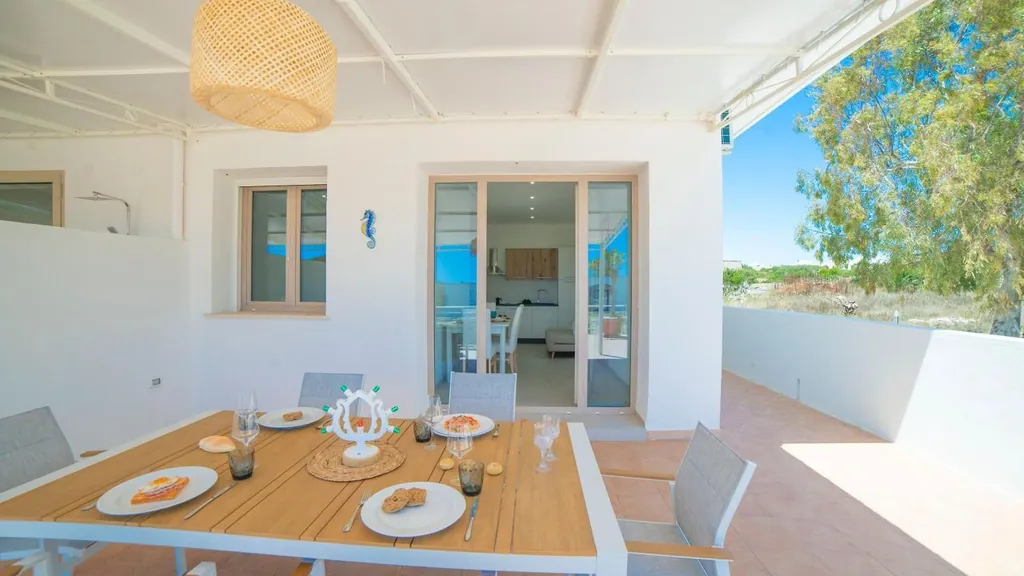
Salento Prime has no houses in Nardò or its seaside villages: our houses are further south, on the same Ionian coast, between Lido Marini and Torre Pali. From here Santa Maria al Bagno is about 46 km away, around fifty minutes by car: a lovely day trip, to combine with Gallipoli or Porto Selvaggio. The nearest house is our Le Secche Suite & House – 4, La Secca di Venerdi: 4 guests, 1 bathroom with a shower and 50 m², with a double bedroom and a bedroom with two single beds or a double bed, views of the sea and the Mediterranean scrub, air conditioning, a modern fully equipped kitchen with a dishwasher, a living room, an equipped terrace, a garden, Wi-Fi and free private parking. Small dogs are allowed and the sea is less than 1 km away.
The house is part of Le Secche Suite & House, a small complex of six units completed in 2024: you will find them all on the page holiday homes in Lido Marini. From here the sandy beaches of Lido Marini and Torre Pali are a few minutes away, and in the same holiday you can head up the Ionian coast to Gallipoli and Nardò.
Would you like advice on dates, getting around or other houses in the area? Contact us: we will help you choose the right option.
When to go and how much time to plan
June: the sea is already pleasant, the little beach is quiet on weekdays and the long days let you combine a swim, the museum and the sunset.
July and August: it is the liveliest period, with all the houses open, the seafront busy until late and the summer shows at Quattro Colonne. The sea is warm, but for parking and a spot on the sand it is best to arrive early in the morning.
September: in our view the best month. The sea is still warm, there are far fewer people and in the middle of the month the village celebrates the Madonna with the procession at sea.
April, May and October: ideal for the seafront, a visit to the museum and a walk to Porto Selvaggio; swimming is for those who don’t mind cool water.
November to March: Santa Maria is quieter, but the museum stays open and at the end of January, for the Giorno della Memoria (Holocaust Remembrance Day), events and guided tours of the museum and the village are organised in Nardò. In heavy seas the sight of the waves on the Quattro Colonne is magnificent, best watched from a distance.
Events and festivals (indicative dates, check them every year on the website of the municipality of Nardò and on SalentoMe):
- Giorno della Memoria (Holocaust Remembrance Day), with events and guided tours of the museum and the village: 27 January
- Summer shows at Quattro Colonne, in the «Nardò Estate» programme: July and August
- Feast of the Madonna in Santa Maria al Bagno, with the procession through the streets of the village, the blessing of the sea and fireworks over the sea: mid-September
How much time to allow: half a day is enough for the village, the Quattro Colonne and the museum; a whole day if you add a swim, the seafront walk to Santa Caterina and the sunset. A typical day:
- 9:00: a walk to the Quattro Colonne and coffee on the seafront
- 9:30: visit to the Museo della Memoria e dell’Accoglienza (on days when it opens in the morning)
- 11:00: a swim at the little beach or from the rocks
- 13:30: lunch in the village
- 17:30: the seafront walk to Santa Caterina
- 19:30: sunset over the bay, in front of the Quattro Colonne
Surroundings and extra ideas
Santa Maria al Bagno is well placed for exploring the Nardò coast, with its seaside villages, coastal towers and the Parco di Porto Selvaggio, and it is a quarter of an hour from Gallipoli. Distances and driving times are approximate, calculated from the Quattro Colonne.
Santa Caterina (4 km, 6 minutes; 2.7 km on foot along the seafront): the neighbouring seaside village, at the end of the seafront, gateway to the Parco di Porto Selvaggio. Read our guide to Santa Caterina.
Porto Selvaggio (about 4 km, 6 minutes, then on foot): the regional nature park with its pine wood, the bay set in greenery and the towers on the coast. Read our guide to Porto Selvaggio.
Galatone (8 km, 12 minutes): the inland town from which, at the end of the nineteenth century, came the families who turned Santa Maria into a holiday resort, with an old town well worth exploring.
Nardò (9 km, 13 minutes): the municipality Santa Maria belongs to, with its baroque old town around Piazza Salandra. Read our guide to Nardò.
Gallipoli (11 km, 14 minutes): the old town on its rocky island, the castle, the baroque cathedral and the sandy beaches south of the town. Read our guide on what to do in Gallipoli.
Torre del Pizzo (22 km, 27 minutes): the white sixteenth-century tower on Punta Pizzo, in the nature park south of Gallipoli, with the pine wood, the dunes and the trails. Read our guide to Torre del Pizzo.
Lido Marini (46 km, 50 minutes): the sandy beaches of the Ugento coast, where our nearest houses are. Read our guide to Lido Marini.
Local tip
Visit the museum before you swim, not after. When you come out and look at the bay, the little beach and the villas on the seafront, you see them differently: they are the very places where, eighty years ago, thousands of people who had survived the Shoah began to live again, to marry and to make plans for the future.
In the evening, walk south to the Quattro Colonne as the sun goes down into the sea: the columns turn orange, then become four dark silhouettes against the sky. It is the most beautiful moment of the day in Santa Maria.
And if the sea is calm, bring your mask and swim from the rocks near the columns early in the morning: the water is crystal clear and you will have it almost to yourself.
FAQ
Where is Santa Maria al Bagno?
On Salento’s Ionian coast, in the municipality of Nardò (Lecce), between Santa Caterina and Gallipoli, about 9 km from Nardò, 11 km from Gallipoli and 33 km from Lecce. Many people call it simply «Santa Maria».
What are the Quattro Colonne?
They are the four corner bastions of the Torre del Fiume di Galatena, a sixteenth-century coastal tower built to defend a freshwater spring. The central part of the tower collapsed and only the bastions remained, which look like four columns by the sea.
What was Camp 34?
Displaced Persons Camp No. 34, a reception camp set up by the Allies across Santa Maria al Bagno, Cenate and Mondonuovo, in operation from the end of 1943 to July 1947. It housed thousands of Jewish survivors of the Shoah on their way to Palestine. For that welcome, in 2005 Nardò received the Gold Medal for Civil Merit.
When is the Museo della Memoria e dell’Accoglienza open?
In November 2026 it was open from Tuesday to Sunday, with different morning and afternoon hours, and closed on Monday; by booking it can also be visited on other days. Opening times change with the seasons: always check the museum website before you go.
Is there a sandy beach in Santa Maria al Bagno?
Yes, but a small one: a little sandy beach in the middle of the bay. The rest of the coast is low rock, from which you swim in clear sea.
Is Santa Maria al Bagno suitable for children?
Yes: at the little beach you get into the water from the sand, the village can be explored on foot and next to the museum there is the Acquario del Salento. On the rocks, however, care is needed.
Where can you park in summer?
In the car parks at the entrance to the village, such as the one on via Edrisi. In summer 2026 parking and the shuttle to the centre were free: check every year on the website of the Comune di Nardò.
Can you walk to Santa Caterina?
Yes: the seafront links the two seaside villages; it is about 2.7 km, just over half an hour on foot. From Santa Caterina you enter the Parco di Porto Selvaggio.
Where to stay near Santa Maria al Bagno?
Salento Prime has no houses in Nardò: the nearest is Le Secche Suite & House – 4, between Lido Marini and Torre Pali, about 46 km and around fifty minutes away by car, for 4 guests, with views of the sea and the scrub, an equipped terrace and private parking. You will find the other houses on the holiday homes in Lido Marini page.
Conclusion
Santa Maria al Bagno is the Salento of small seaside villages: a bay with a little beach, low rocks, the villa-lined seafront all the way to Santa Caterina and sunsets over the water. But it is also a place of memory, with the Quattro Colonne that tell of centuries of raids from the sea and the museum that recalls the years when the village became a home for thousands of survivors. Come in June or September, visit the museum and stay until sunset.
If you want a quiet base for exploring the Ionian coast, between Lido Marini and Torre Pali you will find our Le Secche Suite & House – 4: 4 guests, views of the sea and the Mediterranean scrub, an equipped terrace and private parking, around fifty minutes from Santa Maria al Bagno. You will find our houses in the area on the page holiday homes in Lido Marini.
Discover the available accommodations with Salento Prime. To best organize your base and transfers, contact us here or start a chat on WHATSAPP.
Cover photo: Fabrizio Garrisi, CC BY-SA 4.0, via Wikimedia Commons