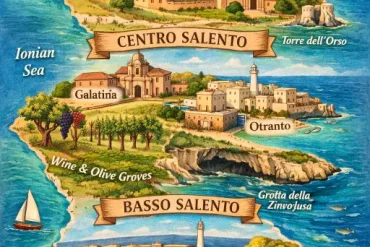
Discover the three souls of Salento: from Upper Salento with its masserie and ancient olive trees, to the Centre with Baroque towns and the Adriatic coast, down to Lower Salento where the Adriatic meets the Ionian. A complete guide to working out where to go based on what you are looking for.
Geographical Salento: Upper, Central and Lower – How to Find Your Way Around the Salento Peninsula
TL;DR: ✓ Salento is divided into three distinct areas
✓ Upper Salento: rural, masserie, olive groves (province of Brindisi)
✓ Central Salento: Baroque Lecce, Adriatic coast with beach facilities
✓ Lower Salento: land’s end, sea caves, two seas
Featured Snippet
Salento is geographically divided into Upper Salento (province of Brindisi, known for masserie and ancient olive groves), Central Salento (the Lecce area, with Baroque architecture and the Adriatic coast down to Otranto) and Lower Salento (from Santa Maria di Leuca to Gallipoli, with cliffs and the meeting of the Adriatic and Ionian seas), each with its own landscape, history and tourist identity.
When people talk about Salento, many imagine a single, uniform destination. In reality this peninsula of about 5,500 km² holds three distinct geographical souls, each with its own character, landscapes and traditions. Understanding the division between Upper, Central and Lower Salento helps you choose more knowingly where to go, what to see and what atmosphere to enjoy.
Upper Salento welcomes you with expanses of ancient olive trees (more than 60 million of them), fortified masserie and a farming way of life that is still authentic.
Central Salento is the Baroque and cultural heart, with Lecce as its capital and a jagged Adriatic coastline of more than 80 km.
Lower Salento is the southernmost point, where the two seas symbolically meet and the landscape becomes rocky, sun-baked, almost Levantine Mediterranean.
In this guide you will discover the features of each area, how to find your way around and what experiences to expect depending on the area you choose to explore.
Index
- Comparison table of the three areas
- Curiosities and atmosphere
- Where it is and how to find your way around
- Upper Salento: masserie, olive groves and the hinterland
- Central Salento: Baroque, culture and the Adriatic coast
- Lower Salento: land’s end between two seas
- Practical tips for exploring the three areas
- When to go and how much time to plan
- Surroundings and extra ideas
- Local tip
- FAQ
- Conclusion
Comparison table of the three areas
| Feature | Upper Salento | Central Salento | Lower Salento |
|---|---|---|---|
| Provinces | Brindisi, northern Lecce | Lecce | Southern Lecce, Taranto |
| Type of sea | Wild Adriatic coves | Adriatic beaches with facilities | Adriatic cliffs + Caribbean-style Ionian beaches |
| Landscape | Olive groves, masserie, countryside | Baroque, historic towns, pine woods | Rocky, Mediterranean scrub |
| Crowds | Low | High (July-August) | Medium-high |
| Ideal for | Rural relaxation, slow tourism | Culture, nightlife, beaches with facilities | Sea excursions, hiking, photography |
| Average budget/day | 60-90€ | 80-120€ | 70-110€ |
| Distance from Lecce | 30-50 km north | 0-30 km | 40-80 km south |
| Nearest airport | Brindisi (20-40 km) | Brindisi (45 km) | Brindisi (90-120 km) |
Curiosities and atmosphere
The geographical division of Salento is not just an administrative or cartographic matter: it reflects deep historical, geological and cultural differences documented since Messapian times (9th century BC). Upper Salento roughly corresponds to the province of Brindisi and part of the northern Salento area, a zone that for centuries was a crossroads of trade thanks to the port of Brindisi, a departure point for Greece and the East as early as Roman times (Via Appia).
Here the landscape is dominated by expanses of centuries-old olive trees, some of them over 1,000 years old, dry-stone walls totalling more than 40,000 km across Puglia according to ISTAT, and fortified masserie that tell of an agricultural and pastoral past. Central Salento revolves around Lecce, the Baroque city par excellence, with more than 40 churches in Lecce stone, and stretches along the Adriatic coast as far as Otranto.
This is the most densely populated area (about 800,000 inhabitants in the province of Lecce) and the most culturally lively, where the Adriatic becomes crystal clear and golden stone takes centre stage in extraordinary architecture. Lower Salento, the “heel of Italy”, is the very tip where the Adriatic and Ionian symbolically touch at Santa Maria di Leuca, creating sea currents that support unique biodiversity. Here the landscape changes: less green, more rocky, with sheer cliffs reaching 50-70 metres in height, sea caves (more than 30 recorded) and an atmosphere reminiscent of the Greek islands. Each area has developed its own identity in food (pasticciotto leccese vs pittule vs municeddhe), architecture and even language, with dialect variations noticeable between the north and south of the peninsula.
Where it is and how to reach it
Salento occupies the southern part of Puglia, corresponding to the province of Lecce (2,759 km²), part of the province of Brindisi (1,839 km²) and a small portion of the province of Taranto on the Ionian side. The geographical coordinates of the central point are 40.0844° N, 18.1384° E. To get your bearings, imagine a peninsula stretching from the north-west (Taranto) and north-east (Brindisi) southwards down to Santa Maria di Leuca (39.7975° N, 18.3613° E). Upper Salento ideally starts from the Taranto-Brindisi line and runs down to the level of Lecce, including towns such as Francavilla Fontana, Oria, Mesagne, San Vito dei Normanni, Ceglie Messapica and Ostuni (on the border). Central Salento is centred on Lecce (40.3515° N, 18.1750° E) and extends along the Adriatic coast, including places such as San Cataldo (9 km from Lecce), Roca Vecchia (25 km), Torre dell’Orso (28 km) and Otranto (45 km). Lower Salento begins south of Otranto on the Adriatic coast and south of Gallipoli on the Ionian coast, down to the tip of Leuca (98 km from Lecce), including towns such as Tricase, Castro, Gagliano del Capo and Alessano on the Adriatic side, and Ugento, Casarano and Morciano di Leuca on the Ionian side.
How to get there by car from Brindisi airport:
- Upper Salento (Ostuni/Ceglie): 25-35 km, 25-40 minutes via the SS16 or SP1
- Central Salento (Lecce): 45 km, 40-50 minutes via the SS613 Brindisi-Lecce
- Lower Salento (Leuca): 135 km, 1h 50min via the SS16 and SS275
Trains and buses: from Lecce railway station, Trenitalia regional trains and FSE (Ferrovie del Sud Est) buses connect most towns in Central and Lower Salento. Main lines: Lecce-Otranto (12 services/day), Lecce-Gallipoli (10 services/day), Lecce-Maglie-Leuca (8 services/day).
Upper Salento: masserie, olive groves and the hinterland
Upper Salento is the area least visited by mass tourism (about 15% of total tourist flows in Salento according to Regione Puglia 2024) and for that very reason it keeps an authentic charm. Here time seems to slow down among rows of monumental olive trees, some with more than 1,000 years of history such as those of Borgagne and San Pietro Vernotico, and masserie that are true agricultural fortresses. The landscape is gently rolling, with altitudes rarely above 150 metres, dotted with dry-stone walls (UNESCO heritage since 2018), scattered trulli and small white villages. This is the ideal area if you are looking for peace, contact with rural nature and genuine hospitality far from crowded beaches. The masserie of Upper Salento often offer tastings of Collina di Brindisi PDO extra virgin olive oil, cheeses such as caciocavallo podolico and DOC wines (Primitivo di Manduria, Salice Salentino), and many have kept their original architecture with star vaults, watchtowers (16th-17th-century masserie fortified against Turkish raids) and inner courtyards. The cooking here is simple and hearty: handmade orecchiette with turnip tops, grilled meat, bombette from Cisternino (stuffed meat rolls), fresh cheeses. The most interesting towns include Oria with its Norman-Swabian castle (13th century), Ceglie Messapica, known for traditional fine dining (home of chef Dora Rizzo), and Ostuni with its brilliant white historic centre overlooking the plain of olive trees. Upper Salento has fewer beach clubs but gives access to lesser-known coves on the Adriatic coast towards Torre Guaceto (state nature reserve, about 1,200 hectares) and Specchiolla.
Main attractions of Upper Salento
Educational farms and olive mills: many masserie open their doors for guided tours, especially between October and December during the olive harvest. You can watch traditional pressing and taste single-variety oils. Average cost: €15-25 per person with tasting. Booking recommended.
White towns: Ostuni (68,000 visitors a year), Cisternino and Locorotondo (on the border with the Itria Valley) have whitewashed historic centres with narrow lanes, stairways and views over the countryside. Ostuni is 38 km from Brindisi and 85 km from Lecce.
Torre Guaceto Nature Reserve: a marine protected area of 1,200 hectares with dunes, Mediterranean scrub and a Blue Flag sea since 2000. Less crowded than the beaches in the south (controlled capacity: max 700 people/day in high season). Entry: €4 adults, €2 children.
Wineries and agriturismi: an area devoted to producing DOC wines (Primitivo di Manduria, Negroamaro, Salice Salentino) and Collina di Brindisi PDO olive oil. Wineries such as Cantele, Leone De Castris and Taurino offer tours and tastings by appointment (€25-40).
Monumental olive trees: visit the olive groves of Borgagne (some trees are estimated to be over 1,500 years old), San Pietro Vernotico and Carovigno. Free access along country roads; respect private property.
@amolapuglia Salento in love ❤️🌊 👉 Thanks to: @andrea.pappaccogli #salento #puglia #italy #sea #summer #lecce #travel #instagood #love #photography #italia #photooftheday #picoftheday #mare #nature #sun #weareinpuglia #apulia #beach #sunset #holiday #pugliagram #instagram #igersitalia #igerspuglia #photo #volgopuglia #instalike #beautiful #otranto ♬ suono originale - Amo la Puglia
@welcometosalento La Montagna Spaccata . . . . #Salento #italy🇮🇹❤️ #puglia #nardo ♬ suono originale - Popi dj
Central Salento: Baroque, culture and the Adriatic coast
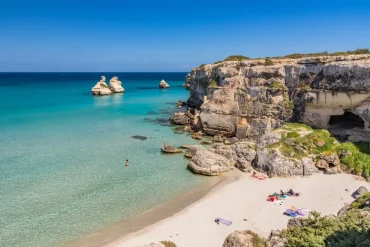
Central Salento is the beating heart of the peninsula, where history, art and sea come together in a complete experience. Lecce, called the Florence of the South, has about 95,000 inhabitants and is an open-air museum with more than 40 Baroque churches in golden Lecce stone (locally quarried calcarenite), hidden courtyards, papier-mâché workshops (a tradition since the 17th century) and a lively cultural scene. According to Lonely Planet, Lecce is one of the 10 Italian cities to visit. From Lecce the Adriatic is 9-12 km away: San Cataldo is the historic beach of the people of Lecce (connected by city bus, 20 minutes), while heading north you find coves such as Roca Vecchia with its submerged Messapian archaeological site (which can be explored by snorkelling), Torre dell’Orso with its 20-metre white cliffs, the pine wood behind it and the two sea stacks known as the “Due Sorelle” (Two Sisters), up to Otranto (45 km from Lecce, 12,000 inhabitants), the easternmost town in Italy. Otranto deserves at least half a day: its historic centre is a maze of white lanes, the cathedral of Santa Maria Annunziata (founded in 1080) holds an extraordinary 16×10-metre medieval floor mosaic with the Tree of Life (the work of the monk Pantaleone, 1163-1165), and from the Aragonese walls you can see the turquoise sea. Central Salento is perfect for anyone who wants to combine culture, evening nightlife (Lecce has more than 200 bars, pubs and restaurants) and beach days at beach clubs. This is where you will find the highest concentration of tourist services, with more than 850 accommodation facilities according to the Lecce Chamber of Commerce.
Main attractions of Central Salento
Lecce historic centre: the Basilica of Santa Croce (a masterpiece of Lecce Baroque, 1549-1695), Piazza Duomo (one of the most beautiful enclosed squares in Italy), the Roman Amphitheatre (1st-2nd century AD, capacity 14,000 spectators), the Castle of Charles V (1539-1549). Allow at least 4-5 hours to stroll through the streets of the centre. Free entry to churches and squares; castle museum €10.
Otranto: the cathedral with the Tree of Life mosaic (entry €3), the Aragonese castle (1485-1498, entry €6), the seafront and coves such as Baia dei Turchi (4 km north, free beach and beach club, parking €5/day).
Adriatic coast: Torre dell’Orso (800m sandy beach with the Due Sorelle, beach club €10-15/day), Roca Vecchia (natural pool and Messapian remains, free access), Laghi Alimini (coastal lakes, canoeing and birdwatching, wild beaches).
Grotta della Poesia: a natural pool carved into the rock at Roca Vecchia, 18 metres across and 4 metres deep. One of the most photographed places in Salento. Free access but crowded in high season (avoid 11:00-17:00). Diving has been banned since July 2023 to protect the submerged archaeological site.
Acaya: a fortified Renaissance village (1535-1536), 4 km from Vernole. Castle, walls, gates. Perfect for an afternoon stroll through history and local crafts. Free entry to the village, castle €5.
Lower Salento: land’s end between two seas
Lower Salento is the southernmost and wildest part (the far south: Leuca lighthouse, 39°47’43″N), where the peninsula narrows to just 40 km wide and the two seas symbolically meet at Santa Maria di Leuca (from the Latin “De Finibus Terrae”, the end of the earth). Here the landscape changes radically: less green and cultivated, more rocky, with sheer cliffs reaching 60-70 metres (Castro-Santa Cesarea area), sea caves reachable by boat (more than 30 recorded between the Adriatic and Ionian) and a dazzling light reminiscent of the Greek islands. On the Adriatic side you find places such as Castro (early medieval village of 350 inhabitants, with a tourist marina), Tricase Porto (900 inhabitants, picturesque fishing harbour), Marina di Andrano and Santa Cesarea Terme with its Moorish architecture (Villa Sticchi 1894, Moorish-Byzantine style) and sulphurous thermal waters (34°C, Fetida, Sulfurea, Gattulla and Solfatara springs). On the Ionian side there is Gallipoli (old town of 2,000 inhabitants on an islet of 0.5 km², joined by a 17th-century bridge, 20,000 inhabitants in the whole municipality), Pescoluse with its brilliant white beaches nicknamed the “Maldives of Salento” (7 km of sand), Torre San Giovanni and Mancaversa. Leuca is the symbolic finishing point: the lighthouse (47 metres high, 1866, visible for 30 nautical miles), the Basilica De Finibus Terrae (a Marian sanctuary), the Art Nouveau villas of the early 20th century (more than 40 recorded), and the monumental staircase (284 steps from the top down to the harbour). This area is perfect if you are looking for crystal-clear sea (visibility up to 25 metres), diving (more than 15 recorded sites), boat trips to the caves (Zinzulusa, Romanelli, Palombara) and a more contemplative pace. Lower Salento also has a fascinating hinterland with towns such as Specchia (one of the Most Beautiful Villages in Italy, 4,800 inhabitants, medieval historic centre), Presicce-Acquarica with its underground olive mills (18th century, more than 20 recorded) and Tricase with its picturesque harbour.
Main attractions of Lower Salento
Santa Maria di Leuca: the lighthouse (guided tours €5, booking required), the Basilica De Finibus Terrae sanctuary (7th century, rebuilt in 1720), the monumental Garibaldi staircase (284 steps), Art Nouveau villas (Villa Episcopo, Villa Mellacqua, Villa Daniele). Boat trips to the sea caves leave from here (€15-25/person, 1h-2h).
Castro: an early medieval village with an Aragonese castle (open to visitors, €4), the marina below and the Zinzulusa cave (zinzuli = rags in dialect, after the stalactites), which can be visited on foot (200m route, €8, inside temperature 18°C). One of the most spectacular karst caves in Europe, with a final lake inhabited by rare crustaceans.
Gallipoli: the old town on an islet (0.5 km²), with 16th-century bastions, a Baroque historic centre, a Hellenistic Greek fountain (unique in Italy) and a morning fish market (6:00-12:00). The surrounding coast has beach clubs (Baia Verde, Punta della Suina, €12-18/day) and summer nightlife.
Pescoluse and the Maldives of Salento: brilliant white beaches with turquoise sea, shallow water (1.5m deep up to 50m from the shore), ideal for families. Well-equipped beach clubs (€10-15/day) but very busy in July-August (up to 5,000 visitors/day).
Sea caves: Zinzulusa (visitable on foot, €8), Romanelli (boat only, prehistoric Palaeolithic finds), Palombara (boat, bat colony), Tre Porte (boat, triple natural arch), Azzurra (boat, blue light), Cattedrale (boat, 4m stalactites). Trips leave from Castro (€15-20), Tricase Porto and Santa Maria di Leuca (€20-30). Duration 1h-2h30.
Inland towns: Specchia (Most Beautiful Village in Italy 2013, medieval centre, 4,800 inhabitants), Presicce (town of hypogea, 5,300 inhabitants, underground olive mills open to visitors €5), Supersano, Maglie (15,000 inhabitants, the area’s shopping hub). Perfect for afternoon strolls through flower-filled lanes and craft workshops.
Capo di Leuca: the very tip, a lighthouse visible from 30 nautical miles, the symbolic meeting point of the Adriatic and Ionian. The monumental Garibaldi staircase links the basilica to the marina (284 steps, 48m drop).
Practical tips for exploring the three areas
Ideally you should have a car to move freely between the three areas, especially if you want to explore the hinterland and the coves less served by public transport. Car hire at Brindisi airport: €25-45/day (in season), book online in advance. In high season (July-August) the coastal resorts of Central and Lower Salento can be very crowded: if you are looking for peace, go for Upper Salento or lesser-known towns such as Tricase, Specchia and Supersano. Each area has weekly markets (Upper Salento: Ceglie on Saturday morning, Ostuni on Friday; Centre: Lecce Wednesday-Saturday, Otranto on Saturday; Lower: Tricase on Thursday, Gagliano on Tuesday) and summer festivals (Notte della Taranta in Melpignano in August, the Fiera di Santa Lucia in Lecce in December). Always carry water (1.5-2L/person/day), a hat and SPF 50+ sunscreen, especially in Lower Salento where natural shade is scarce. If you are visiting the sea caves, book boat trips in advance in the peak months (June-September, booking recommended 48h ahead). Many masserie in Upper Salento require booking for tours and tastings (call 24-48h ahead). Respect the protected areas (Torre Guaceto, Porto Selvaggio, Alimini), do not pick plants (strictly forbidden for protected flora, fines up to €300) or disturb wildlife, and follow the instructions at archaeological sites.
🚗 Parking: in historic towns (Otranto centre €2/h, Gallipoli old town €1.50/h, Lecce centre €1.50-2/h) use paid car parks on the outskirts and walk into the centre. Free parking is usually 300-500m from the centre.
🏖 Sea: Upper Salento has wild coves (Torre Guaceto, Specchiolla), Central Salento beaches with facilities (Torre dell’Orso, Alimini €10-15/day), Lower Salento a mix of cliffs (Castro, Leuca) and Caribbean-style beaches (Pescoluse, Torre Pali €12-18/day).
🍴 Food break: Upper Salento has masserie and agriturismi (full lunch €25-35), Central Salento city restaurants and trattorias (€15-30), Lower Salento fried-food shops and fish taverns (seafood starters €12, fried fish €10-14).
🐾 Dog-friendly: many free beaches allow dogs (Alimini north area, Torre Guaceto north area, Pescoluse free beach). Check the municipal ordinances for beach clubs (some have dedicated areas, +€5).
When to go and how much time to plan
Salento can be visited all year round (an average of 330 days of sunshine a year according to data from the Italian Air Force), but the three areas offer different experiences depending on the season.
Upper Salento is ideal in spring (April-May, temperatures 18-24°C, green and flowering countryside) and in autumn (October-November, 16-22°C) during the olive harvest (October-December).
Central Salento is lively all year thanks to Lecce (cultural events 12 months a year), but the sea is perfect from June to September (water temperature 22-26°C).
Lower Salento, more exposed and windy (frequent mistral and scirocco), can be cool in winter (January-February, lows of 8-10°C) but offers crystal-clear sea from May (21°C) to October (22°C).
July and August are very crowded and hot, with temperatures easily exceeding 35°C (peaks of 40°C inland): if you can, choose June (25-30°C, sea 23°C) or September (24-28°C, sea 25°C). Weekdays and weekends are much the same in high season (constant crowds), while in low season (October-May) weekends are livelier in towns that organise events (food festivals, markets, concerts). A complete tour of the three areas needs at least 7-10 days: 2-3 days in Upper Salento based in a masseria, 3-4 days in Central Salento between Lecce and the Adriatic coast, 3-4 days in Lower Salento exploring both coasts. If you have less time, choose one or two areas based on your interests: culture + sea = Central Salento, sea + caves = Lower Salento, relaxation + food and wine = Upper Salento.
Surroundings and extra ideas
Valle d’Itria: on the border with Upper Salento, easy to visit on a day trip from Ostuni (20 km) or Ceglie Messapica (15 km). The trulli of Alberobello (UNESCO heritage since 1996, 1,500 trulli), Locorotondo (a round town, DOC white wine), Cisternino (white town, butcher’s shops that grill meat to order). Distance from Lecce 80 km, 1h by car.
Taranto: ancient Magna Graecia, founded in 706 BC by Spartan colonists. The MArTA archaeological museum with gold jewellery, pottery and chamber tombs (entry €8, one of the most important archaeological museums in Italy). The old town between two seas (Mar Grande and Mar Piccolo), swing bridge. About 50 km from Upper Salento, 75 km from Lecce.
Porto Cesareo: marine protected area (17 km of coast, sea beds down to 30m) on the Ionian side, between Central and Lower Salento. Sandy beaches (Torre Lapillo, Punta Prosciutto), shallow sea ideal for families (1m deep up to 30m from the shore). Distance from Lecce 28 km. Beach clubs €12-15/day.
island of Sant’Andrea: opposite Gallipoli (800m from the coast), reachable by boat (€5 return, departures every 30min from the harbour). Regional nature reserve, 50 hectares, lighthouse (1866). Ideal for snorkelling (Posidonia meadows) and birdwatching (Audouin’s gull, little tern). No camping or fires.
Coastal trekking: the Castro-Santa Cesarea Terme path (6 km, 2h, medium difficulty, sea views), Otranto-Laghi Alimini (8 km, 2h30, easy, through pine woods and dunes), Torre Vado-Pescoluse (4 km, 1h, easy, beaches). Download the Wikiloc app for GPS tracks.
Food and wine route: a winery route through Copertino (Cantina Copertino), Leverano (Cantina Leverano, Conti Zecca) and Salice Salentino (Cantina Leone De Castris) in Central Salento. Tastings of Primitivo (14-16% vol.), Negroamaro (13-14% vol.) and Salice Salentino DOC red/rosé. Booking required, cost €15-35.
Summer events: Notte della Taranta in Melpignano (20-30 August, final mega-concert with 200,000 people, free entry), a spread-out festival of pizzica and folk music. The Fiera di Santa Lucia in Lecce (13 December, markets and festive lights). The Focara of Novoli (16-17 January, a 25m-high bonfire, Guinness World Record).
Cycling: Upper Salento on cycle paths (Ostuni-Cisternino 22 km) and back roads between masserie. Lower Salento on the Ciclovia dell’Acquedotto Pugliese (Caposele-Leuca, 500 km in total, 120 km in Salento). Bike hire €10-15/day, e-bike €25-35/day.
Local tip
If you really want to understand the difference between the three souls of Salento, have breakfast at three different moments of your trip:
in Upper Salento, sit down in a masseria at dawn (6:30-7:30) and taste freshly baked Laterza bread with new oil (November-January) and tomatoes from the garden, while the sun lights up the olive trees. Recommended masserie: Masseria Il Frantoio (Ostuni), Masseria Chinunno (Ceglie).
In Central Salento, have a warm pasticciotto (€1.50-2) in one of Lecce’s historic pastry shops: Alvino (Piazza Sant’Oronzo, since 1910), Natale (Via Trinchese, since 1949), Martinucci (Via Garibaldi), ideally at 8-9 in the morning, watching the city wake up among students and elderly locals at their tables.
In Lower Salento, stop at a bar on the harbour in Tricase Porto or Castro Marina and order a caffè in ghiaccio with almond milk (€2) and a rustico leccese early in the morning (7-8), when the fishermen come back and sort their nets and the sea is still calm and mirror-like.
Three breakfasts, three rhythms, three Salentos. For the best photos, in Upper Salento go for sunsets among the olive groves (18:30-19:30 in summer, golden hour), in Central Salento for Baroque architecture in the golden light of late afternoon (17-18:30, when Lecce stone turns to gold), and in Lower Salento for the cliffs at dawn (6-7, pink light) or at sunset (19-20 in summer, amber-coloured rocks). Photo spots: Grotta della Poesia (7-8 in the morning, nobody there), the Due Sorelle at Torre dell’Orso (sunset), the Leuca staircase (from the top towards the lighthouse).
@francesco_giannotta CASTRO MARINA : La Perla del Salento 💎 . #castromarina #perte #salento #puglia #fypage #italia #viral #foryou ♬ suono originale - Francesco Giannotta
FAQ
What is the main difference between Upper, Central and Lower Salento? Upper Salento is rural and agricultural, with ancient olive trees (more than 60 million plants), fortified masserie and fewer tourist crowds (15% of flows). Central Salento revolves around Lecce and the Adriatic coast, offering Baroque culture (40+ churches), beaches with facilities and services (850 accommodation facilities). Lower Salento is the southernmost point, rocky and wild, where the Adriatic and Ionian symbolically meet, with sea caves (30+ recorded), cliffs up to 70m high and fishing villages. Each area has its own landscape, food and cultural identity, which you can even hear in the dialect variations.
Where is it best to stay to visit all three areas? Lecce is the most strategic base: geographically central, well connected (trains and FSE buses in every direction), with Brindisi airport 45 km away. From Lecce you can take day trips both to Upper Salento (Ostuni 85 km, 1h by car) and to the south (Leuca 98 km, 1h30). Alternatively, consider Otranto to explore Central and Lower Salento (45 km from Lecce, 53 km from Leuca), or a masseria in Upper Salento (Ceglie, Ostuni) if you want peace and prefer to focus on that area from a fixed base.
How much time do you need to see Salento properly? You need at least 7-10 days to enjoy the three areas without rushing: days 1-2 Upper Salento (masserie, towns, Torre Guaceto), days 3-5 Central Salento (Lecce 1.5 days + the Adriatic coast), days 6-10 Lower Salento (Adriatic side 2 days + Ionian side 2 days + hinterland 1 day). With 3-4 days you can focus on a single area or do a quick tour of the main highlights (Lecce + Otranto + Leuca). A long weekend (3 days) is ideal for Central Salento with Lecce and the coast, or for Lower Salento between Leuca and Gallipoli. Count on an average of 150-200 km a day if you want to see everything.
Is the Adriatic or the Ionian sea better in Salento? The Adriatic (east coast, about 120 km) has crystal-clear emerald water, rocky sea beds with reefs and caves, and intimate coves (Castro, Otranto, Torre dell’Orso), ideal for snorkelling (Posidonia meadows, visibility 15-25m) and scenic landscapes. The Ionian (west coast, about 90 km) offers wider sandy beaches (Pescoluse 7 km, Punta Prosciutto 3 km), shallow water (1-1.5m deep up to 30-50m from the shore) suited to families with children, sunsets over the sea and warmer water (+1-2°C on average). The choice depends on your preferences: snorkelling and cliffs → Adriatic, relaxing on the beach with children → Ionian. Wind: the mistral cools the Adriatic in summer, the scirocco stirs up the Ionian.
Conclusion
Salento is not a single destination but a mosaic of landscapes, traditions and atmospheres that change radically depending on where you are. Understanding the division between Upper, Central and Lower Salento lets you plan a tailor-made trip, choosing the experiences that best match your interests and the way you like to travel.
Upper Salento is perfect if you are looking for peace, rural authenticity and slow tourism among century-old masserie and monumental olive groves (some trees over 1,000 years old), away from the most beaten tourist tracks. Here the pace is set by the farming seasons, winery tastings and golden sunsets over the countryside.
Central Salento is ideal if you want to combine culture (Lecce and its 40 Baroque churches), evening nightlife (200+ venues), beaches with facilities and a well-served base from which to explore the rest of the peninsula on day trips. It is the most dynamic area, with services for every budget and access all year round.
Lower Salento is the realm of crystal-clear sea (visibility up to 25 metres), sea caves you can visit (Zinzulusa, Romanelli, more than 30 recorded), rocky landscapes reminiscent of Greece and fishing villages poised between history and legend. Here time slows down between boat trips, swims in turquoise water and walks through medieval historic centres.
If you have time, cross all three areas on a progressive itinerary: you will discover that each area has its own rhythm, its own light, its own way of welcoming you. Start with Upper Salento in the morning, when the countryside is silent and fragrant with wild herbs and freshly pressed oil. Pass through Lecce in the late afternoon to see the Baroque gilded by the sun that turns the stone to gold. Finish at Leuca at sunset, gazing out at the two seas meeting on the horizon as the lighthouse comes on and the Art Nouveau villas turn pink. Every journey is a journey within the journey, every area a new discovery that deepens your understanding of Salento. This is geographical Salento: a peninsula that reveals itself slowly, kilometre after kilometre, town after town, until it wins you over completely with its ability to be so many different things while remaining deeply itself.
Discover the available accommodations with Salento Prime. To best organize your base and transfers, contact us here or start a chat on WHATSAPP.