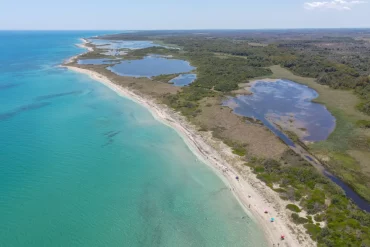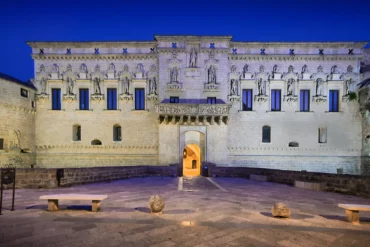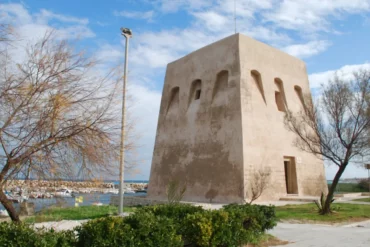
Would you like to discover a stretch of Salento where, within a few kilometres, you find a large sandy bay, cliffs with sea stacks, an archaeological site overlooking the sea and a town with a star-shaped castle? This guide takes you to Melendugno, «Melendugnu» in dialect, between Lecce and Otranto, and to its seaside villages: Torre dell’Orso with the Due Sorelle, the sea stacks of Sant’Andrea after the collapse of the arch in February 2026, Roca Vecchia with the Grotta della Poesia, San Foca and Torre Specchia Ruggeri, and then the inland area, with the dolmens, the abbey of San Niceta and the village of Borgagne, with practical tips and local curiosities.
In short
Melendugno is a municipality of about 10,000 inhabitants in the province of Lecce, on the Adriatic coast of Salento, about 18 km from Lecce and 25 km from Otranto. The town lies inland, about 6 km from the sea; its territory is one of the largest in the province and has more than 15 km of coastline, with the seaside villages of Torre Specchia Ruggeri, San Foca, Roca, Torre dell’Orso, Torre Saracena and Sant’Andrea. Here you will find the sandy bay of Torre dell’Orso with the Due Sorelle sea stacks, the cliffs and sea stacks of Sant’Andrea, where the famous Arco degli Innamorati collapsed on the night of 14 to 15 February 2026, and the archaeological area of Roca Vecchia with the Grotta della Poesia, where swimming is not allowed. The best months are June and September.
What is Melendugno?
Melendugno is a farming town in central-eastern Salento, surrounded by olive groves, with a small historic centre of courtyard houses, the D’Amely baronial palace, a sixteenth-century tower with a star-shaped plan, and two Bronze Age dolmens in the countryside. Its name, however, is linked above all to its seaside villages, some of the best-known beach resorts on Salento’s Adriatic coast. The municipality also includes the hamlet of Borgagne, a few kilometres from the sea.
Melendugno has two souls. Inland there is the town, quiet, with its Baroque churches, the castle and a countryside of olive trees, dolmens and farmhouses: this is where people live all year round. By the sea, on the other hand, there is a coastline that keeps changing: low rocks and small beaches at Torre Specchia Ruggeri and San Foca, the cliffs of Roca with their caves and the ruins of the ancient town, the large sandy bay of Torre dell’Orso and finally the pale cliffs of Sant’Andrea, with sea stacks rising out of the turquoise sea.
In summer the seaside villages fill up with families, young people and tourists; in spring and autumn they go quiet again and are perfect for walking along the coast. This is the Salento for those who want beach, cliffs and history on the same day, half an hour from Lecce. In this guide you will find how to get there, what to see in town and on the coast, where to swim, what to know after the collapse of the Sant’Andrea arch and how to plan your day.
Curiosities and atmosphere
There are two stories about the origin of Melendugno’s name. According to legend, the town takes its name from the mythical Malennio, said to have founded Roca, Lecce and Rudiae; the name then supposedly changed from Malandugno, «bringer of misfortune», to Melendugno, «bringer of sweetness». Another theory, which also appears in the municipal coat of arms, links it to honey and bees: in dialect honey is called «mele». In town people still say «Melendugnu» or «Malandugnu».
The coast of Melendugno has been a place of passage for thousands of years. The shortest route to Albania, about 80 km, starts from the bay of Torre dell’Orso: studies of the inscriptions left by sailors in the coastal caves have established intense traffic between the two shores, and in ancient times the bay was the port of the sanctuary town of Roca. This is why some scholars think Virgil had these very places in mind when he told of Aeneas landing in Italy. The name «Poesia» also has a story: it comes from the Greek «Posia», which means a freshwater spring. Torre dell’Orso, too, has a debated name: some link it to Saint Ursula, some to the monk seal and some to a rock below the tower shaped like a bear. Melendugno is also the birthplace of the poet Rina Durante, to whom the municipal library is dedicated. Up-to-date news and notices are on the website of the municipality of Melendugno.
Where it is and how to reach it
Melendugno is in central-eastern Salento, between Lecce and Otranto. The town is inland, about 6 km from the sea; Lecce is about 18 km away, Otranto 25 km. The seaside villages are 7-12 km from the centre: San Foca is the nearest, Torre dell’Orso is about 9 km away and Sant’Andrea, the southernmost, about 11 km.
By car: from Lecce take the provincial road to Vernole and Melendugno, just over 20 minutes without traffic; from the town the provincial roads lead to San Foca, Torre dell’Orso and Borgagne. From the south you arrive from Otranto, heading north up the coast. In summer the seaside villages fill up and the municipality sets up paid parking areas and temporary car parks near the sea: arrive early in the morning and leave the car only in the permitted spaces.
By public transport: national trains arrive in Lecce, which is the most convenient station; from there you get around by bus or by car. There are bus connections between Lecce, the seaside villages of Melendugno and Otranto: lines and timetables change with the season, so check them before you set off. The most convenient airport is Brindisi, about an hour away by car.
What to do and what to see
Melendugno is lived between the town and the sea: early in the morning the cliffs of Sant’Andrea or the archaeological area of Roca, in the hot hours the beach at Torre dell’Orso, in the evening a stroll in town or along the harbour of San Foca. Here are the experiences not to miss.
1. The centre of Melendugno and the D’Amely baronial palace (1 hour)
The heart of the town is the D’Amely baronial palace, which everyone here calls the castle: it is a large star-shaped tower designed in the second half of the sixteenth century by the military engineer Gian Giacomo dell’Acaya for Baron Pompeo Paladini. More than 12 metres high, with walls four and a half metres thick and a sloping base, it was surrounded by a moat and was entered by a drawbridge, later replaced by a masonry bridge; above the portal is the coat of arms of the D’Amely barons, with two lions holding up a tower, and above it the statue of the Immaculate Virgin. In Puglia there are only three buildings with a similar plan. Not far away is the mother church of Maria Santissima Assunta, from the sixteenth century, enlarged in the seventeenth and eighteenth centuries, with the bell tower of 1696, the façade of 1774 and, inside, the altar of the Madonna del Rosario and the wooden crucifix by Aprile Petrachi. The church of the Immacolata, from 1666, is also worth a stop: it was built at the edge of the old walls over the gate towards San Foca and still has the high parapet with the loopholes from which the town was defended. Among the streets of the centre you will find the typical courtyard houses. The castle can be seen well from the outside; check on the spot whether and when it is open to visitors.
2. The abbey of San Niceta, the dolmens and Roca Nuova (1-2 hours)
Near the cemetery, just outside the town, is the little church of the abbey of San Niceta, Melendugno’s patron saint. According to the historian Ferrari, the abbey was founded in 1167 by Tancred of Hauteville and run by Basilian monks: today the church remains, with three Gothic arches and frescoes from the fifteenth and sixteenth centuries, two of which are dated 1563. In the countryside towards Calimera, on the other hand, there are two Bronze Age dolmens: the Gurgulante dolmen, less than 2 km from the town, and the Placa dolmen, about 4 km away, a large stone slab resting on pillars, where a wild olive tree has taken the place of one of the supports. On the road to Torre dell’Orso you can also see the remains of Roca Nuova, the village founded by the inhabitants of Roca Vecchia after the town was destroyed in 1544 and abandoned in the nineteenth century, with its large tower. The dolmens are in the countryside, along minor roads: respect the fields around them and check on the spot how close you can get.
3. Torre dell’Orso, the bay and the Due Sorelle (half a day)
It is Melendugno’s most famous seaside village: a bay of very fine sand about 800 metres long, enclosed between two cliffs, with low dunes and the pine wood behind it and a crystal-clear sea. At the southern end, a few metres from the shore, rise the Due Sorelle, two close and similar sea stacks; according to legend they were two sisters who dived into the stormy sea and whom the gods, moved to pity, turned into rocks. In the southern cliff opens the cave of San Cristoforo, with ancient Greek, Latin and medieval inscriptions left by sailors; on the northern cliff stands the sixteenth-century tower that gave the place its name, begun in 1568. In May 2026 the tower was covered in scaffolding: check on the spot how close you can get. For years the bay has been among the places nominated in the «I Luoghi del Cuore» census of the FAI. You will find everything about the beach, facilities and tips in our guide to Torre dell’Orso.
4. The sea stacks of Sant’Andrea after the collapse of the arch (1 hour)
A few kilometres south of Torre dell’Orso lies Sant’Andrea, or Torre Sant’Andrea, a small fishermen’s landing below the lighthouse, which has been active since 1936 and was built on top of an old defensive tower, with its seaward side chequered black and white. In front of the high, pale, crumbly cliffs, the sea stacks rise out of the turquoise sea: the largest is called Isola Piramide. The symbol of this coast was the Arco degli Innamorati, or Arco dell’Amore, a rock bridge at Punta del Pepe, north of the lighthouse: on the night of 14 to 15 February 2026, during a violent storm surge, it collapsed into the sea. Today, in its place, the two side pillars and a heap of white boulders in the water remain; the sea stacks and cliffs are still there and the landscape is still beautiful, but the photos with the arch you find online are no longer up to date. After the collapse there are many danger signs along the cliff, and some areas had already been closed because of the risk of rockfalls: walk only on the open paths, stay away from the edge and do not climb on rocks that are fenced off.
5. Roca Vecchia and the Grotta della Poesia (1-2 hours)
Between San Foca and Torre dell’Orso lies Roca Vecchia, one of the most important archaeological sites in Salento: on a headland over the sea stood a fortified Bronze Age town, more than three thousand years ago, then a Messapian centre, a village of monks and a medieval citadel, razed to the ground in 1544 because it had become a refuge for pirates. Today you can see the remains of the walls, the ruins of the castle, the sixteenth-century watchtower and the sanctuary of the Madonna di Roca. A few steps away are the two Poesia caves, the Grande and the Piccola: two karst caves whose roofs collapsed, filled by the sea, forming two natural rock pools. Hundreds of Messapian, Latin and Greek inscriptions have been found on the walls of the Poesia Piccola, because it was a place of worship. In the Grotta della Poesia swimming and diving are not allowed: you look at it from above. Since summer 2026 the archaeological area, caves included, can be visited with a ticket in the summer months, managed by ArcheoRoca: check opening times and days beforehand. You will find all the tips in our guide to the Grotta della Poesia.
6. Borgagne, the inland village (1 hour)
Borgagne, «Burgagne» in dialect and «Vràni» in Salento Greek, is Melendugno’s only hamlet, a few kilometres from the sea at Sant’Andrea. It is a small farming village surrounded by centuries-old olive trees, which grew up around the lauras of the Basilian monks. In the centre you will find the castle of the Petraroli, with the tower of 1498 that still bears the inscription of Baron Belisario de Petraroli, now a private home and therefore to be seen from the outside, the church of the Presentation of the Lord, with its portal of 1611, the church of the Madonna del Carmine, from 1619, and the sixteenth-century courtyard houses in Via Conciliazione Laterano and Via IV Novembre. It is a perfect stop on a summer evening, after the beach.
7. Torre Specchia Ruggeri and the northern coast (1 hour)
At the northern end of the municipality, on the border with Vernole, lies Torre Specchia Ruggeri, or simply Torre Specchia, a small seaside village that started out as a fishing village, with little beaches among the rocks. It takes its name from the sixteenth-century coastal tower, on a low cliff, which was in line of sight with the tower of San Foca; until the 1980s it was used by the Forestry Corps and today it cannot be visited. From here the coast runs down towards San Foca among low rocks, small flat islets and coves: it is the quietest stretch of the seaside villages, ideal for an evening walk.
The sea at Melendugno and who it suits
The sea at Melendugno changes almost every kilometre. To the north, between Torre Specchia Ruggeri and San Foca, the coast is low, with flat rocks and small beaches. At Roca it becomes a cliff with caves and inlets, more for looking at than for swimming in. At Torre dell’Orso the large bay of fine sand opens up: it is the most convenient beach, for families too. To the south, towards Torre Saracena and Sant’Andrea, the high cliffs return, with deep, clear water and the sea stacks. The currents of the Strait of Otranto make the water particularly clear.
San Foca is the seaside village closest to the town: an old fishing village that has become a beach resort, with a marina and two small sandy beaches, one north and one south of the harbour. Here there is also the «Io Posso» terrace, which makes the sea accessible to people with ALS and other disabilities. Read our guide to San Foca.
Melendugno is perfect for families, who find a large sandy beach with facilities at Torre dell’Orso, for couples, for those who love swimming and photographing the cliffs and for those who want to combine sea and archaeology. It is less suited to those looking for peace and quiet in August, when the seaside villages are very crowded, and to those with walking difficulties who want to reach the cliffs of Roca and Sant’Andrea.
Free beach and facilities
At Torre dell’Orso and on the beaches of San Foca, beach clubs alternate with stretches of free beach: check access, rules and parking on the spot. On the cliffs of Roca and Sant’Andrea do not count on any facilities and only go into the water where access is permitted and safe; swimming is not allowed in the Grotta della Poesia. In the seaside villages and in town you will find bars, restaurants and pizzerias, especially in summer; out of season many places by the sea are closed.
For the beach bring an umbrella, water and sun cream; at Torre dell’Orso do not walk on the dunes. For the cliffs you need closed shoes with a good grip.
Melendugno vs other places in Salento
On the Adriatic coast there are many famous destinations close together. Here is a practical comparison to help you choose:
Torre dell’Orso vs Sant’Andrea
- Torre dell’Orso: a large bay of fine sand with beach clubs and facilities, perfect for a whole day on the beach
- Sant’Andrea: high cliffs, sea stacks and deep water, to be seen above all from above; little room to lie down and great care needed on the paths after the collapse of the arch
Melendugno vs Otranto
- Melendugno: many different seaside villages, from the sand of Torre dell’Orso to the cliffs of Roca and Sant’Andrea, and a quiet inland town
- Otranto: a historic town by the sea, with the Cathedral, the castle and the old town, 25 km further south. Read our guide to Otranto
Melendugno vs Lecce as a base
- Melendugno: the sea a few minutes away and evenings in the seaside villages
- Lecce: the Baroque, the restaurants and city life, about half an hour from the beaches of Melendugno
When to choose Melendugno: if you want a convenient sandy beach and, a few minutes away, cliffs, sea stacks and an archaeological site by the sea.
When to choose somewhere else: if you are mainly looking for history and monuments, choose Otranto or Lecce; if you want a wilder, less crowded rocky coast, look south, towards Porto Badisco and the Capo di Leuca.
Practical tips
In summer get going early: the car parks of the seaside villages are already filling up by mid-morning, especially at Torre dell’Orso. Many are paid; use only the signposted areas and do not leave the car along the narrow streets of the seaside villages. For Sant’Andrea and Roca choose early morning or late afternoon: the cliffs are in full sun and the light is more beautiful.
On the cliffs always follow the signs and fences: the rock on this coast is soft and crumbles easily, as the collapse of the Sant’Andrea arch showed. Do not go near the edge, do not dive from the rocks and when the sea is rough stay away from the water. In the Grotta della Poesia swimming and diving are not allowed, even if you have a ticket.
Useful practical information
| 📍 Where | Melendugno (Lecce), on the Adriatic coast of Salento, 18 km from Lecce and 25 km from Otranto; the seaside villages are 7-12 km from the town |
|---|---|
| 🚗 Parking | In summer paid parking areas and temporary car parks near the seaside villages; arrive early in the morning |
| ♿ Access | Easy sandy beach at Torre dell’Orso; accessible «Io Posso» terrace at San Foca; Roca and Sant’Andrea on rock and uneven paths |
| 🏖 Beach | Fine sand at Torre dell’Orso and small beaches at San Foca; rocks and coves at Torre Specchia Ruggeri; cliffs at Roca and Sant’Andrea |
| 🌊 Sea | Clear; sandy seabed at Torre dell’Orso, deep below the cliffs; no swimming in the Grotta della Poesia |
| 👟 What to bring | Closed shoes for the cliffs, a hat and water, an umbrella for the beach, water shoes |
| 🍴 Food | Bars, restaurants and pizzerias in the seaside villages in summer and in town all year round |
| 📅 Best time | June and September for the sea; spring and autumn for the cliffs, Roca and the dolmens |
Where to stay near Melendugno
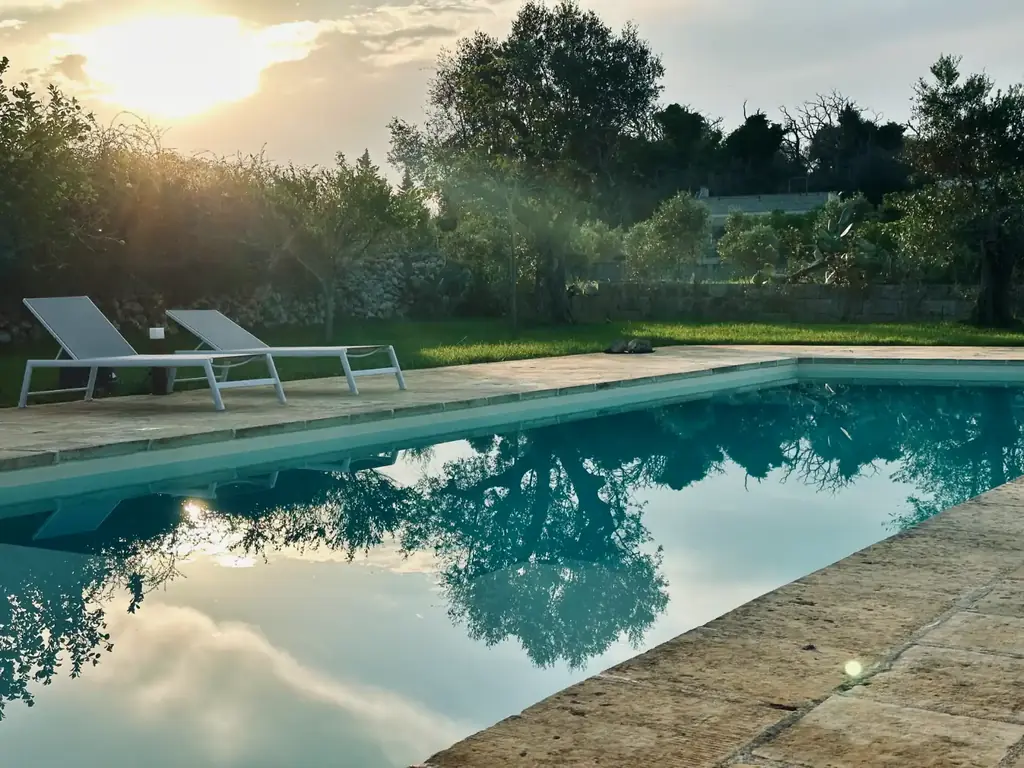
We have no houses in Melendugno. Our nearest house is further south, along the Adriatic coast, in Marittima: the Villetta Arenosa con piscina, about 37 km and 50 minutes by car from the town and about an hour from Torre dell’Orso and Sant’Andrea. It is not the right base for going to the sea at Melendugno every day, but it is convenient if you want to spend one or two days here and enjoy the rest of your holiday on the coast between Otranto, Castro and Santa Maria di Leuca. It has room for 4 guests, with 2 rooms, 3 bathrooms and 80 m² on two levels, a double bedroom under the typical star vaults, a bright living room with an equipped kitchenette and a sofa bed, air conditioning, a washing machine and a dishwasher. Outside there is a large private garden with a pool with views of the sea and of Castro, a sun terrace, an outdoor bathroom and showers, a play area with a volleyball net and five-a-side football goals, a barbecue and private parking.
You will find this and our other houses in the area on the page holiday homes in Marittima. Would you like advice on dates, getting around or other houses in the area? Contact us: we will help you choose the right option.
When to go and how much time to plan
April and May: the ideal time for the archaeological area of Roca, the cliffs of Sant’Andrea, the dolmens and the town, with mild temperatures and the scrub in flower. Swimming is for those who don’t mind cool water.
June: the sea is already pleasant, the beaches are quiet on weekdays and the days are very long: Torre dell’Orso in the morning, Roca or Sant’Andrea in the evening.
July and August: it is high season, with the seaside villages full, car parks filling up early and lots of evenings of music and festivals. Go to the beach early in the morning or in the late afternoon.
September: in our opinion the best month. The sea is still warm, there are far fewer people and in mid-month the town celebrates its patron saint, San Niceta.
October: still mild days, perfect for walking on the cliffs and visiting the town and Borgagne.
November to March: the seaside villages are almost deserted and many places are closed. In storm surges the coast is spectacular, but it should be watched from a distance: it was precisely in a winter storm surge that the Sant’Andrea arch collapsed.
Events and festivals (indicative dates, check them every year on the website of the municipality of Melendugno and on SalentoMe):
- Feast of the Madonna di Roca: in May, with the pilgrimage to the sanctuary of Roca Vecchia
- Feast of the Madonna del Carmine in Borgagne: mid-July
- Feast of the Madonna Stella Maris in Torre dell’Orso: the first Sunday in August
- Feast of San Foca in San Foca: 18-19 August
- Patron saint’s feast of San Niceta in Melendugno: 15-16 September
How much time to allow: one day is enough to see the most famous seaside villages; with two or three days add the town, Borgagne, the dolmens and a swim on each stretch of coast. A typical day:
- 7:30: sunrise on the cliffs of Sant’Andrea, before the heat and the crowds
- 9:30: beach and a swim at Torre dell’Orso
- 13:30: lunch in one of the seaside villages
- 16:00: rest, then a swim at San Foca or Torre Specchia Ruggeri
- 18:00: the archaeological area of Roca Vecchia and the Grotta della Poesia, in the evening light
- 20:00: a stroll through the centre of Melendugno, between the castle and the mother church, then dinner in town or on the harbour at San Foca
Surroundings and extra ideas
Melendugno is halfway between Lecce and Otranto, in a convenient position for discovering the Adriatic coast, the Grecìa Salentina and the nature reserves. Distances and driving times are approximate and start from the town.
San Foca (7 km, 10 minutes): the marina, the two sandy beaches and the sixteenth-century tower, in the seaside village closest to the town. Read our guide to San Foca.
Vernole and the Le Cesine Reserve (5-13 km, 10-25 minutes): the neighbouring municipality, with the hamlet of Acaya, and the Cesine state nature reserve, a protected coastal wetland with marshes, pine wood and beach. Read our guide to Vernole.
Calimera and Corigliano d’Otranto (6-21 km, 10-30 minutes): two towns of the Grecìa Salentina, where you can still hear griko, the ancient Greek language of Salento. Read our guide to Corigliano d’Otranto.
Lecce (18 km, 25 minutes): the capital of Salento Baroque, for a day or an evening among churches, palaces and squares.
Baia dei Turchi (about 8 km from Sant’Andrea, 20-25 minutes): the little sandy cove in the Alimini pine wood where, according to tradition, the Turks landed in 1480. Read our guide to the Baia dei Turchi.
Otranto (25 km, 35 minutes): the easternmost town in Italy, with the Cathedral and its mosaic, the Aragonese castle and the old town by the sea. Read our guide to Otranto.
Local tip
The coast of Melendugno faces east: at least one morning, get up before dawn and go to Sant’Andrea. Watching the sun rise out of the sea behind the sea stacks, with the cliffs turning pink, is the best way to get to know this place, even without the arch. Stay on the open paths and away from the edge, then go down to Torre dell’Orso for your first swim, while the beach is still empty.
For Roca Vecchia choose the last part of the afternoon: the low light on the ancient walls and on the Grotta della Poesia is beautiful and it is less hot. Also look for the cave of San Cristoforo at Torre dell’Orso: few people know that on its walls are the dedications and invocations left by ancient sailors before crossing the Strait of Otranto.
In the evening, instead of staying in the crowded seaside villages, go up to the town or to Borgagne: among the squares, the courtyard houses and the star-shaped castle you will find a Salento different from the one of the beaches.
FAQ
Where is Melendugno?
On the Adriatic coast of Salento, in the province of Lecce, between Lecce, about 18 km away, and Otranto, 25 km away. The town is inland, about 6 km from the sea; in dialect it is called «Melendugnu».
What are the seaside villages of Melendugno?
From north to south: Torre Specchia Ruggeri, San Foca, Roca, Torre dell’Orso, Torre Saracena and Sant’Andrea. The municipality also includes the inland hamlet of Borgagne.
What happened to the arch of the Sant’Andrea sea stacks?
The Arco degli Innamorati, the rock bridge that was the symbol of Sant’Andrea, collapsed into the sea during a storm surge on the night of 14 to 15 February 2026. The sea stacks and cliffs are still there, but the rock is fragile: follow the signs and stay away from the edge.
Can you swim in the Grotta della Poesia?
No, swimming and diving are not allowed in the Grotta della Poesia, even with an entrance ticket to the archaeological area. To swim, choose the nearby beaches, such as Torre dell’Orso or San Foca.
Do you have to pay to visit Roca Vecchia?
Since summer 2026, in the summer months, the archaeological area of Roca Vecchia, with the Poesia caves, can be visited with a ticket. Opening times, periods and arrangements change: check them before you go.
Is Torre dell’Orso good for children?
Yes, it is the most convenient beach in Melendugno: a large bay of fine sand, with beach clubs and free stretches. In August it is very crowded, so arrive early in the morning.
What to see in the town of Melendugno?
The D’Amely baronial palace, the sixteenth-century star-shaped tower, the mother church of the Assunta, the church of the Immacolata with its defensive parapet, the abbey of San Niceta and, in the countryside, the Placa and Gurgulante dolmens.
How do you get to Melendugno without a car?
By train to Lecce, then by bus: there are connections between Lecce, the seaside villages of Melendugno and Otranto, with lines and timetables that change with the season. The nearest airport is Brindisi, about an hour away by car.
When is the best time to go?
June and September for the sea, when there are fewer people and the water is already, or still, warm. Spring and autumn are perfect for the cliffs, Roca Vecchia and the town.
Where to stay near Melendugno?
Salento Prime has no houses in Melendugno: the nearest is the Villetta Arenosa con piscina in Marittima, about 37 km further south, for 4 guests, with 2 rooms and a private pool with a sea view. It is a convenient base if you want to combine Melendugno with the coast between Otranto and Castro.
Conclusion
Melendugno is a small summary of the Adriatic Salento: the large sandy bay of Torre dell’Orso, the cliffs and sea stacks of Sant’Andrea, the ruins of Roca Vecchia and the Grotta della Poesia, and inland a town of olive trees, Baroque churches, dolmens and a star-shaped castle. Since the collapse of the arch the coast has changed, but it is still beautiful: enjoy it slowly, at dawn and at sunset, and respect its fragile rock.
If you want to stay on the same coast, further south, in Marittima you will find our Villetta Arenosa con piscina: 4 guests, 2 rooms, 3 bathrooms and a private pool with a sea view. You will find our houses in the area on the page holiday homes in Marittima.
Discover the available accommodations with Salento Prime. To best organize your base and transfers, contact us here or start a chat on WHATSAPP.
Cover photo: Falk2, CC BY-SA 4.0, via Wikimedia Commons, cropped