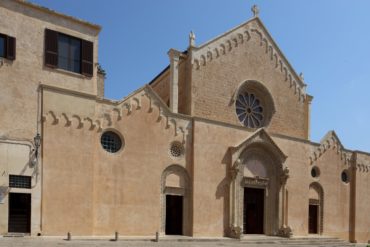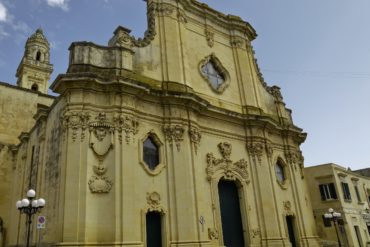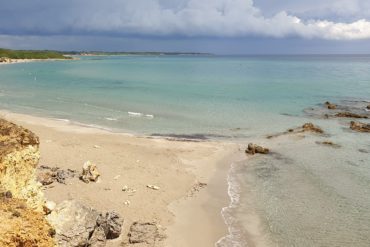
Would you like to discover the easternmost town of Italy, with an old town enclosed by walls on the sea and one of the most surprising cathedrals in the South? This guide takes you to Otranto, «Uṭṛàntu» in dialect, on Salento’s Adriatic coast: the Cathedral with the great Tree of Life mosaic and the chapel of the Martyrs, the Aragonese Castle, the Byzantine church of San Pietro, the bastions and the seafront, and then the surrounding coast, from the Torre del Serpe to the bauxite quarry, from Punta Palascia to the Alimini lakes, with practical tips and local curiosities.
In short
Otranto is a small town of about 5,500 inhabitants in the province of Lecce, on Salento’s Adriatic coast, 46 km from Lecce: it is the easternmost municipality in Italy, and a few kilometres from the centre is Punta Palascia, the easternmost point of the peninsula. The old town, enclosed by the Aragonese walls, holds the Cathedral with its twelfth-century floor mosaic and the relics of the eight hundred Martyrs of 1480, the Aragonese Castle and the Byzantine church of San Pietro. The historic centre is a limited traffic zone: leave the car outside and explore it on foot. To the north are the sandy beaches and the Alimini lakes, to the south a coast of cliffs with the Torre del Serpe, the bauxite quarry and the Palascia lighthouse. The best months are May, June and September.
What is Otranto?
Otranto is a seaside town in eastern Salento, the seat of an ancient archdiocese, which gave its name to the Strait of Otranto, the stretch of sea between Italy and Albania, and to the Terra d’Otranto, the old province of the Kingdom of Naples. Messapian, Roman, Byzantine, Norman and Aragonese, it is famous for its Cathedral, for the sacrifice of the Martyrs in 1480 and for the castle that inspired the first Gothic novel in history. Its territory stretches from the beaches and lakes of the Alimini, to the north, to the cliffs of Punta Palascia and Porto Badisco, to the south.
The old town of Otranto looks out over the harbour and the bay: lanes paved with pale stone, white houses, flights of steps, arches and small squares, all enclosed by the walls and bastions built to defend the town from the sea. In a few steps you reach the Cathedral, the Aragonese Castle with its moat and the little Byzantine church of San Pietro; then you go down towards the Lungomare degli Eroi, the harbour and the town beach, where the water is shallow and clear.
Otranto is a place to enjoy all year round: in summer it is full of life, with the Alimini beaches a few minutes away, while in spring, autumn and winter its lanes fall quiet again and the coast is perfect for walking. It is Salento for those who love history and the sea together. In this guide you will find how to get there, where to leave the car, what to see in town and in the surroundings, where to swim and how to plan your day.
Curiosities and atmosphere
The name Otranto comes from that of the Idro, the small stream that flows through the valley where the town stands and runs into the harbour: to the Greeks it was Hydrous, to the Romans Hydruntum, to the Greeks of Salento Derentò and to the people of Otranto «Uṭṛàntu». For centuries it was Italy’s Gateway to the East, the port from which people set sail for Greece and the Levant: in 1095, in its Cathedral, the crusaders led by Bohemond of Hauteville received their blessing, and in the Middle Ages the town was home to a large Jewish community. A few kilometres to the south stood the Basilian monastery of San Nicola di Casole, with one of the richest libraries in Europe: according to tradition, the monk Pantaleone, who made the Cathedral mosaic, came from that monastery.
The most dramatic page in its history dates from 1480. At the end of July a Turkish fleet of Sultan Mehmed II, led by Gedik Ahmet Pasha, besieged the town; on 11 August Otranto fell and on 14 August about eight hundred men who had refused to renounce the Christian faith were beheaded on the Colle della Minerva. The Aragonese took the town back the following year and surrounded it with new walls and a new castle. Those Martyrs, proclaimed saints by Pope Francis on 12 May 2013, are the patron saints of Otranto, which is still called the City of the Martyrs today. The castle, for its part, gave its title to the first Gothic novel in history, «The Castle of Otranto» by Horace Walpole, from 1764. One last curiosity: this is where the Strada Statale 16 Adriatica ends; it starts in Padua and, at more than a thousand kilometres, it is the longest state road in Italy. Up-to-date news and notices are on the website of the municipality of Otranto.
Where it is and how to reach it
Otranto is on Salento’s Adriatic coast, in the south-eastern part of the province of Lecce, looking out over the Strait of Otranto. Lecce is about 46 km away, Maglie 18 km, Santa Maria di Leuca 48 km; Punta Palascia is less than 7 km by road to the south, the Alimini lakes 6-9 km to the north.
By car: from Lecce take the SS16 towards Maglie and carry on to Otranto, where the road ends: about three quarters of an hour without traffic. The old town is a limited traffic zone with electronic gates, and in summer the restrictions are extended: in 2026, for example, from 15 June to 15 September the municipality reactivated the seasonal ZTLs, with the gates on via Cappuccini, from 20:00 to 6:00, and on via San Francesco di Paola, from 18:00 to 6:00, while the via delle Torri gate is active from April. Times and gates change every year: check them before you set off and, if you are staying inside the ZTL, ask your accommodation how to register your number plate. Leave the car in the parking areas outside the centre, many of them paid, and carry on on foot.
By public transport: national trains arrive in Lecce; from there FS Sud Est regional trains take you to Maglie, where you change for Otranto, the terminus of the Maglie-Otranto line and the easternmost station in Italy, just over a kilometre from the old town. Always check timetables, changes and any replacement buses. The most convenient airport is Brindisi, about an hour and a half away by car. In summer, check whether there are seasonal buses to the coast: routes and timetables change every year.
What to do and what to see
You can walk around Otranto in a day, but it deserves more: the Cathedral and the castle in the morning, the sea in the afternoon, the bastions and the seafront in the evening, and another half day for the surrounding coast, with the bauxite quarry, the Palascia lighthouse and the Alimini. Here are the experiences not to miss.
1. The Cathedral and the Tree of Life mosaic (1 hour)
The Cathedral of Santa Maria Annunziata, the largest church in the province of Lecce, was built by the Normans on the remains of a Messapian village, a Roman house and an early Christian church, and was consecrated on 1 August 1088. After 1480 the façade was rebuilt, with the great sixteen-spoke rose window; the baroque portal dates from 1674. Inside, a nave and two aisles divided by granite columns and a seventeenth-century wooden ceiling with gilded coffers hold the real treasure: the floor mosaic, one of the largest and best preserved of the European Middle Ages. It was made between 1163 and 1165 by the monk Pantaleone, commissioned by Archbishop Gionata, with more than six hundred thousand stone tesserae. Along the central nave grows an enormous Tree of Life, supported by two elephants, among whose branches you will find Adam and Eve, Cain and Abel, Noah’s Ark and the Tower of Babel, the twelve months of the year with the work in the fields, fantastic animals, Alexander the Great flying up into the sky carried by two griffins and even King Arthur, «Rex Arturus», riding a goat. Beneath the presbytery lies the eleventh-century crypt, a small forest of more than seventy columns and pillars, all different, with remains of frescoes. Since July 2025 the pews that covered the mosaic have been removed, but during Masses, weddings and funerals the floor is covered by chairs: choose a time when there are no services. You will find the history and information about visits on the Archdiocese’s website dedicated to the Otranto mosaic.
2. The chapel of the Martyrs and the Colle della Minerva (1 hour)
At the end of the right-hand aisle of the Cathedral is the chapel of the Martyrs, rebuilt in 1711: seven large cabinets hold the bones of the eight hundred people of Otranto killed on 14 August 1480, and behind the altar is the stone on which, according to tradition, the beheadings took place. It is a place of prayer and it makes a strong impression: go in quietly and respect those who are praying. To understand the story fully, then climb up to the Colle della Minerva, less than a kilometre from the old town, where the martyrdom took place. Here stands the church of Santa Maria dei Martiri, rebuilt in 1614 and now a diocesan sanctuary: along the flight of steps you will find the chapel where the stone of the martyrdom used to be and the column that commemorates Berlabei, the Turkish executioner who, according to the story, converted on seeing the Martyrs die and was killed by his own companions. Inside, a large sixteenth-century painting by Lavinio Zoppo depicts the massacre. In 1980 Pope John Paul II also stopped here.
3. The Aragonese Castle and the exhibition on the Grotta dei Cervi (1-2 hours)
The castle was built for Alfonso of Aragon after the town was retaken, between 1485 and 1498, and was later strengthened by the Spanish: the coat of arms of Charles V is still carved over the portal. It has a five-sided plan, is surrounded by a wide moat and has three large round towers and a spearhead-shaped bastion facing the harbour. Inside you can visit the halls, the underground passages with tunnels and galleries from the end of the fifteenth century and the terraces, with the sentry walks and a fine view over the old town and the sea; in the round towers the shape of the domes amplifies voices and sounds. On the top floor, since September 2025, there has been the permanent exhibition «I luoghi della Preistoria a Otranto e la Grotta dei Cervi», curated by the municipality with the Soprintendenza: it presents the discoveries made along the Otranto coast, from the Pleistocene to the Metal Ages, with a selection of finds from the cave at Porto Badisco, which is closed to the public. Also read our guide to the Grotta dei Cervi. The castle often hosts temporary exhibitions and visits require a ticket: check opening times and days beforehand.
4. The old town, the walls and the Byzantine church of San Pietro (1-2 hours)
Enter the old town through Porta Terra, the oldest entrance to the town, defended by the Torre Alfonsina, which still bears the motto «Sit Virgo Mater fortitudo mea», «May the Virgin Mother be my fortress». The walls partly follow the Byzantine line and were rebuilt several times, by the Normans, by Frederick II and then by the Aragonese and the Spanish, with the help of great military architects such as Francesco di Giorgio Martini; along the way you come across the Duchesca, Ippolita and Matta towers and the Bastione dei Pelasgi. Among the lanes, on one of the highest points of the town, is the small church of San Pietro, from the ninth to tenth century, the most important example of Byzantine art in Puglia: it has a square Greek-cross plan, a dome supported by four columns and, in the three apses, Byzantine-style frescoes, including the Washing of the Feet and the Last Supper, among the oldest. Check on the spot when it is open. Next to the Cathedral, in Palazzo Lopez, there is also the Museo Diocesano, with a carved sixteenth-century baptismal font and the remains of an early Christian mosaic found beneath the Cathedral floor.
5. The Lungomare degli Eroi, the harbour and L’Approdo (1 hour)
From the old town, go down to the Lungomare degli Eroi, the promenade that runs at the foot of the walls with views over the bay and the town beach. On the Piazzale degli Eroi stands the monument commemorating the Heroes and Martyrs of 1480. At the northern end of the bay, on a spur of rock that drops straight into the sea, is the little church of the Madonna dell’Altomare, rebuilt in 1744, with a mosaic floor and decorations that recall the sea: the sailors’ star, anchors, dolphins and shells. Near the harbour, then, stop in front of «L’Approdo. Opera all’Umanità Migrante» by the Greek sculptor Costas Varotsos: it is the wreck of the Katër i Radës, the Albanian patrol boat that sank in the Strait of Otranto on 28 March 1997, in which more than eighty people fleeing Albania died, turned into a monument. It is a place that invites you to stop and remember.
6. The coast to the south: Torre del Serpe, the bauxite quarry and Punta Palascia (half a day)
South of the town, the provincial road to Porto Badisco runs along a coast of cliffs and scrub, inside the Costa Otranto – Santa Maria di Leuca e Bosco di Tricase Regional Nature Park. After a couple of kilometres comes the Torre del Serpe, or Torre dell’Idro, 200 metres from the sea: only one wall remains, but it is the symbol of Otranto and appears on its coat of arms. According to legend it was a lighthouse, and every night a snake climbed up from the rocks to drink the oil from the lantern. A little further on is the former bauxite quarry, abandoned at the end of the 1970s: the groundwater has formed an emerald-green pond between walls of red earth, one of the most photographed places in Puglia. The pond is surrounded by private land: in February 2026 the owners put up no-entry signs, then an agreement with the municipality guaranteed access on foot, but the final arrangement of the entrances is still under discussion. Check beforehand, follow signs and fences, stay on the paths and keep away from the edges: the ground is steep and slippery, and in October 2026 a tourist fell while going down towards the lake. Continuing south you pass the Baia delle Orte, with its sixteenth-century tower, and reach Punta Palascia, or Capo d’Otranto, the easternmost point of Italy, with its lighthouse from 1867, restored and reopened in 2008. From the road a short walk down leads to the lighthouse and the cliffs; the inside opens only at certain times of year, so check beforehand. From here a Park trail continues along the coast to the Torre Sant’Emiliano and Porto Badisco: read our guide to Porto Badisco.
7. The Alimini lakes and the beaches to the north (half a day)
North of Otranto, 6-9 km away, are the Alimini lakes, one of the most precious natural areas in Salento, protected as a site of European importance. There are two of them: Alimini Grande, about 2.5 km long, is connected to the sea and has salt water, while Alimini Piccolo, also called Fontanelle, is fed by freshwater springs; a channel, «lu Strittu», joins them. All around are pine woods, Mediterranean scrub and rare plants such as the marsh orchid and the water chestnut, and in the migration months you can see many waterbirds. From Otranto a circular cycle route of the Province of Lecce leads to the lakes, and along the coast, beyond the pine wood, long sandy beaches open up, with beach clubs and free stretches. It is the right place for a bike ride in the morning and a swim in the afternoon.
The sea at Otranto and who it suits
The sea at Otranto changes character within a few kilometres. In town, right below the Lungomare degli Eroi, there is a sandy beach with shallow, clear water, perfect for a swim between one visit and the next. To the north, towards the Alimini, the coast becomes a long line of sandy beaches backed by dunes and pine woods, ideal for families. To the south, on the other hand, from the Torre del Serpe to Punta Palascia and on to Porto Badisco, there are cliffs, coves and deeper sea, to be reached on foot and enjoyed with a mask, only when the sea is calm.
Between the town and the Alimini there is also the Baia dei Turchi, a small sandy cove enclosed between the pine wood and the sea, inside the Alimini protected area: according to tradition, this is where the Turks landed in 1480. It can only be reached on foot, through the pine wood, from the car parks along the road.
Otranto is perfect for those who want to combine history and the sea in the same day, for couples, for walkers, for those travelling out of season and for families looking for a base with sandy beaches nearby. It is less suited to those who want absolute silence in August, when the town is very crowded, and to those who don’t like leaving the car and walking.
Free beach and facilities
Both below the seafront and at the Alimini, beach clubs alternate with stretches of free beach; check access, parking and any paid areas on the spot. On the rocky coast to the south, don’t count on facilities: you get into the water from the rocks, and it is a good idea to bring reef shoes and water with you. In town you will find bars, restaurants and trattorias for all tastes, especially in the old town and on the seafront.
For the beach, bring an umbrella, water and sun cream; at the Alimini, don’t walk on the dunes and use the marked paths.
Otranto vs other places in Salento
In Salento there are many famous destinations, all close to one another. Here is a practical comparison to help you choose:
Otranto vs Torre dell’Orso
- Otranto: a historic town, with the Cathedral, the castle and the old town, the town beach and the Alimini a few minutes away
- Torre dell’Orso: a large sandy bay with its sea stacks, beach clubs and summer buzz, 18 km further north. Read our guide to Torre dell’Orso
Otranto vs Castro
- Otranto: bigger and livelier, with many monuments and the sandy beaches to the north
- Castro: the old village on the hill with its castle, the harbour where the boats leave for the sea caves and a rocky sea. Read our practical guide to Castro
Otranto vs Gallipoli
- Otranto: on the Adriatic, the sea of sunrises, with a compact old town inside the Aragonese walls
- Gallipoli: on the Ionian Sea, the sea of sunsets, with its old town on an island linked to the mainland by a bridge and the liveliest evening life on the coast
When to choose Otranto: if you want a base with plenty of history to discover on foot, sandy beaches nearby and the easternmost coast of Italy to explore.
When to choose somewhere else: if you are mainly looking for a sea of rocks and caves, look south, to Porto Badisco and Castro; if you want the beach on your doorstep, choose one of the seaside villages to the north, towards the Alimini and Torre dell’Orso.
Practical tips
Leave the car outside the old town and get around on foot: the historic centre is small but hilly, with paved streets and flights of steps. For the Cathedral, choose a time without Masses or ceremonies, so you can see the whole mosaic, wear suitable clothing and respect the silence in the chapel of the Martyrs. The opening times of the Cathedral, the castle, the Museo Diocesano and the lighthouse change with the seasons and are not always published: check them before you go.
In summer, visit the monuments early in the morning or towards evening and keep the middle of the day for the sea. For the bauxite quarry and Punta Palascia you need closed shoes, water and a hat: there is no shade and the paths are uneven. Always respect signs and fences, because much of the land along the coast is private, and when the sea is rough keep away from the rocks.
Useful practical information
| 📍 Where | Otranto (Lecce), on Salento’s Adriatic coast, 46 km from Lecce and 48 km from Santa Maria di Leuca |
|---|---|
| 🚗 Parking | Parking areas outside the old town, many of them paid; the historic centre is a ZTL with electronic gates |
| ♿ Access | Hilly old town, with paved streets and flights of steps; the castle is listed by the municipality as accessible; the bauxite quarry and the Palascia on dirt paths |
| 🏖 Beach | Sandy beach below the seafront; long sandy beaches at the Alimini, 6-9 km away; rocks and coves to the south |
| 🌊 Sea | Shallow and sandy in town and at the Alimini; deep and rocky towards Punta Palascia |
| 👟 What to bring | Comfortable shoes, suitable clothing for the Cathedral, closed shoes and water for the paths, an umbrella for the beach |
| 🍴 Food | Bars, restaurants and trattorias in the old town and on the seafront |
| 📅 Best time | May, June and September; mid-August for the feast of the Martyrs, December and New Year for the Alba dei Popoli |
Where to stay near Otranto
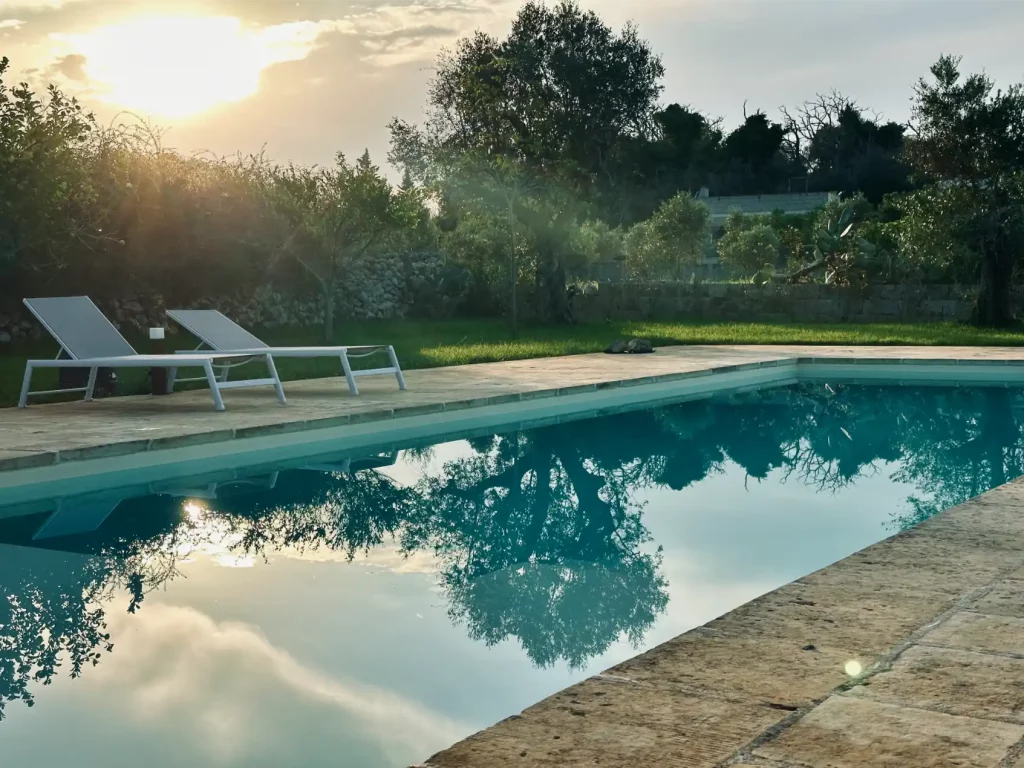
We have no houses in Otranto, but further down the Adriatic coast, in Marittima, about 24 km and half an hour away by car, you will find our Villetta Arenosa con piscina: 4 guests, 2 rooms, 3 bathrooms and 80 m² on two levels, with a double bedroom under the typical star vaults, a bright living room with an equipped kitchenette and a sofa bed, air conditioning, a washing machine and a dishwasher. Outside there is a large private garden with a pool with views of the sea and of Castro, a sun terrace, an outdoor bathroom and showers, a play area with a volleyball net and five-a-side football goals, a barbecue and private parking. The sea is less than 1 km away: it is a quiet base for exploring the coast between Otranto, Porto Badisco, Santa Cesarea Terme and Castro.
You will find this and our other houses in the area on the page holiday homes in Marittima. Would you like advice on dates, getting around or other houses in the area? Contact us: we will help you choose the right option.
When to go and how much time to plan
April and May: the ideal time for the old town, the monuments and the coastal paths, with mild temperatures, the scrub in flower and few people. Swimming is for those who don’t mind cool water.
June: the sea is already pleasant, the beaches are quiet on weekdays and the days are very long: the monuments in the morning, the Alimini in the afternoon.
July and August: it is high season, with the town full, the summer ZTLs and car parks that fill up early. In mid-August there is the feast of the Holy Martyrs, the most heartfelt moment of the year. Visit the centre early in the morning or in the evening.
September: the best month, in our opinion. The sea is still warm, there are fewer people and at the beginning of the month there is the feast of the Madonna dell’Altomare, with the procession at sea.
October: days that are still mild, perfect for the Cathedral, the castle and walks towards Punta Palascia.
November to March: Otranto goes back to being a quiet little town and the lanes are almost empty. From early December to 6 January there is the Alba dei Popoli, and at New Year many people wait at the Palascia lighthouse for the first sunrise in Italy. When the sea is stormy, the coast is spectacular, but it should be watched from a distance.
Events and festivals (indicative dates, check them every year on the Otranto municipality website and on SalentoMe):
- Tavole di San Giuseppe: around 19 March
- Otranto Antiqua, antiques market: in 2026 every third Sunday of the month, from April
- Feast of San Francesco da Paola: in spring (in 2026 on 30 and 31 May)
- Feast of the Holy Martyrs of Otranto: 13-15 August, with the procession of the reliquary urn on 14 August, the anniversary of the martyrdom, and fireworks over the harbour
- Feast of the Madonna dell’Altomare: early September, around the first Sunday of the month, with the fishermen’s procession at sea
- Alba dei Popoli: from early December to 6 January, a programme of events centred on the first sunrise of the year at the easternmost point of Italy
How much time to allow: one day is enough for the old town, the Cathedral and the castle; with two or three days you can add the coast to the south, the Alimini and Porto Badisco. A typical day:
- 9:00: the Cathedral, the mosaic and the chapel of the Martyrs, outside service times
- 10:30: the Aragonese Castle and the exhibition on the Grotta dei Cervi
- 12:00: a stroll through the old town, from Porta Terra to the church of San Pietro and the bastions
- 13:30: lunch in the old town or on the seafront
- 15:30: a swim below the seafront or at the Alimini
- 18:00: the Torre del Serpe, the bauxite quarry and the coast road to Punta Palascia
- 20:30: a stroll on the bastions and along the Lungomare degli Eroi, then dinner in the old town
Surroundings and extra ideas
Otranto is a convenient base for exploring eastern Salento, with its cliffs, inland villages and sandy beaches. Distances and driving times are approximate.
Porto Badisco and the Grotta dei Cervi (10 km, 15 minutes): the small bay where, according to tradition, Aeneas landed, with its little fishing harbour and, not far away, the cave of the Neolithic paintings, closed to the public. Read our guide to Porto Badisco.
Giurdignano (9 km, 10 minutes): a small inland village with one of the largest concentrations of dolmens and menhirs in Italy, so much so that it is called the megalithic garden of Italy, and the Byzantine crypt of San Salvatore.
Torre Sant’Andrea, Torre dell’Orso and the Grotta della Poesia (14-18 km, 20-30 minutes): heading north, the sea stacks of Sant’Andrea, the large sandy bay of Torre dell’Orso and the natural pool of the Grotta della Poesia, at Roca. Read our guide to Torre dell’Orso.
Santa Cesarea Terme (16 km, 20 minutes): the spa town with its baths in caves by the sea and its Moorish-style villas, along the coast road that runs down from Porto Badisco.
Castro and the Grotta della Zinzulusa (22 km, 30 minutes): the harbour where the boats leave for the caves, the old village on the hill with its castle and the Zinzulusa, one of the best-known coastal caves in southern Italy. Read our practical guide to Castro.
Marittima and the Cala dell’Acquaviva (24 km, 30 minutes): the inlet between the cliffs where the sea mixes with the fresh water of the springs, near our house.
Lecce (46 km, 45 minutes): the capital of Salento baroque, for a day among churches, palazzi and squares.
Local tip
At least one morning, get up before dawn and go to Punta Palascia: watching the sun rise out of the sea at the easternmost point of Italy, with the lighthouse behind you, is an emotion the people of Otranto know well, and not only at New Year. On the way back, before the heat, stop at the Torre del Serpe.
In the Cathedral, don’t rush: look for King Arthur on his goat, the twelve months of the year and the two elephants at the base of the tree, and then go down into the crypt, where the light comes in through the windows between the columns. If you find chairs on the mosaic because there is a service, come back later: it is worth it.
In the evening, climb up onto the bastions and watch the harbour and the bay as the lights come on, then go down to the Lungomare degli Eroi. And if you can, come back to Otranto in winter too: without the summer crowds, the white lanes and the sound of the sea below the walls tell the story of a different town.
FAQ
Where is Otranto?
On Salento’s Adriatic coast, in the province of Lecce, about 46 km from Lecce and 48 km from Santa Maria di Leuca. It is the easternmost municipality in Italy; in dialect it is called «Uṭṛàntu».
What is there to see in Otranto in one day?
The Cathedral with the Tree of Life mosaic and the chapel of the Martyrs, the Aragonese Castle, the Byzantine church of San Pietro, Porta Terra and the bastions, the Lungomare degli Eroi and, if you have a car, the coast road towards the Torre del Serpe, the bauxite quarry and Punta Palascia.
Can you see the Cathedral mosaic?
Yes: since July 2025 the pews that covered it have been removed. During Masses, weddings and funerals, however, the floor is covered by chairs, so choose a time when there are no services and check the times before you go.
Where are the Martyrs of Otranto?
The relics of the eight hundred Martyrs killed on 14 August 1480 are kept in the chapel of the Martyrs, at the end of the right-hand aisle of the Cathedral. The place of the martyrdom is the Colle della Minerva, less than a kilometre from the old town, where the church of Santa Maria dei Martiri stands.
Can you visit the castle of Otranto?
Yes, with a ticket: you can usually visit the halls, the underground passages and the terraces, and on the top floor there is the permanent exhibition on the prehistory of Otranto and the Grotta dei Cervi. The castle often hosts temporary exhibitions; check opening times and days beforehand.
Can you visit the bauxite quarry?
The pond is reached by crossing private land: after the closure in February 2026, an agreement between the municipality and the owners guaranteed access on foot, but the final rules have not yet been set. Check beforehand, respect signs and fences and keep away from the edges, because the ground is steep and slippery.
Where is the easternmost point of Italy?
It is Punta Palascia, or Capo d’Otranto, less than 7 km by road south of the town, with its lighthouse from 1867. At New Year many people gather here to see the first sunrise in Italy.
Can you drive into the historic centre?
No, the old town is a limited traffic zone with electronic gates, and in summer the restrictions are extended. Leave the car in the parking areas outside the centre and check the times and gates in force each year on the municipality’s website.
How do you get to Otranto without a car?
By train: from Lecce, FS Sud Est regional trains run to Maglie, where you change for Otranto; the station is just over a kilometre from the old town. The nearest airport is Brindisi, about an hour and a half away by car.
Where to stay near Otranto?
In Marittima, about 24 km along the Adriatic coast, there is Salento Prime’s Villetta Arenosa con piscina: 4 guests, 2 rooms and a private pool with a sea view. You will find the other houses on the holiday homes in Marittima page.
Conclusion
Otranto is the Salento where history and the sea meet: a Norman cathedral with a mosaic that tells the story of the medieval world, the memory of the Martyrs, a castle that inspired a novel, a white old town enclosed by walls and, all around, the beaches of the Alimini and the cliffs of the easternmost coast of Italy. Give it at least a day, at an unhurried pace, and go back to Punta Palascia at dawn.
If you want to stay on the same coast, in Marittima you will find our Villetta Arenosa con piscina: 4 guests, 2 rooms, 3 bathrooms and a private pool with a sea view. You will find our houses in the area on the page holiday homes in Marittima.
Discover the available accommodations with Salento Prime. To best organize your base and transfers, contact us here or start a chat on WHATSAPP.
Cover photo: Lupiae, CC BY-SA 3.0, via Wikimedia Commons