Looking for shallow, clear water, sandy beaches and islets just a few metres from the shore? This guide takes you to Porto Cesareo, the fishing village on the Ionian coast of Salento: the Marine Protected Area, one of the largest in Italy, the Isola Grande or Isola dei Conigli in front of the harbour, the submerged Roman columns of Torre Chianca, which you can see even with a mask and snorkel, Torre Cesarea on the seafront, the Museum of Marine Biology and the beaches as far as Torre Lapillo, with practical tips, rules to know and local curiosities.
In short
Porto Cesareo, «Cisària» in Salento dialect, is a municipality in the province of Lecce on the Ionian coast, about 28 km from Lecce and 16 km from Nardò. The town stands on a small peninsula with its fishing harbour and looks out on an archipelago of islets: the largest is the Isola Grande, also called Isola dei Conigli (Rabbit Island), about 500 metres from the coast. Since 1997 its sea has been a Marine Protected Area of 16,654 hectares and 32 km of coastline, from Punta Prosciutto to Torre Inserraglio. The beaches are mostly sandy, with shallow water, and alternate with low rocks and dunes. The best months are June and September.
What is Porto Cesareo?
Porto Cesareo is a fishing village that has become one of the best-known seaside resorts in Salento. It has been an independent municipality since 1975, when it separated from Nardò, and it also includes the seaside villages of Torre Lapillo and Punta Prosciutto. Its name is linked to Torre Cesarea, the large sixteenth-century tower on the seafront. The area combines the Porto Cesareo Marine Protected Area, the only state marine reserve in Salento, and the Palude del Conte e Duna Costiera regional nature reserve: islets, Posidonia seabeds, coastal towers, dunes and kilometres of beaches.
Porto Cesareo has always lived from the sea. In the morning the fishing boats come back, in the fishmongers of Via Silvio Pellico, the «street of the fishmongers», you buy the catch of the day, and on the seafront Torre Cesarea watches over the boats moored between the harbour and the islands. In front of the town the water is shallow, clear and sheltered by the islets, with colours ranging from turquoise to green.
In summer the town fills up and in the evening the seafront is crowded; out of season it goes back to being a quiet fishing village. The sandy beaches begin a few steps from the centre and continue west as far as Torre Chianca and Torre Lapillo. In this guide you will find how to get there, what to see between the harbour, the islands and the towers, how to see the submerged Roman columns, the rules of the Marine Protected Area and how to plan your day, including the surrounding area.
Curiosities and atmosphere
The history of Porto Cesareo begins long before the town. At Scalo di Furno, a rocky spur west of the built-up area, a Bronze Age village surrounded by a wall was discovered by chance in 1963: the excavations, begun in 1969, have also brought to light Mycenaean pottery that came from Ithaca and Cephalonia. In Roman times the port was called Portus Sasinae and was a landing place for the farm produce of the hinterland. After centuries of abandonment, because of pirates and marshes, in the eighteenth century a tuna fishery attracted families of fishermen, many from Taranto: the first permanent core of the town only arose in the mid-nineteenth century, and in 1880 the church of the Madonna del Perpetuo Soccorso was built next to the small chapel of Santa Cesarea, dating from 1639-1640.
The sea keeps giving up surprises. In October 1932 some fishermen brought up, between the Isola della Malva and the Isola della Chianca, an Egyptian statuette of the god Thoth, now in the National Archaeological Museum of Taranto. As early as 1971 the naturalist Pietro Parenzan was calling for the dunes and seabeds of this coast to be protected: in 1997 this led to thePorto Cesareo Marine Protected Area, managed by a consortium of the municipalities of Porto Cesareo and Nardò and the Province of Lecce, and since 2011 listed among the Specially Protected Areas of Mediterranean Importance. Here researchers have described 53 submerged caves and found a tiny marine organism able to reverse its own life cycle. Fishing is protected too: the small-scale artisanal fishing of Porto Cesareo is a Slow Food Presidium, and the town’s typical fish is the red mullet.
Where it is and how to reach it
Porto Cesareo lies on the Ionian coast of Salento, in the north-western part of the province of Lecce, in the area called Terra d’Arneo. It borders Manduria and Avetrana, in the province of Taranto, to the north, and Nardò to the east and south. Lecce is about 28 km away, Nardò 16 km, Gallipoli 32 km and Brindisi airport about 55 km by road.
By car: from Lecce you go through Arnesano and Leverano and take provincial road 21 down to the sea: about 35-40 minutes without traffic. From Nardò, provincial road 359 reaches Porto Cesareo in about twenty minutes; from the south of Salento you drive up the Lecce-Gallipoli dual carriageway to Nardò and from there follow the same provincial road. The coast road that passes through Sant’Isidoro and Torre Squillace also arrives from the Nardò coast. In summer the centre and the roads near the sea fill up early: arrive in the morning and check parking and any paid zones on the spot.
By public transport: Porto Cesareo has no railway station. In summer Trenitalia offers the «Porto Cesareo Link» train-plus-bus connection: you take the train to Lecce and continue on the FS Sud Est bus that leaves near the station, in Via Don Bosco; check that it is running in the current year. In summer there are also the «Salento in Bus» lines: check routes and timetables before you set off. The most convenient airport is Brindisi, just over an hour away by car.
What to do and what to see
Porto Cesareo is all about the shallow sea, the islands and the towers: a swim and snorkelling in the morning, when the water is calmest, fish from the harbour for lunch, a kayak or boat trip among the islets in the afternoon and the seafront in the evening. Here are the experiences not to miss.
1. The seafront, the harbour and Torre Cesarea (1 hour)
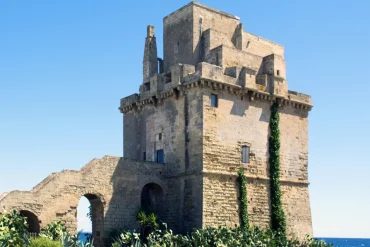
The heart of the town is the seafront, between the fishing harbour and Torre Cesarea, or Torre Capitana. It is the largest coastal tower in the area: 16 metres high, with sides of 21.5 metres and walls up to 4 metres thick, it was built between 1568 and 1570 by the master builder Virgilio Pugliese to a design by Giovanni Tommaso Scala and rebuilt in 1622. It was the command post for the towers along this stretch of coast and was in visual contact with Torre Chianca to the north and Torre Squillace to the south. Today it houses the offices of the Guardia di Finanza, so you admire it from the outside. After the tower, stroll towards the harbour and stop in Via Silvio Pellico, the street of the fishmongers, to see the fish just landed.
2. The Isola Grande or Isola dei Conigli (half a day)
In front of the harbour, about 500 metres from the coast, lies the Isola Grande, which everyone calls Isola dei Conigli (Rabbit Island): a low island covered by a pine wood of Aleppo pines, acacias and Mediterranean scrub, the result of reforestation in the 1950s, with small sandy beaches and very clear sea all around. On the island and its shores a Phoenician-era ring, an ancient tomb and many fragments of amphorae have been found, a sign that ships were already landing here in antiquity; the FAI also flags it because too many visitors and abandoned litter are putting it at risk.
In summer small boats and ferry services leave the harbour for the island: ask at the harbour for times and boarding points. Swimming there is not advisable, because many boats pass and moor between the town and the island. There are no facilities on the island: bring water, stay on the paths, do not light fires and take all your rubbish back with you.
3. The submerged Roman columns of Torre Chianca (1-2 hours)
This is the most unusual experience in Porto Cesareo. On the sandy seabed off Torre Chianca, at a depth of about 4 metres, lie several large columns of cipollino marble 9 metres long, discovered in 1960: they were the cargo of a Roman ship of the 2nd century AD, which had set out from the quarries of Karystos, in Greece, and sank before reaching its destination. When the sea is calm you can see them even with a mask and snorkel, and an augmented reality app lets you discover them without even getting into the water. In the same area underwater archaeology has identified a wreck loaded with North African amphorae, between Torre Chianca and Torre Lapillo, and the remains of an ancient necropolis in very shallow water between Torre Chianca and the Isola dei Conigli: you will find them described on the portal italia.it.
They are protected archaeological heritage: look without touching, take nothing away and do not lean on the columns. Go only when the sea is calm, use a diver-down buoy and watch out for boats; if you are not an experienced swimmer, choose a boat or snorkelling trip with a local operator.
4. Torre Chianca, the Isola della Malva and the western beaches (half a day)
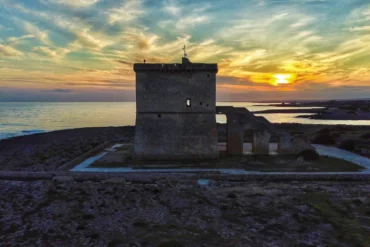
Heading west, the coast of Porto Cesareo is a succession of sandy bays and low rocks: first the Primo Ponte beach, then the Scalo di Furno spur, the Spiaggia delle Dune and Torre Chianca, which stands between two small inlets. The tower, from the sixteenth century, has a square plan, is 18 metres high and has no outside staircase; during the Second World War it housed an artillery post. In front of the tower rises the Isola della Malva, a low islet that from above is shaped like a heart, so much so that some call it the «isola del cuore» (heart island). Further on the beach continues for kilometres, past Belvedere, Bacino Grande and Lago Sereno, as far as Torre Lapillo.
5. The «Pietro Parenzan» Museum of Marine Biology (1 hour)
A few steps from the centre is the University of Salento’s Museum of Marine Biology, founded in 1966 by the naturalist Pietro Parenzan. It displays about 900 exhibits: shells collected on the coasts of Puglia, an algarium with more than 700 specimens of seaweed and many Mediterranean organisms. After ten months of restoration it reopened at the end of 2024 with new rooms, including one devoted to traditional fishing in Salento and one to the basking shark. It is perfect with children and in the hottest hours. After the reopening it was open every day from 9:00 to 13:00, except Mondays: check the opening times before you go.
6. By kayak, SUP or boat in the Marine Protected Area (2-3 hours)
The best way to understand Porto Cesareo is to look at it from the sea. When the sea is calm you can paddle among the islets by kayak or SUP, or go on a boat trip or a dive with a local centre. Below the surface there are Posidonia meadows, coralligenous reefs a few metres deep and dozens of submerged caves; loggerhead turtles (Caretta caretta) have also been sighted along this coast. Choose an operator who works regularly in the Marine Protected Area and ask about the route beforehand: navigation, anchoring and fishing have precise rules.
7. The Palude del Conte e Duna Costiera Reserve (1-2 hours)
North of Torre Lapillo, towards Punta Prosciutto, the coast changes: behind the beaches rise dunes up to 6-7 metres high, covered in Mediterranean scrub, and behind the dunes opens a large depression with wetlands and plants that live in brackish water. This is the Palude del Conte e Duna Costiera regional nature reserve, established in 2006, covering almost 900 hectares and managed by the municipality of Porto Cesareo. Near Torre Castiglione, of which only ruins remain, there are also the «spunnulate», karst sinkholes that reach the water table and form small ponds. Visit it on foot, taking your time: do not climb on the dunes and use only the marked paths.
Sea, beaches and who will love it
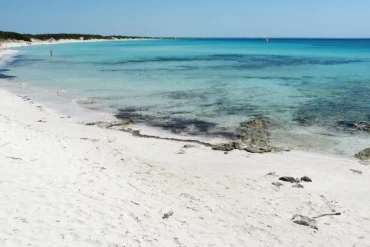
The sea at Porto Cesareo is shallow, clear and luminous: in front of the town and along the western shore the sandy seabed slopes gently, and the islets shelter the bay, so the water is often calm even when there is a bit of a swell elsewhere. The colours range from the white of the sand to turquoise, with the dark patches of Posidonia and rocks. In strong wind, however, the sea gets rough here too and the water turns cloudy.
It is perfect for families with children, who can stand for a long way out, for those who love easy snorkelling, kayaking and SUP, for those who want beaches with facilities and a lively town in the evening, and for anyone curious about underwater archaeology. It is less suited to those looking for silence and deserted beaches in August, when Porto Cesareo is one of the busiest resorts in Salento, and to those who prefer high cliffs and deep water.
Free beach and facilities
Along the coast of Porto Cesareo many beach clubs alternate with stretches of free beach, from the town beach to Torre Chianca and Torre Lapillo: check on the spot which stretches are free and where to park. In town you will find restaurants, fishmongers, bars and ice-cream shops, many open mainly in summer; on the Isola dei Conigli, on the other hand, there are no facilities.
Bring an umbrella, plenty of water, a mask and snorkel and a bag for your rubbish, especially if you are going to the island.
Porto Cesareo vs other resorts on the Ionian coast
On this coast the landscapes change within a few kilometres. Here is a practical comparison to help you choose:
Porto Cesareo vs Torre Lapillo and Punta Prosciutto
- Porto Cesareo: the town with its harbour, the islands off the shore, the submerged columns and every facility
- Torre Lapillo and Punta Prosciutto: long white sandy beaches backed by dunes, further north in the same municipality. Read our guide to Punta Prosciutto
Porto Cesareo vs Porto Selvaggio (Nardò)
- Porto Cesareo: sand, shallow water and calm sea, easy to reach
- Porto Selvaggio: a pebble bay at the end of the pine wood, reachable only on foot or by shuttle, with water kept cool by the springs. Read our guide to Porto Selvaggio
Porto Cesareo vs Lido Marini
- Porto Cesareo: islets, a marine protected area and a fishing village that is lively all year round
- Lido Marini: long sandy beaches with shallow water in the south of Salento, near our houses. Read our guide to Lido Marini
When to choose Porto Cesareo: if you are looking for shallow, calm water, want to combine beach, islands and snorkelling and like having restaurants and services close at hand.
When to choose somewhere else: if you are looking for a quiet cove among the cliffs or a bay in nature without beach clubs, look at Porto Selvaggio or the less built-up beaches of southern Salento.
Practical tips
In July and August arrive early, before 9 am: you will find a space for the car and for your umbrella, and the sea is calmer and clearer. For the Torre Chianca columns and for kayak trips choose a day without wind; when the sea is rough the water turns cloudy and you can’t see anything.
You are in a Marine Protected Area: of the two A zones, the strictly protected reserves, one is in the northern stretch, off the dunes of the Palude del Conte towards Punta Prosciutto, and one in the south, off the Palude del Capitano in the municipality of Nardò, and swimming is not allowed there. In the rest of the area you can swim, but navigation, anchoring and fishing have precise rules, which the MPA updates every year: if you go out by boat, first consult the maps and the regulations on the Marine Protected Area’s website. Do not collect sea urchins, shells or archaeological finds, do not walk on the dunes and do not light fires or stoves on the beach. For dogs on the beach, check the municipality’s ordinances for the current year.
Useful practical information
| 📍 Where | Porto Cesareo (Lecce), on the Ionian coast, 16 km from Nardò and 28 km from Lecce |
|---|---|
| 🚗 Parking | In town and near the beaches; in August arrive early in the morning and check for any paid zones |
| ♿ Access | Sandy beaches that are easy to reach; the Isola dei Conigli can only be reached by boat |
| 🏖 Beach | Sand and low rocks, with many beach clubs and free stretches |
| 🌊 Sea | Shallow, clear and sheltered by the islands; Marine Protected Area, no swimming in the A zones |
| 👟 What to bring | Mask and snorkel, a diver-down buoy for the columns, an umbrella, water and a bag for your rubbish |
| 🍴 Food | Fish restaurants and fishmongers in town, in Via Silvio Pellico and around the harbour |
| 📅 Best time | June and September for the sea; spring and autumn for the town and the reserve |
Where to stay near Porto Cesareo
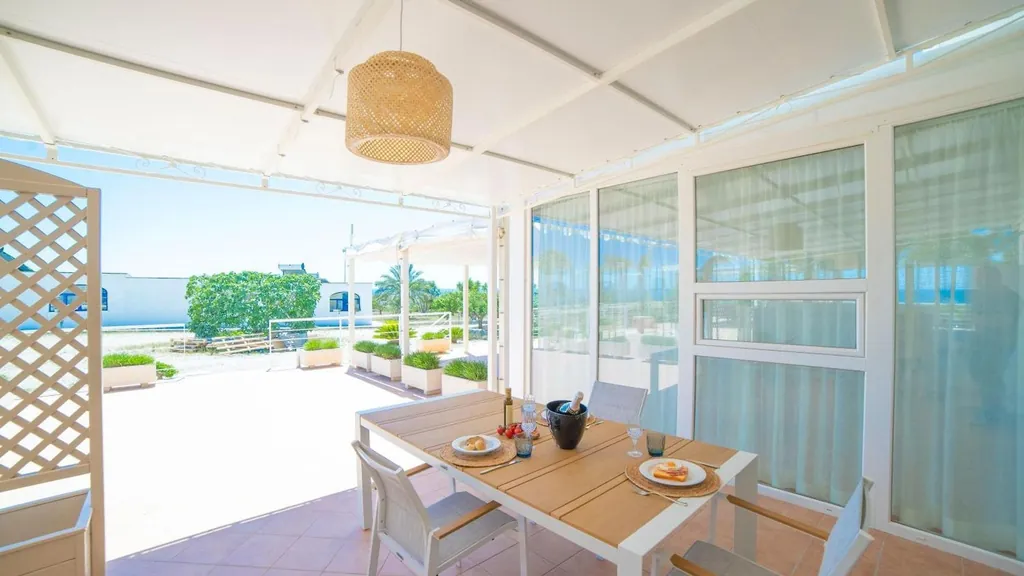
We have no houses in or around Porto Cesareo: our houses are further south, on the same Ionian coast, and Porto Cesareo makes a lovely day trip. The nearest is between Lido Marini and Torre Pali, about 67 km away, just over an hour and a quarter by car: our Le Secche Suite & House – 3, La Secca di Spriculizzi: 3 guests, 1 bathroom with a shower and 45 m², with a sea view, air conditioning, a modern fully equipped kitchen with a dishwasher, a living room, an equipped terrace, a garden, Wi-Fi and free private parking. Small dogs are allowed and the sea is less than 1 km away.
The house is part of Le Secche Suite & House, a small complex of six units completed in 2024, with other options for 3 or 4 guests, some with a private pool: you will find them all on the page holiday homes in Lido Marini. From here the sandy beaches of Lido Marini and Torre Pali are a few minutes away, and in the same holiday you can devote a day to Porto Cesareo and the Isola dei Conigli, setting off early in the morning.
Would you like advice on dates, getting around or other houses in the area? Contact us: we will help you choose the right option.
When to go and how much time to plan
June: the sea is already pleasant, the beaches are quiet on weekdays and the days are very long. It is the right time for the Isola dei Conigli, before the big crowds.
July and August: this is the liveliest and busiest period. The shallow sea warms up quickly and in the evening the seafront is full of life, but for parking and an umbrella it is best to arrive early in the morning, and the island is very busy at weekends.
September: in our opinion the best month. The sea is still warm, there are far fewer people and on windless days the water is crystal clear: perfect for the Torre Chianca columns.
April, May and October: the ideal time for the town, the museum, the towers and walks in the Palude del Conte reserve, with the scrub in flower; swimming is for those who don’t mind cool water.
November to March: Porto Cesareo goes back to being a fishing village, with the harbour and the fishmongers open and a quiet seafront. During storm surges the sight of the sea around the islands is beautiful, but stay away from the rocks.
Events and festivals (indicative dates, check them every year on the website of the municipality of Porto Cesareo and on SalentoMe):
- Feast of Santa Cesarea and the Madonna del Perpetuo Soccorso, the town’s patron saint: usually at the end of August, with the procession of the statues at sea on the fishing boats
How much time to allow: a whole day for the town, the island and the columns; two or three days if you want to add Torre Lapillo, Punta Prosciutto and the reserve. A typical day:
- 8:30: snorkelling at the Roman columns of Torre Chianca, when the sea is calmest
- 10:30: Museum of Marine Biology (check the opening times)
- 12:00: a walk along the seafront to Torre Cesarea and the fishmongers of Via Silvio Pellico
- 13:30: fish lunch in town
- 15:30: boat or kayak to the Isola dei Conigli and a swim among the islets
- 19:30: sunset over the islands from the seafront
Surroundings and extra ideas
Porto Cesareo is well placed for discovering the Ionian coast between Punta Prosciutto and Gallipoli, with its sandy beaches, coastal towers, nature parks and art towns. Distances and driving times are approximate.
Torre Lapillo (5 km, 10 minutes): the seaside village just to the north, with its large sixteenth-century tower and a long sandy beach. Read our guide to Torre Lapillo.
Punta Prosciutto (13 km, 20 minutes): the white sandy beach with the dunes of the Palude del Conte Reserve, at the far northern end of the province of Lecce. Read our guide to Punta Prosciutto.
Torre Colimena (19 km, 25 minutes): already in the province of Taranto, with the Salina dei Monaci, where you can see pink flamingos.
Torre Squillace and Sant’Isidoro (4-7 km, 5-10 minutes): south of the town, the first seaside villages of Nardò, with their towers and sandy beaches. Read our guide to Nardò.
Porto Selvaggio (16 km, 20 minutes): the pebble bay in the pine wood of the regional park, with Torre dell’Alto and the prehistoric caves. Read our guide to Porto Selvaggio.
Lecce (28 km, 40 minutes): the Baroque, Piazza Sant’Oronzo and the Roman amphitheatre. Read our guide to Lecce.
Gallipoli (32 km, 40 minutes): the old town on the island, the castle and the harbour. Read our guide to Gallipoli.
Local tip
Go to the Torre Chianca columns early in the morning, on a windless day: the water is perfectly still, the sun is still low and the pale sandy seabed makes the columns stand out as if in an aquarium. Swim slowly, stay on the surface and leave them as you found them.
At lunchtime go back into town and choose the fish of the day, perhaps the red mullet of Porto Cesareo: in Via Silvio Pellico you can watch the catch arriving from the boats in the harbour.
In the evening stay on the seafront. Porto Cesareo faces west and the sun sets over the sea, behind the islands: the moored boats become dark silhouettes and Torre Cesarea turns orange. It is the most beautiful moment of the day, even in August.
FAQ
Where is Porto Cesareo?
On the Ionian coast of Salento, in the province of Lecce, on the border with the province of Taranto: about 28 km from Lecce, 16 km from Nardò and 32 km from Gallipoli. In Salento dialect it is called «Cisària».
How do you get to the Isola dei Conigli?
By boat: the Isola Grande, or Isola dei Conigli, is about 500 metres from the coast and in summer small boats and ferry services leave from the harbour. Swimming there is not advisable because of the boat traffic. There are no facilities on the island.
Where are the submerged Roman columns?
Off Torre Chianca, a few kilometres from the centre, at a depth of about 4 metres on a sandy seabed. They are the cargo of a Roman ship that sank, and you can see them even with a mask and snorkel when the sea is calm. Look without touching and use a diver-down buoy.
What is the Porto Cesareo Marine Protected Area?
It is a state marine reserve established in 1997: 16,654 hectares of sea and 32 km of coastline between Punta Prosciutto and Torre Inserraglio, in the municipalities of Porto Cesareo and Nardò. It is divided into zones with different rules.
Can you swim anywhere in the Marine Protected Area?
No. In the two A zones, the strictly protected reserves, swimming is not allowed: one is in the northern stretch towards Punta Prosciutto, the other in the south off the Palude del Capitano. In front of the town and on the nearby beaches you can swim normally; for boating, anchoring and fishing check the rules on the MPA website.
Is Porto Cesareo good for children?
Yes: the beaches are sandy, the sea is shallow and often calm, and the Museum of Marine Biology is a good alternative in the hottest hours. In August the beaches are very crowded: arrive early.
Can you visit Torre Cesarea?
You admire it from the outside, on the seafront: today the tower houses the offices of the Guardia di Finanza. Torre Chianca and Torre Lapillo are along the coast north-west of the town.
How do you get to Porto Cesareo without a car?
In summer with the Trenitalia and FS Sud Est train-plus-bus connection from Lecce, or with the summer «Salento in Bus» lines. Always check the timetables and routes for the current year: for getting around between the beaches a car is still the most convenient option.
When is the best time to go?
June and September for the sea, when there are fewer people and the water is warm; spring and autumn for the town, the museum and the reserve. In July and August go early in the morning.
Where to stay near Porto Cesareo?
Salento Prime has no houses in Porto Cesareo: the nearest is Le Secche Suite & House – 3, between Lido Marini and Torre Pali, about 67 km and just over an hour and a quarter away by car, for 3 guests, with a sea view, an equipped terrace and private parking. You will find the other houses on the holiday homes in Lido Marini page.
Conclusion
Porto Cesareo is the Salento of shallow water and islands: a fishing village with its great tower on the seafront, the Isola dei Conigli a stone’s throw from the shore, Roman columns resting on the seabed and one of the largest marine protected areas in Italy. Go early in the morning, bring a mask and snorkel, respect the rules of the protected sea and stay for the sunset over the islands.
If you want a base in the south of Salento, with Porto Cesareo as a day trip, between Lido Marini and Torre Pali you will find our Le Secche Suite & House – 3: 3 guests, a sea view, an equipped terrace and private parking, just over an hour and a quarter from Porto Cesareo. You will find our houses in the area on the page holiday homes in Lido Marini.
Discover the available accommodations with Salento Prime. To best organize your base and transfers, contact us here or start a chat on WHATSAPP.
Cover photo: Paolo Damiano Dolce, CC BY-SA 4.0, via Wikimedia Commons, cropped