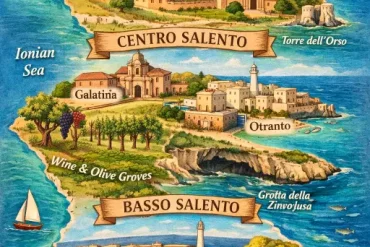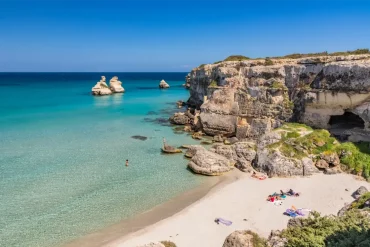
Discover the Devil’s Cave between Castro and Santa Cesarea Terme: unique acoustic phenomenon, how to get there, boat tours €18–38, when to visit. Complete guide with practical tips.
Devil’s Cave: The Mysterious Crevice Where the Sea Sings in Salento
Featured Snippet: The Devil’s Cave is a coastal karst cavity in the municipality of Castro (Salento) where sea waves create a unique acoustic phenomenon by breaking through underground tunnels, producing deep sounds that have fueled folk legends for centuries.
Featured Snippet: The Grotta del Diavolo is a coastal karst cave located in the municipality of Castro (Salento) where sea waves create a unique acoustic phenomenon by crashing through underground tunnels, producing deep sounds that have fueled folk legends for centuries.
The Whispering Cave: Echoes and Legends Among the Rocks of the Salento Adriatic
Few places in Salento manage to combine spectacular geology and popular folklore like the Devil’s Cave. Here the sea does not merely lap the coast: it enters, resonates, and whistles through invisible tunnels, creating an acoustic effect that for centuries has fueled stories and superstitions.
You will discover how to reach this hidden crevice between Castro and Santa Cesarea Terme, when to visit it to experience it at its best, what to expect from the experience, and how to combine it with other gems of the Salento Adriatic coast.
Index
- Curiosities and atmosphere
- Where it is and how to get there
- What to do and what to see
- When to visit and who it is suitable for
- Practical tips
- When to go and how much time to plan
- Devil’s Cave vs other caves of Salento
- Surroundings and extra ideas
- Local tip
- FAQ
- Conclusion
Curiosities and atmosphere
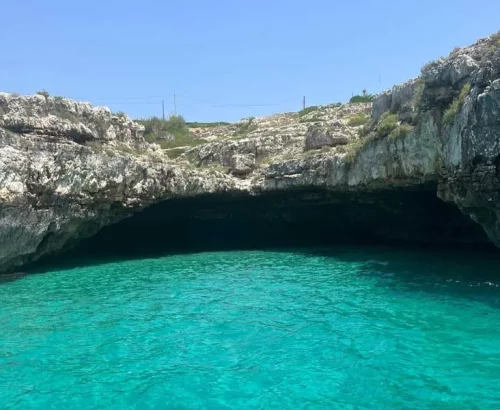
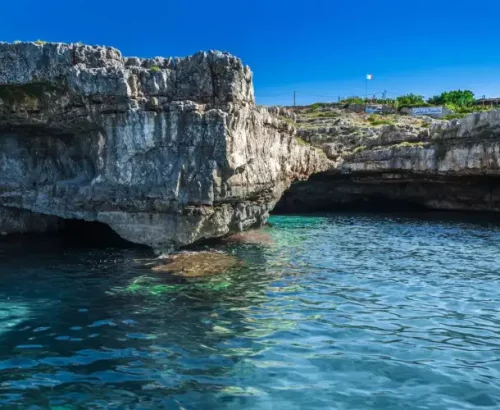
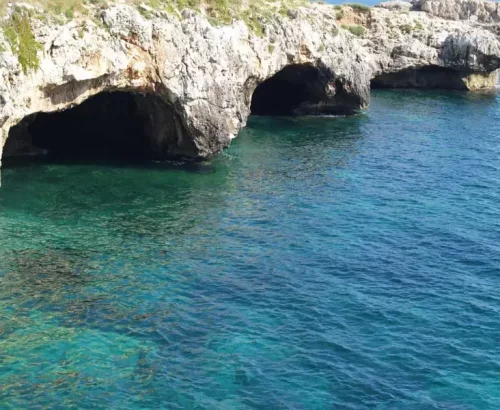
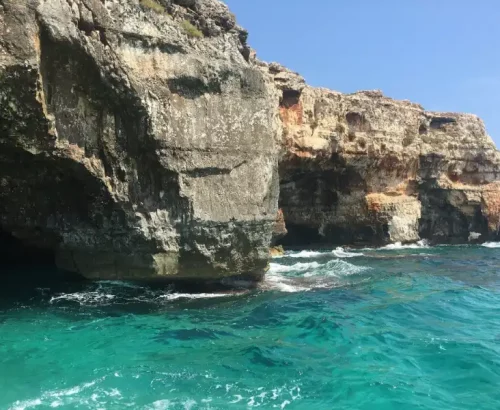
The Devil’s Cave is a coastal karst cavity characterized by a natural acoustic phenomenon caused by the refraction of sea waves through underground tunnels. This system of crevices, where waves push through cracks and hidden chambers generating a deep and unsettling sound, gave rise to the popular name and to numerous legends linked to dark presences. The cave is nestled among the limestone cliffs of the Adriatic coast, in a stretch where the shoreline becomes wild and rugged. The main entrance is visible from the sea, but much of the structure develops below sea level and inside the rock. Those arriving by land perceive the sound first: a dull rumble that seems to come from the bowels of the cliff, especially on windy days. The atmosphere is rich in natural charm and mystery, far from organized beaches and perfect for those seeking direct contact with the power of the sea.
Where it is and how to reach it
The Devil’s Cave is located along the Salento Adriatic coast, in the area between Castro Marina and Santa Cesarea Terme, specifically within the municipality of Castro. The GPS coordinates are 40.0089° N, 18.4297° E. From Lecce, the drive takes about 50-60 minutes by following the SS16 southeast toward Maglie and then the signs for Castro. From Otranto, the distance is shorter, about 20-25 minutes north along the coastal road. From Gallipoli, it takes roughly 70-80 minutes crossing the inland area. There are no direct public transport options that reach the cave itself: travelers without a car can reach Castro by Ferrovie del Sud Est buses from Lecce and then continue on foot or by local taxi. Brindisi Airport is about 90-100 km away, while the nearest railway station is Poggiardo on the Lecce-Gagliano del Capo line, but from there a road connection is required.
What to do and what to see
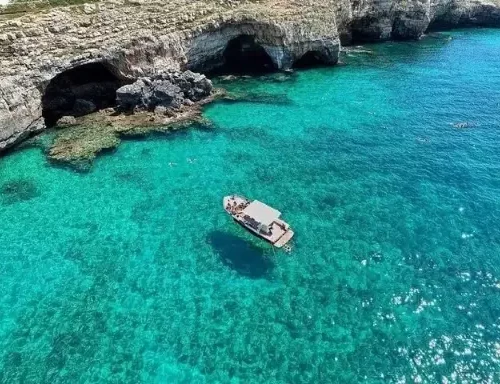
The main experience is exploration by sea: several boats organize tours of the marine caves in the area, including the Devil’s Cave. During these excursions, when conditions allow, you enter the main crevice, listen to the amplified echo of the waves, and observe the rock formations and the play of light on the water. By land, direct access inside is impossible, but you can reach a panoramic viewpoint on the cliff above and observe the entrance from above. The coastal path connecting Castro to Santa Cesarea Terme passes nearby: walking along it, you can appreciate the geological context and spot other smaller cavities. Some more adventurous visitors approach by kayak or SUP, but sea conditions and personal experience must be carefully considered. The cave has no human structures or installations: all of its appeal comes from nature and the acoustic phenomenon.
The boat excursion and the other caves
Tours usually depart from the port of Castro Marina and last between 1 and 2 hours, covering a sequence of caves along the coast. In addition to the Devil’s Cave, they visit the Zinzulusa (the most famous), the Romanelli Cave, and other smaller cavities. The passage into the Devil’s Cave is brief but intense: the boat slows down, the engine is turned off, and you enter a silence broken only by the sound of the waves echoing inside. Some tours offer the opportunity to go snorkeling nearby, where the water is crystal clear and the rocky seabed hosts small marine life. Guides share historical and geological anecdotes, enriching the experience with details about coastal karst formations and stories connected to local fishermen.
When to visit and who it is suitable for
The Devil’s Cave is ideal for those who love wild nature, the sea, and experiences outside mass tourism circuits. It suits couples looking for evocative scenery, geology enthusiasts and nature photographers, as well as adventurous groups of friends. Families with children can join the boat tours if the youngsters tolerate marine crossings well and are able to remain seated for 1-2 hours.
The cave is not suitable for people with reduced mobility: the coastal path has rocky and uneven sections with no accessible infrastructure, and getting on and off the boats requires agility. Those who suffer from claustrophobia should consider this carefully: the interior of the cave has confined spaces, and entering by sea can feel oppressive when boats slowly move into the dark crevice. In winter and during the colder months, rough seas often make access by boat impossible: during these periods, only the panoramic viewpoint on land can be visited, where the acoustic phenomenon is actually more intense and evocative.
Practical tips
Boat excursions mainly run from May to September, with departure times usually in the morning (9:00-10:00) or late afternoon (16:00-17:00) to avoid the strongest sun. During the peak summer months, demand is high, so booking in advance is recommended, especially if traveling on weekends or in August. In spring and autumn, outings depend on sea conditions, which can be rough. Bring sunscreen, a hat, water, and a light sweatshirt for the return trip by boat when the wind picks up. If you visit the cave by land to reach the panoramic viewpoint, wear trekking shoes or sneakers with non-slip soles: the path is not equipped and requires attention. There are no restrooms or refreshment points directly on site, so plan ahead from Castro or Santa Cesarea. The area is natural and lacks accessibility infrastructure along the coastal path, making it suitable only for those who can walk on uneven terrain.
🚗 Limited parking along the coastal road, it is better to leave the car in Castro Marina (municipal parking €1-2/hour in summer)
🏖 Access to the sea is only possible via organized boats, costing €18-38 per person for a full tour
🐾 Dogs are allowed on the trail but not on standard boat tours, check with the operator for private tours
🍴 No refreshment points on site, bring snacks and water if you walk along the coast
When to go and how much time to plan
The best period runs from May to early October, when sea conditions allow excursions more regularly. June and September are the sweet spot: calm seas, pleasant temperatures (23-28°C), and fewer tourists compared to July and August. July and August guarantee warmer water (26-28°C) and generally calm seas, but also bring more visitors and slightly higher prices. In winter and the colder months (November-March), rough seas and northerly winds make boat outings difficult or impossible, but the cave remains evocative when viewed from land, with the waves creating a more intense sound. Tuesdays and Wednesdays are usually less crowded than weekends, when tours fill up quickly, especially in high season. The full experience takes 1-2 hours if you join an organized tour, while visiting the panoramic viewpoint by land takes about 30-40 minutes including the walk there, observation time, and return. Those who want to combine multiple caves and perhaps stop in Castro for a stroll should plan on half a day.
Devil’s Cave vs other caves of Salento
The Adriatic coast of Salento offers several sea caves, each with its own specific characteristics. The Devil’s Cave stands out for its unique acoustic phenomenon, but it has more limited access compared to others. Here is a practical comparison:
| Grotta | Accesso | Costo Indicativo | Caratteristica Principale | Durata Visita |
|---|---|---|---|---|
| Grotta del Diavolo | Solo via mare | €18-38 (tour completo) | Fenomeno acustico delle onde | 15-20 min |
| Grotta Zinzulusa | Terra e mare | €6 a piedi / €18-38 in barca | Stalattiti e stalagmiti spettacolari | 30-40 min |
| Grotta Romanelli | Solo visite guidate specializzate | Variabile | Testimonianze preistoriche, sito archeologico | 45-60 min |
| Grotta Azzurra | Via mare | Inclusa nei tour (€18-28) | Riflessi blu intenso dell’acqua | 10-15 min |
The Zinzulusa remains the most accessible and well-equipped, ideal for families and those who prefer a more comfortable experience
Surroundings and extra ideas
Castro Marina offers a compact seaside village with narrow alleys, an Aragonese castle, and several places to eat where you can enjoy fresh fish prepared according to local tradition. The Municipality of Castro organizes summer events and guided tours of the historic center. The Zinzulusa Cave, just a few minutes away by boat or by car, can also be visited on foot via a well-equipped path: the interior features spectacular stalactites and stalagmites, with a safe tourist route suitable for all ages. Santa Cesarea Terme combines historic thermal baths with sulfurous waters, Moorish-Byzantine Liberty-style architecture, and a rugged coastline ideal for panoramic trekking. Heading south, Tricase Porto and the Ciolo Channel offer breathtaking scenery for excursions and cliff diving. Otranto is about 25 km to the north: its cathedral with the medieval floor mosaic and the historic center enclosed by Aragonese walls are worth at least a half-day stop. Inland, Andrano preserves a quiet old town and rural authenticity far from tourist flows. Those who love wild seas can venture as far as Porto Badisco, a small inlet rich in mythological references linked to the landing of Aeneas.
Local tip
Leave from Castro Marina early in the morning (8:30-9:00), when tours are less crowded and the light is ideal for photography, with the sun illuminating the cave entrances from the east. After the boat excursion, stop by the fish market at the harbor if it is Wednesday or Saturday morning: you will find fresh local catch (sea urchins in season, octopus, red mullet) and typical products. If you visit the cave by land, continue along the trail toward Santa Cesarea for about an hour of panoramic walking: this stretch is among the most beautiful on the Adriatic coast of Salento, with hidden coves where you can stop for a solitary swim. For the best photographic shot, look for the rocky promontory about 200 meters south of the cave entrance: from there you can frame the crevice with the open sea in the background, particularly evocative at sunset when the low-angle light enhances the contrasts of the limestone rock. A well-organized full day includes a cave visit (9:00-11:00), lunch in Castro at one of the trattorias on the harbor (try sea urchins when in season between March and April), an afternoon at the Santa Cesarea thermal baths or in a secluded cove such as Grotta delle Striare, and a return at sunset via the Castro Alta viewpoint for an aerial view of the coastline stretching across the entire gulf as far as Otranto.
@whereisthenextstop Visitors can explore the caves by boat, marveling at the vibrant colors, unique rock formations, and crystal-clear waters. Some of the most notable grotte include the Grotta del Diavolo and Grotta del Drago, each with its own fascinating legends and striking features. 🇮🇹🥰 #travelitaly #hiddengems #ItalianParadise #TravelGoals #VisitPuglia #exploreitaly #italy🇮🇹 #travelinspiration #puglia #mediterraneanlife #wanderlust #travelvlog #travelblogger #scenicview #italianculture #beachlife #dreamdestinations #italianroadtrip ♬ Rossetto e caffè - Sal Da Vinci
@mrknusli Santa Maria di Leuca 🇮🇹 #puglia_mylove #italy #south #grottadeldiavolo #italia #leuca #santamariadileuca #risco #transparent #wunderschön #holidays @mrs.tapiagonzalez ♬ original sound - Jo3y
FAQ
How do you reach the Devil’s Cave from Lecce?
From Lecce, take the SS16 heading southeast toward Maglie (about 35 km), then follow the signs for Castro Marina. The total drive takes 50-60 minutes by car. Alternatively, Ferrovie del Sud Est buses connect Lecce to Castro with 3-4 daily services, but from the Castro stop you need to walk about 2 km to the port or take a local taxi.
Why is it called the Devil’s Cave?
The name comes from the unsettling sound produced by the waves as they crash inside the cave and pass through cracks in the rock. This acoustic phenomenon, particularly intense with rough seas or when the wind blows from the northeast, has fueled folk legends that associated the deep, whistling noises with dark or diabolical presences. Local fishermen tell stories passed down for generations about these mysterious sounds.
Can it be visited year-round?
The panoramic viewpoint on land is accessible in every season. Boat excursions mainly take place from May to September, when the Adriatic Sea is calmer and weather conditions are favorable. From October to April, sea and weather conditions often make access to the cave by boat impossible, but the acoustic phenomenon is more evident and evocative precisely when the sea is rough, and can be perceived from the coastal path as well.
Is it necessary to book the boat excursion?
In high season (July–August) and on weekends, booking is strongly recommended, especially for groups of 4 or more people. Many operators accept reservations online or via WhatsApp. In spring (May–June) and September, more availability can be found by showing up directly at the port, but departures depend on weather conditions and may be canceled if the sea is rough.
What can you see together with the Devil’s Cave on the same day?
Castro Marina with its medieval village and Aragonese castle (30 minutes on foot), the Zinzulusa Cave, also accessible by land (15 minutes by car), Santa Cesarea Terme for its Liberty-style architecture and sulfur thermal baths (10 minutes by car), and the panoramic coastal trail between the two towns (about 1 hour of trekking). Those with more time can head north to Otranto (25 km) or south to the Ciolo Channel (15 km).
Conclusion
The Devil’s Cave represents an experience that combines nature, geology, and folklore in a lesser-known corner of Salento, away from mainstream tourist routes. It is ideal for those seeking direct contact with the power of the sea and who want to enrich their visit to the Salento Adriatic coast with something different from the classic equipped beaches. The best time to visit is between May and September, when boat excursions allow you to enter the crevice and hear firsthand the acoustic phenomenon that gave the cave its name. Those who prefer observation from land will find the coastal path a fascinating panoramic alternative, especially on windy days when the sound is amplified and echoes among the rocks.
Plan your trip starting from Castro Marina or Santa Cesarea Terme: both offer an ideal base for exploring caves, historic villages, and hidden coves without logistical stress. Boat tours cost €18-38 per person and usually combine 3-5 caves in a single 1-2 hour outing, representing the best way to appreciate this stretch of karst coastline. Dedicate at least half a day to enjoy the experience at a relaxed pace, combining the sea, local culture, and the flavors of fishing tradition. The Adriatic Salento offers spectacular views and ancient stories: the Devil’s Cave is one of those places that leaves a lasting impression thanks to its mix of natural beauty, unique geological phenomena, and that touch of mystery that makes exploration even more intriguing.
Discover the available accommodations with Salento Prime. To best organize your base and transfers, contact us here or start a chat on WHATSAPP.